Back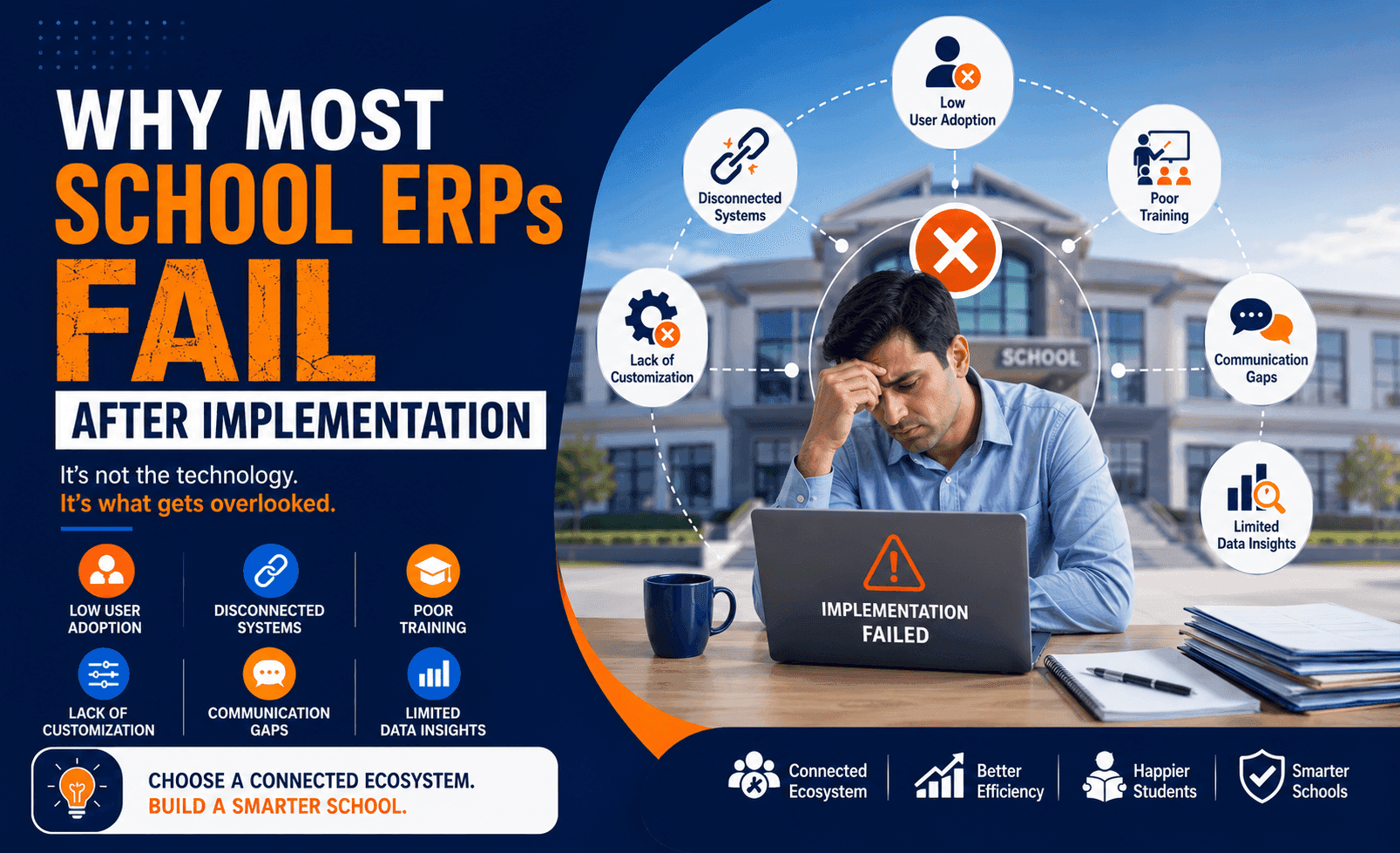
Why Most School ERPs Fail After Implementation
12th June 2026 · 5 min read
From attendance tracking and fee management to communication systems and academic analytics, Educational ERP platforms promise to simplify school operations and improve efficiency.
Schools today are investing heavily in digital transformation.
From attendance tracking and fee management to communication systems and academic analytics, Educational ERP platforms promise to simplify school operations and improve efficiency.
Yet surprisingly, many school ERP implementations fail within months of deployment.
Some systems remain underutilized.
Some become administrative burdens.
Others are abandoned completely after initial adoption.
The problem is not that schools do not need ERP systems.
The real problem is that many ERP solutions fail to understand how schools actually function.
And when technology is not designed around people, processes, and educational experiences, failure becomes inevitable.
The Biggest Myth About School ERP Systems
Many schools believe implementing an ERP automatically solves operational problems.
But technology alone cannot transform an institution.
An ERP is only successful when it aligns with:
• School workflows
• Teacher usability
• Parent engagement
• Student experience
• Administrative efficiency
• Real-time communication
• Data accessibility
Unfortunately, many ERP systems focus more on features than actual usability.
As a result, schools end up with complicated systems that create more confusion than efficiency.
Lack of User Adoption Is the Biggest Reason for Failure
One of the primary reasons school ERPs fail is poor adoption among staff, teachers, and parents.
If a system feels:
• Complex
• Time-consuming
• Difficult to navigate
• Overloaded with unnecessary functions
• Poorly designed for daily usage
people simply stop using it consistently.
Teachers may return to manual processes.
Administrators may maintain parallel spreadsheets.
Parents may ignore the app entirely.
Eventually, the ERP becomes inactive despite significant investment.
A successful ERP must be simple, intuitive, and easy for every stakeholder to use.
Schools Need Connected Ecosystems, Not Isolated Software
Many traditional ERP systems function as standalone administrative tools.
But modern schools require connected educational ecosystems.
A disconnected ERP creates issues like:
• Fragmented communication
• Duplicate data entry
• Isolated academic records
• Poor collaboration between departments
• Lack of centralized visibility
Today’s schools need platforms where academics, administration, communication, analytics, and engagement work together seamlessly.
Without integration, ERP systems become operational silos instead of intelligent educational environments.
Poor Training Leads to Long-Term Failure
Many ERP implementations focus heavily on deployment but very little on adoption training.
Schools often receive:
• Basic onboarding sessions
• Limited support
• Minimal hands-on guidance
• No long-term implementation strategy
As a result, staff members feel overwhelmed and underprepared.
Technology adoption is not just about installing software.
It is about helping people feel comfortable and confident using it daily.
Without proper training and support, even advanced ERP systems fail to deliver results.
One-Size-Fits-All Solutions Rarely Work
Every school operates differently.
Different institutions have unique:
• Academic workflows
• Administrative structures
• Communication processes
• Fee systems
• Learning models
• Parent engagement approaches
Yet many ERP providers offer rigid systems with limited customization.
When schools are forced to adjust their operations around the software instead of the software adapting to the school, frustration grows quickly.
Modern educational platforms must be flexible, scalable, and adaptable.
Lack of Real-Time Communication Creates Disconnect
Communication is one of the most critical aspects of modern education.
Parents expect instant updates.
Teachers require streamlined coordination.
Students need centralized access to information.
Many outdated ERP systems fail because communication remains fragmented across:
• Messaging apps
• Emails
• Manual notices
• Separate portals
A modern educational ecosystem should unify communication within a single connected platform.
Without this, schools continue struggling with operational gaps even after ERP implementation.
Data Without Intelligence Has Limited Value
Schools generate massive amounts of data every day.
But many ERP systems only store information instead of transforming it into actionable insights.
A modern educational platform should help schools:
• Identify student learning gaps
• Track engagement patterns
• Improve academic performance
• Simplify decision-making
• Personalize learning experiences
• Reduce operational inefficiencies
Without intelligent analytics, ERP systems become digital storage tools instead of educational intelligence platforms.
Schools Need Experience-Driven Technology
Many ERP systems are built from a software perspective rather than an education perspective.
This creates systems that are technically functional but emotionally disconnected from actual school experiences.
Successful educational platforms must prioritize:
• User experience
• Simplicity
• Accessibility
• Collaboration
• Student-centric design
• Teacher efficiency
• Parent engagement
Technology should reduce stress — not increase it.
Why Modern Schools Are Looking Beyond Traditional ERP Systems
Today’s educational institutions are moving away from rigid ERP models and toward integrated digital learning ecosystems.
Schools are now looking for platforms that combine:
• Academic management
• Communication tools
• Learning intelligence
• Student analytics
• Parent collaboration
• AI-powered insights
• Administrative automation
all within a seamless and connected environment.
This shift is redefining how educational technology supports schools.
How VIDH Is Changing the Approach
Unlike traditional ERP systems that focus only on administration, VIDH is designed to create a connected educational ecosystem for modern schools.
The platform focuses on:
• Simplified user experiences
• Intelligent educational workflows
• Connected communication
• Student-centered learning environments
• Data-driven decision-making
• Scalable digital transformation
Instead of becoming another complicated software layer, VIDH aims to help schools create smoother, smarter, and more engaging educational experiences.
Schools looking to move beyond outdated ERP challenges can explore how VIDH is helping institutions rethink educational technology for the future.
Final Thoughts
Most school ERP systems do not fail because schools reject technology.
They fail because the technology fails to adapt to real educational needs.
Modern schools need more than administrative software.
They need connected, intelligent, human-centered educational ecosystems that support students, teachers, parents, and administrators together.
The future of educational technology will not belong to systems with the most features.
It will belong to platforms that make education simpler, smarter, and more connected for everyone involved.