Back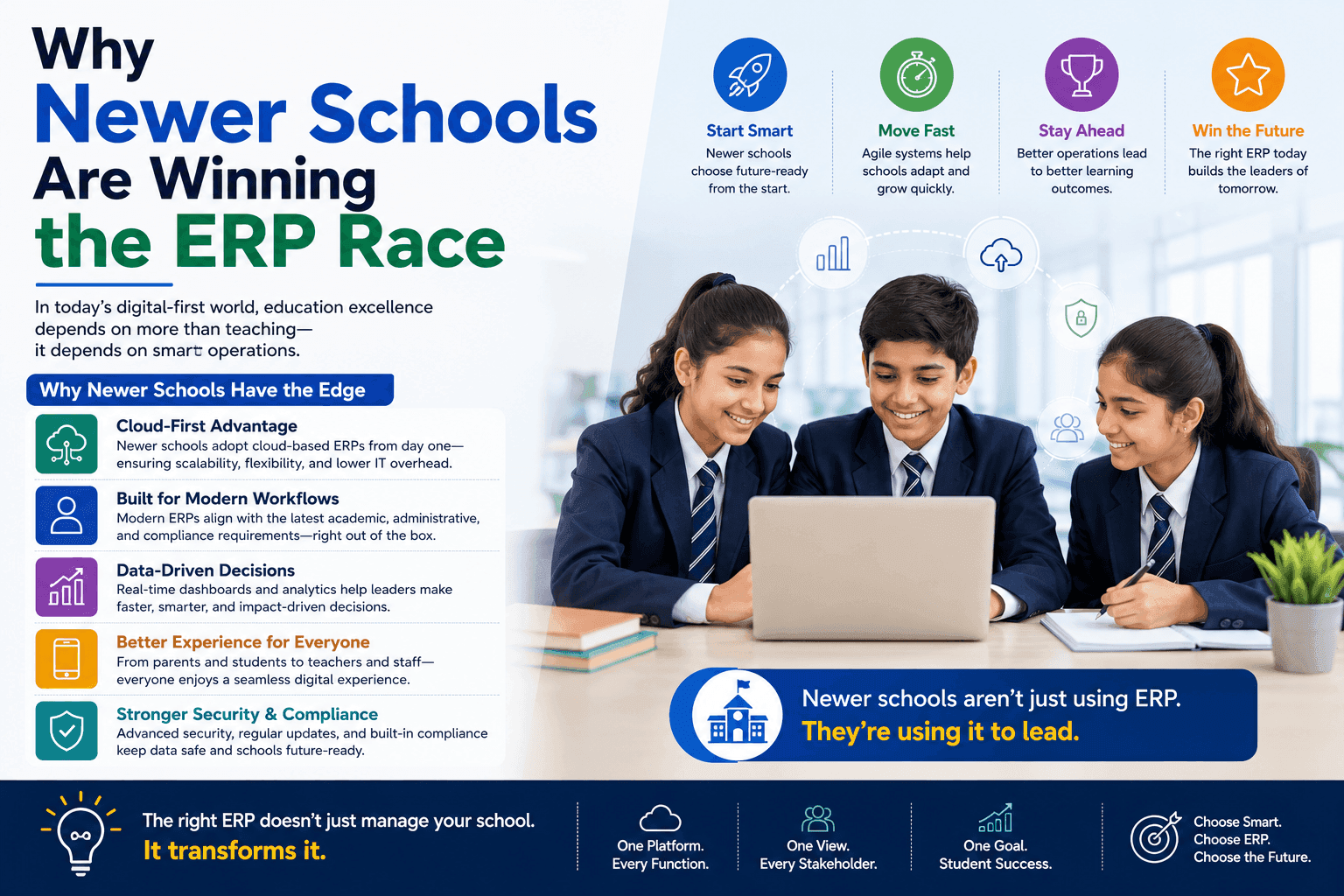
Why Newer Schools Are Winning the ERP Race
1st July 2026 · 5 min read
Newer schools have a surprising advantage when it comes to adopting school management platforms. Here's why, and what established institutions can learn from them.
There is a common assumption in the education sector: the older and more established the school, the better equipped it must be. More alumni, more infrastructure, more systems in place. But when it comes to digital school management, this assumption is quietly flipping.
Newer schools - those that have been operating for five years or less — are increasingly pulling ahead in operational efficiency. Not because they have more resources, but because they have fewer legacy habits to unlearn.
The Legacy Problem Nobody Talks About
Established institutions often run on a patchwork of systems built over decades — spreadsheets that only one accountant understands, attendance registers that duplicate into three separate ledgers, fee collection workflows that depend on a specific person being in the office on a specific day.
These systems are not broken. They work. But that is precisely the problem. When something works well enough, there is little urgency to change it. The friction of transition - retraining staff, migrating historical data, managing resistance from long-tenured employees - feels like more trouble than it is worth.
Newer schools face none of this inertia. Their administrative teams are small, often tech-savvy, and accustomed to learning new tools. They have no legacy data to migrate from a decade-old tally system. They have no institutional memory insisting that "we've always done it this way."
Starting Clean Has Real Financial Value
When a school implements a comprehensive ERP platform from day one, it eliminates entire categories of operational overhead. Fee collection is automated - parents receive reminders, make payments online, and admins have real-time visibility into dues. Attendance is marked digitally and flagged automatically. Student records, report generation, and communication with parents happen within a single system.
For a newer school that may not yet have the administrative staff of a larger institution, this is not just convenient - it is economically essential. Every hour saved on manual data entry is an hour redirected toward teaching, parent engagement, or curriculum development.
The Admissions Advantage
Newer schools are also in active growth mode. Filling seats is a genuine operational priority. Modern school management platforms come with built-in admissions modules: inquiry tracking, CRM follow-ups, and in some cases, a discovery marketplace where parents searching for schools in their area can find and apply directly to the institution.
An established school with 2,000 enrolled students and a 10-year waitlist does not need this. A three-year-old school trying to grow from 200 to 500 students needs it desperately — and the schools that adopt it early grow faster.
What Established Schools Can Learn
This is not an argument that legacy institutions are doomed. It is an argument that the window for frictionless adoption closes over time. The longer a school waits, the more data it accumulates in incompatible formats, the more staff habits calcify, and the more painful any transition becomes.
The schools that move early — whether they are new or simply forward-thinking — build operational muscle that compounds over time. Their data is cleaner. Their reporting is faster. Their staff knows the system well enough to train new joiners without external help.
The Practical Path Forward
For any school considering a management platform today, the real question is not whether to adopt but when. And the answer, consistently, is: before you think you need it.
The ideal time to implement an ERP system is when your school is still small enough for the transition to be manageable, and your staff still has the capacity to learn before the pressure of scale arrives.
Newer schools are not winning the ERP race by accident. They are winning it because they started before the race felt necessary.
Vidh offers a comprehensive school management platform built for schools at every stage - with modular adoption, full data migration support, and an onboarding process designed to minimize disruption.