Back
Filmed the School Show? 3 Checks Before You Post
7 min read
Filmed your child's school event? Three checks before posting: other children in frame, your school's photo rule, and whether a private share will do.
By Bhagya, Vidh · Last updated: 9 November 2026
Short answer: Before you post a video from sports day, the annual function or the school play, check three things. Who else's child is in the frame? What does your school's photography and sharing policy say? And would a private share with family do the job? Filming and sharing rules differ by country, venue and school. Check before you record or post.
This guide is general information for parents and schools, not legal advice. When in doubt, your school's own photography policy is the place to start.
Why this needs care
A clip from a school event can show more than a performance. A uniform, a caption or a location detail can identify a child or their school, and event details can show where people were.
Australia's online safety regulator puts it plainly: "A uniform can identify a school. A caption may name the student or staff member. Location tags, public timetables or event details can reveal where someone has been or is likely to be" (eSafety Commissioner). A post can travel further than you meant it to, so a minute of checking before you share is worth it.
The three checks
1. Who else is in the frame?
Consider your own child's wishes and privacy too. Check with other families before sharing images of their children. eSafety's advice to parents is to "always check with other parents before posting, sharing or tagging images or videos that include their children" (eSafety, Privacy and your child).
Ways to reduce what you share:
- Crop to your child, or choose a clip where they're on their own.
- Leave out names, the school's name and location tags. eSafety also suggests keeping uniforms, routines and schedules out of public posts.
- Blur faces if your editing app allows it.
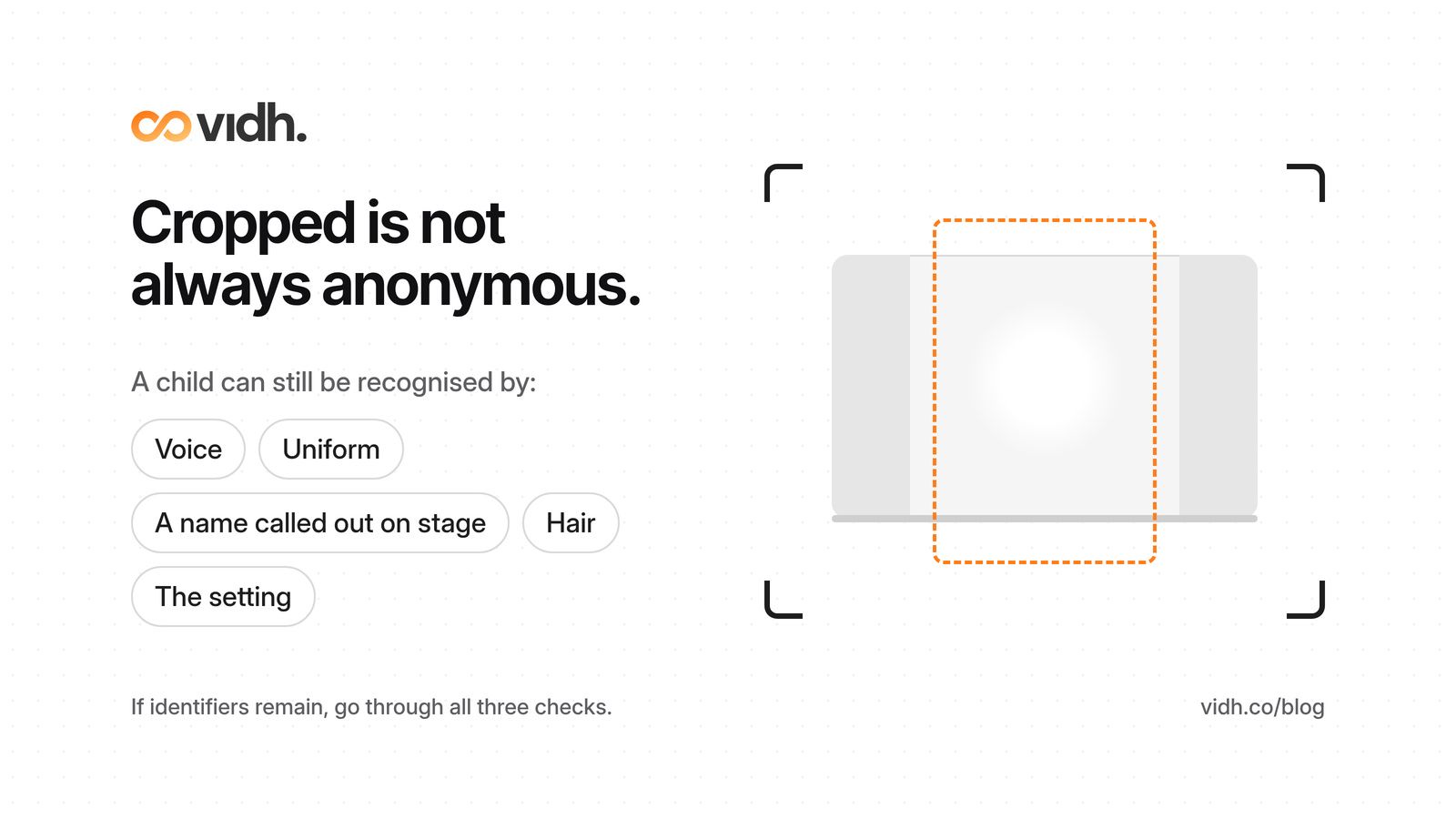
Cropping and blurring help, but they may not be enough on their own. A child can still be recognised by their voice, uniform, hair, a name called out on stage, or the setting. Filming from further back doesn't make a clip anonymous either. If identifiers remain, treat the clip as showing that child and go through all three checks.
Some families have reasons you won't know about for keeping a child's image offline. That's why "nobody complained last time" isn't a good test.
2. What does your school's photo rule say?
Ask for the school's photography and sharing policy. UK child-protection guidance from the NSPCC says schools and clubs "should have a written photography and filming policy statement" and that it is good practice to share it with parents and "seek their consent at the beginning of the year" (NSPCC Learning). eSafety says that at school or club events, the organisation "should be able to provide details of their social media policy or photography/recording policy."
Policies vary. Some allow filming for personal use but no posting, some ask for no filming during a performance, and some make other arrangements. If the rule isn't clear, ask before the event.
3. Would a private share do the job?
Often the people you want to see it are close family. eSafety lists email, text message or a password-protected online service as ways that may give you more control over who sees a photo or video.
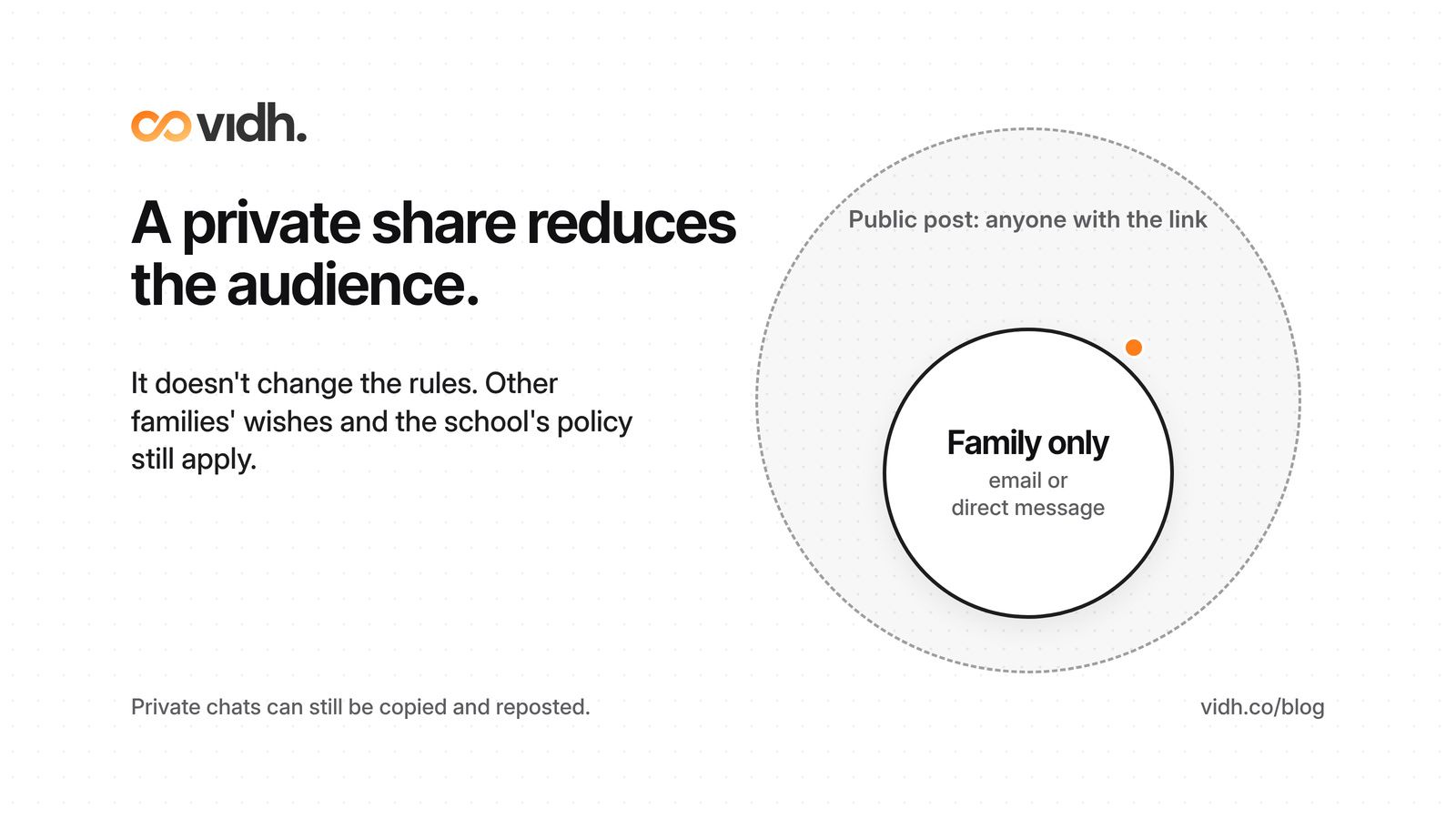
A private share reduces the audience. It doesn't remove the need to respect other families' wishes or the school's rules: those still apply when you send a clip to one person. eSafety also notes that a photo shared in a private chat "could be copied and reposted publicly", and a large class group is not really private. Our school WhatsApp group rules post covers why other children are best kept out of it.
Where you are
These summaries describe what each source says. They don't cover every situation and aren't legal advice.
UK
The Information Commissioner's Office (ICO) says data protection law "doesn't apply to the use of personal data for 'purely personal or household activity'", and that schools "may have their own policies, separate from data protection law". It says posting to a private account "only viewable by friends or family" is "likely to fall within the definition of personal use", while posting to a public account "viewable by an indefinite number of people" is "likely to go beyond personal use", and then "you will need to consider whether individuals in the photos or videos would reasonably expect the images to be used in this way" (ICO, Taking photos in schools). The ICO says this guidance is under review following the Data (Use and Access) Act and may change.
US
The federal student privacy law, FERPA, applies to education records. Under FERPA, a photo or video is an education record only if it is both "directly related to a student" and "maintained by an educational agency or institution or by a party acting for the agency or institution." The Department of Education gives an example: "a photo taken by a parent at a school football game would not be considered an education record", because the school isn't keeping it. That can change: if a parent gives a copy to the school and the school keeps it, for instance in a disciplinary file, the school's copy can become an education record (US Department of Education, FAQs on photos and videos under FERPA). FERPA not covering a parent's own clip is not permission to post it. Other laws, platform rules and school or district policies may still apply.
Australia
eSafety's guidance for school or club events is to check the organisation's photography or recording policy, and it notes that "when an event takes place at a private place, people can enforce rules about photography and videos." For posts, it says to "ask for consent before posting an image that includes another child" and to leave out details that identify the school or location (eSafety, Privacy and your child; eSafety Commissioner).
Everywhere else
Rules vary by country, and school policies vary too, so ask yours. The habit travels well: UNICEF's parenting guidance, quoting sharenting researcher Stacey Steinberg, says we want children "to respect the privacy of their peers and to not post pictures of other children and adults without consent", and notes that "young children can't give informed consent about sharing" (UNICEF Parenting).
If your child is in someone else's post
eSafety's suggested order is to ask the person who posted it to remove it first. If they refuse, or you don't know who posted it, report it to the platform where it appears. If the school or a club posted it, contact them directly. The ICO recommends the same first step in the UK: contact the account owner and ask them to remove the images.
Hypothetical example message (adapt as you like):
"Hi, lovely video from sports day! Would you mind cropping my child out, or sharing it just with family? We keep their photos off public profiles. Thanks so much."
For schools: say it before the event
Setting the rule in the event invitation is easier than sorting it out afterwards.
Example wording for an event notice (an example only; match it to your own policy):
"Family recording is allowed only as set out in our photography policy. Please don't post clips that show other children on public social media."
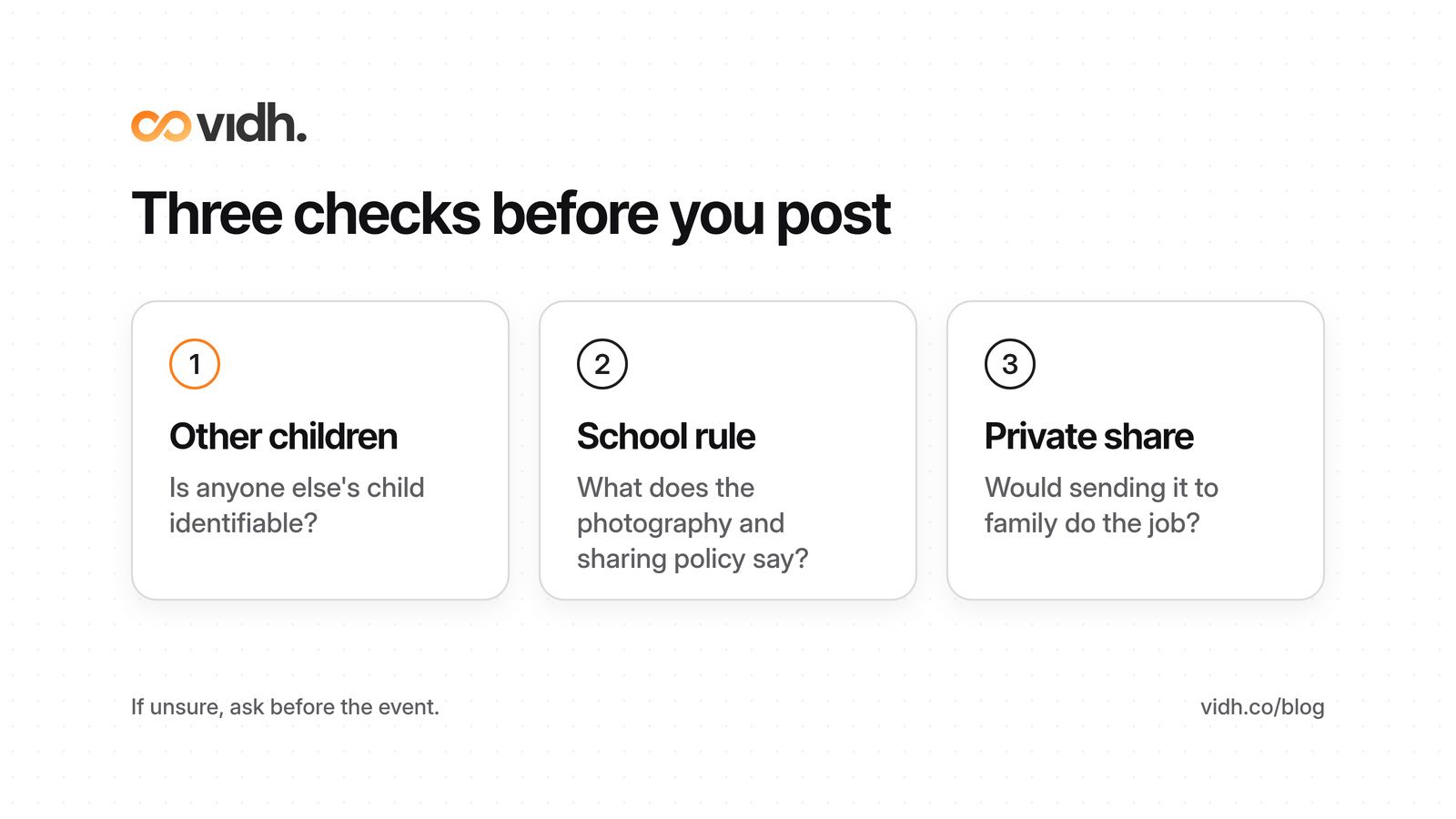
Copy this: three checks before you post
- Other children: Is anyone else's child identifiable, by face, voice, uniform or name? Crop, choose another clip, or check with their family first.
- School rule: Does the school's photography and sharing policy allow this? If unsure, ask.
- Private share: Would a direct message to family do the job? Even then, other families' wishes and the school's rules still apply.
Questions parents ask
Can I post a video of my child's school concert?
Check three things first: whether other children are identifiable in it, what your school's photography and sharing policy says, and whether sharing privately with family would do. Rules differ by country, venue and school.
Is cropping or blurring enough to hide other children?
Not always. A child can still be recognised by their voice, uniform, hair, a name called out on stage or the setting. If identifiers remain, check with their family or choose another clip.
Does FERPA stop US parents posting school event photos?
FERPA covers education records: records directly related to a student and maintained by the school or a party acting for it. A parent's own photo usually isn't one, but that is not permission to post. School or district policies and other laws may still apply.
What should I do if my child is in someone else's post?
Ask the person who posted it to remove it. If they refuse or you don't know who posted it, report it to the platform. If the school or a club posted it, contact them directly.