Back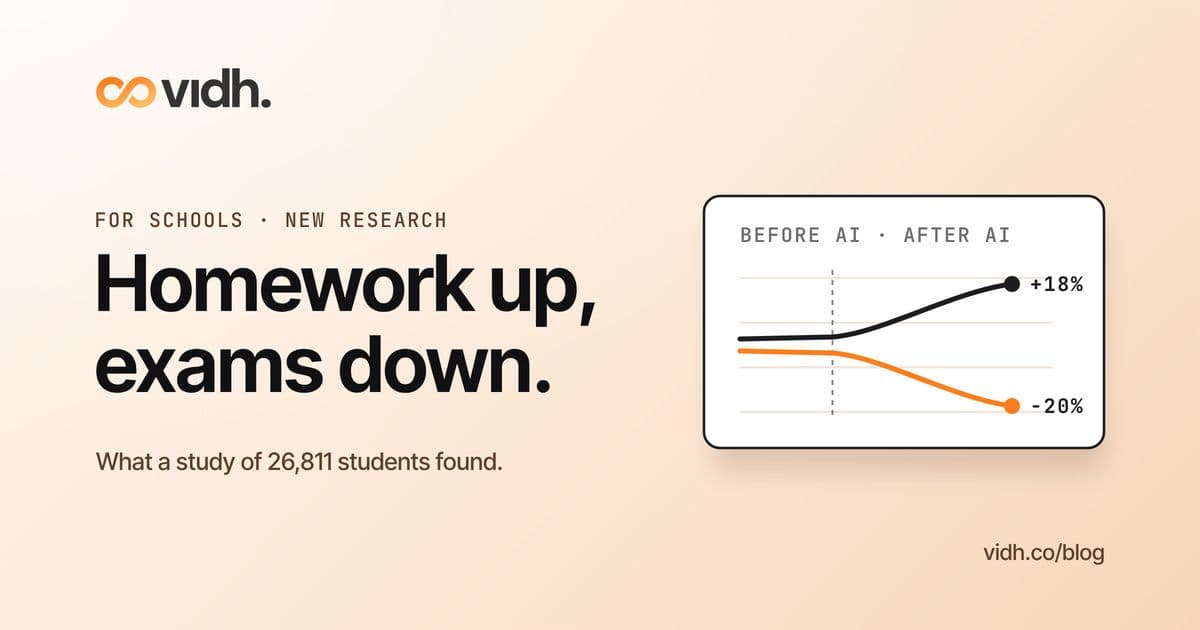
Is AI Bad for Homework? What New Research Shows
5 min read
A study of 26,811 students in one county in China: homework marks rose 18% with AI, exam marks fell 20%. What schools should change in homework and checks.
By Bhagya · Last updated: 3 November 2026
Short answer: When students hand their homework to AI, the homework gets better and the learning gets worse. In a large non-randomised study of 26,811 students in one county in China, homework scores rose by 18% once students started using AI, while monthly closed-book exam scores fell by 20% within six months. Time per assignment fell from 64 minutes to about 45. Students who used AI but kept spending the usual time on homework learned as much as students who didn't use it. The authors add that "we cannot directly extrapolate effect sizes to other settings", so treat the numbers as a warning, not a forecast for your school. The practical fix is to check learning in class, where a chatbot can't sit the test.
It is the Class 8 unit-test review. The Science teacher's register shows homework marks climbing all term, nines and tens from students who used to hand in sixes. The unit test, closed book, says something else: two of her best homework scorers are now below the class average. Nobody copied from anybody. The homework simply stopped telling her what the students knew.
That gap is what a new study from China measured, across 30 months and nine subjects.
Key takeaways
- Homework marks and exam marks split apart. Homework scores went up 18%; monthly exam scores went down 20% within six months of a student starting to use AI.
- Speed is the warning sign. Around four in five AI-using students finished assignments in under 50 minutes, and their exam scores were markedly worse.
- Time on task protected learning. Students who used AI but spent the usual time on homework learned as much as non-users.
- Move the check into the classroom. The authors point to frequent, short, in-class quizzes on the homework material. An oral explain-back and competency-style questions do the same job.
- Tell parents to watch the clock, not the marks. A fast, perfect worksheet is now a reason to ask a question.
- Read the study for what it is: one county, not a randomised trial, and the authors themselves say the effect sizes may not carry over.
What did the study find?
The study is by David Strömberg (Stockholm University) with Victor Lei and Yanhui Wu (University of Hong Kong), published as CEPR Discussion Paper 21577 with a summary column on VoxEU. It uses "30 months of administrative records from 26,811 students in grades 7 to 12 in a county in central China". Weekly homework scores and completion times are linked to monthly closed-book exams and to the high-school and college entrance exams. By June 2025, roughly 80% of the students said they used generative AI, mostly general-purpose chatbots rather than tutoring tools.
The headline numbers, in the authors' words:
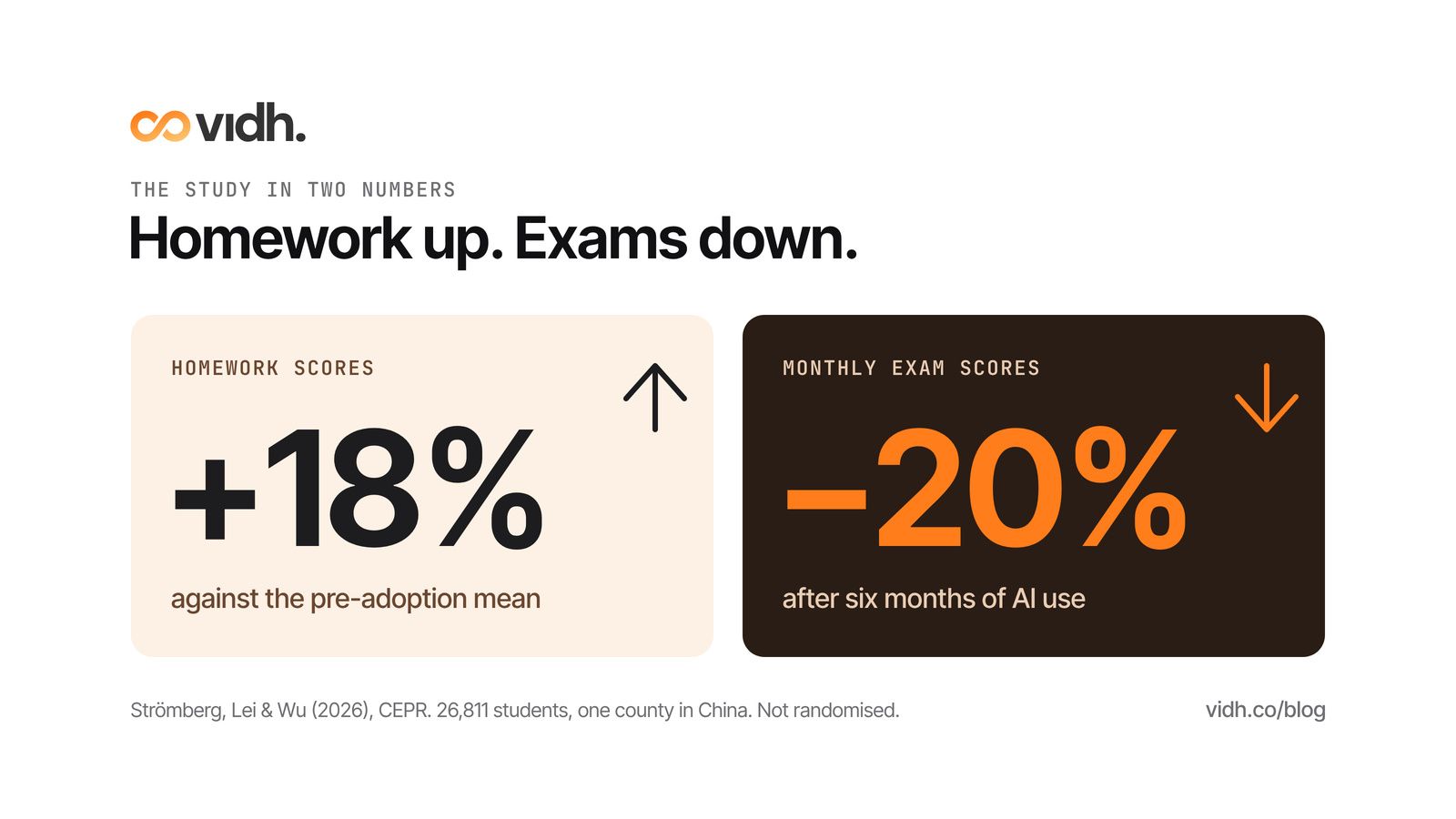
- Homework: "Their homework scores rose by 18% relative to the pre-adoption mean."
- Exams: "After six months, monthly exam scores fell by 20% relative to the pre-adoption average."
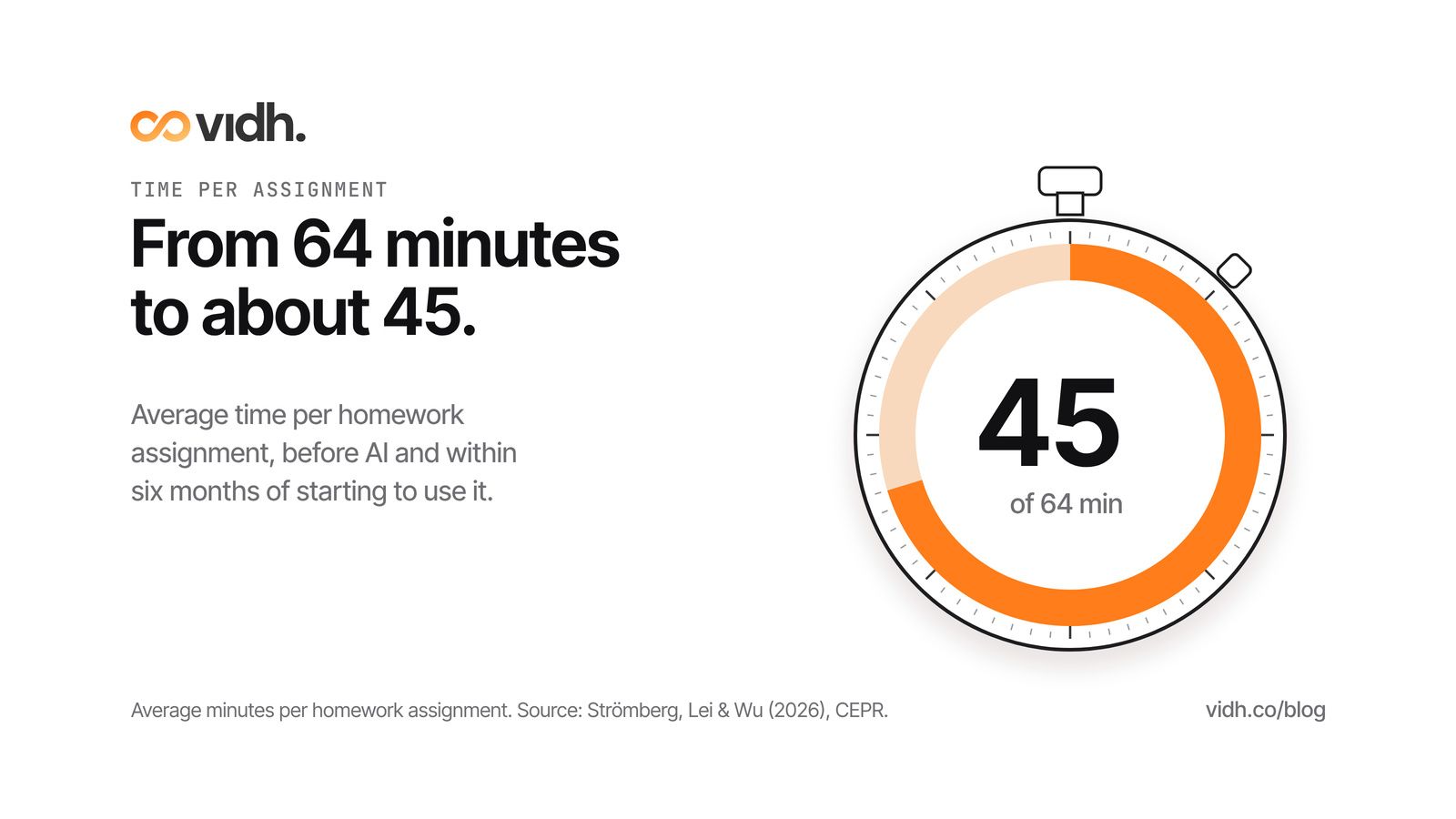
- Time: within six months of adoption, students completed an assignment in "about 45 minutes, down from 64 minutes".
The entrance exams took longer to show it. The penalty built up over roughly two years and reached 24% of the baseline mean for the high-school entrance exam and 18% for the college entrance exam.
How sure can a school be? The students began using AI at different times, so the authors compared each student's results before and after with classmates who had not yet started (a staggered difference-in-differences design). Before adoption, the two groups had almost identical scores. The authors read their estimates as causal, but it is still not a randomised trial, and students who start using AI early may differ in ways the data can't see. It is also a single county. For a randomised comparison, see Bastani and colleagues (2025) in PNAS: in a high-school maths trial in Turkey, an AI tool that gave direct answers reduced closed-book exam scores by 17% once access was taken away. Two very different studies, one randomised in Turkey, one non-randomised in China, point the same way: AI that hands over answers lifts homework scores and lowers exam scores.
Why do homework marks and exam marks diverge?
A homework mark grades the output. A closed-book exam grades what is in the student's head with the phone in the bag. When a chatbot produces the output, the two stop agreeing. Among non-users in the study, higher homework scores went with higher exam scores, as you would expect. Among AI users the link turned around: those who scored higher on homework were more likely to do worse in exams.
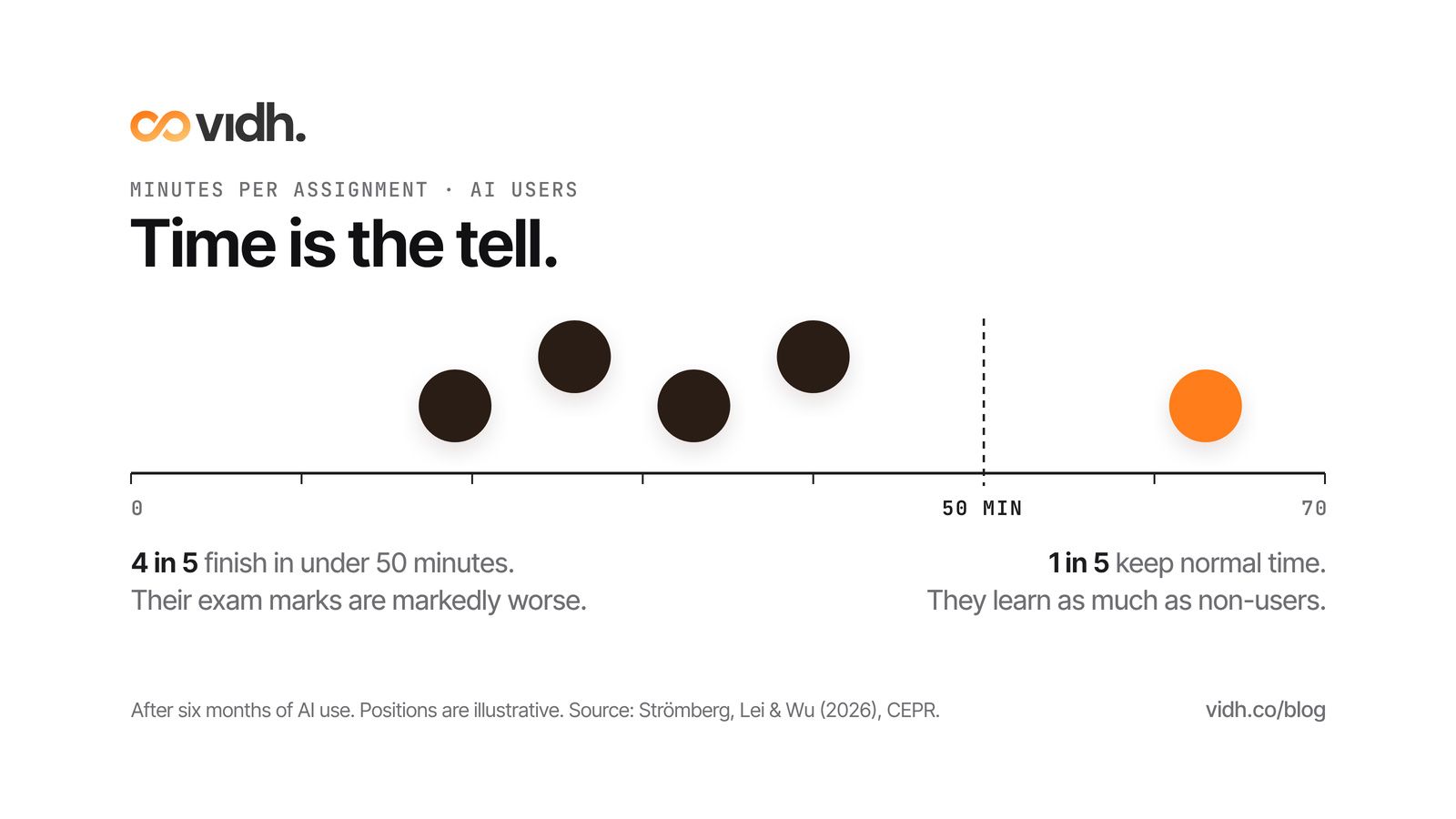
The split comes down to how the time was spent. In the authors' words, "around four out of every five AI-using students complete assignments in less than 50 minutes", faster than the fastest non-AI students, with very high homework scores, and their exam scores were "markedly worse". The other one in five kept spending roughly as long as non-users. Their exam scores held: "when AI students spend the same amount of time on homework as non-AI students, they learn as much."
The authors are careful here. Making students sit longer won't necessarily bring the learning back, because the students who keep their time up may also differ in motivation and skill. Their suggestion is to combine supervised homework time with guidance on productive AI use.
The OECD reached a similar view from a wider body of research. Its Digital Education Outlook 2026 says that "if designed or used without pedagogical guidance, outsourcing tasks to GenAI simply enhances performance with no real learning gains." Teachers already sense this: the same report notes that 72% of lower secondary teachers believe AI can harm academic integrity by letting students pass off work as their own.
One detail is worth sharing in your next staff meeting. The losses were not spread evenly. They were largest in social science subjects (around 27%), then STEM (about 22%), English (17%) and Chinese (9%), and disproportionately large for junior, male and initially high-performing students. Your strongest homework scorers may be the students to watch.
How should schools redesign homework checks?
You can't stop a student opening a chatbot at nine at night. What you can decide is where the marks that count get earned. The study's authors suggest that teachers "monitor other aspects of learning, such as the time actually spent working on homework or performance on frequent, short, in-class quizzes to test homework material." Three changes put that into a school week.
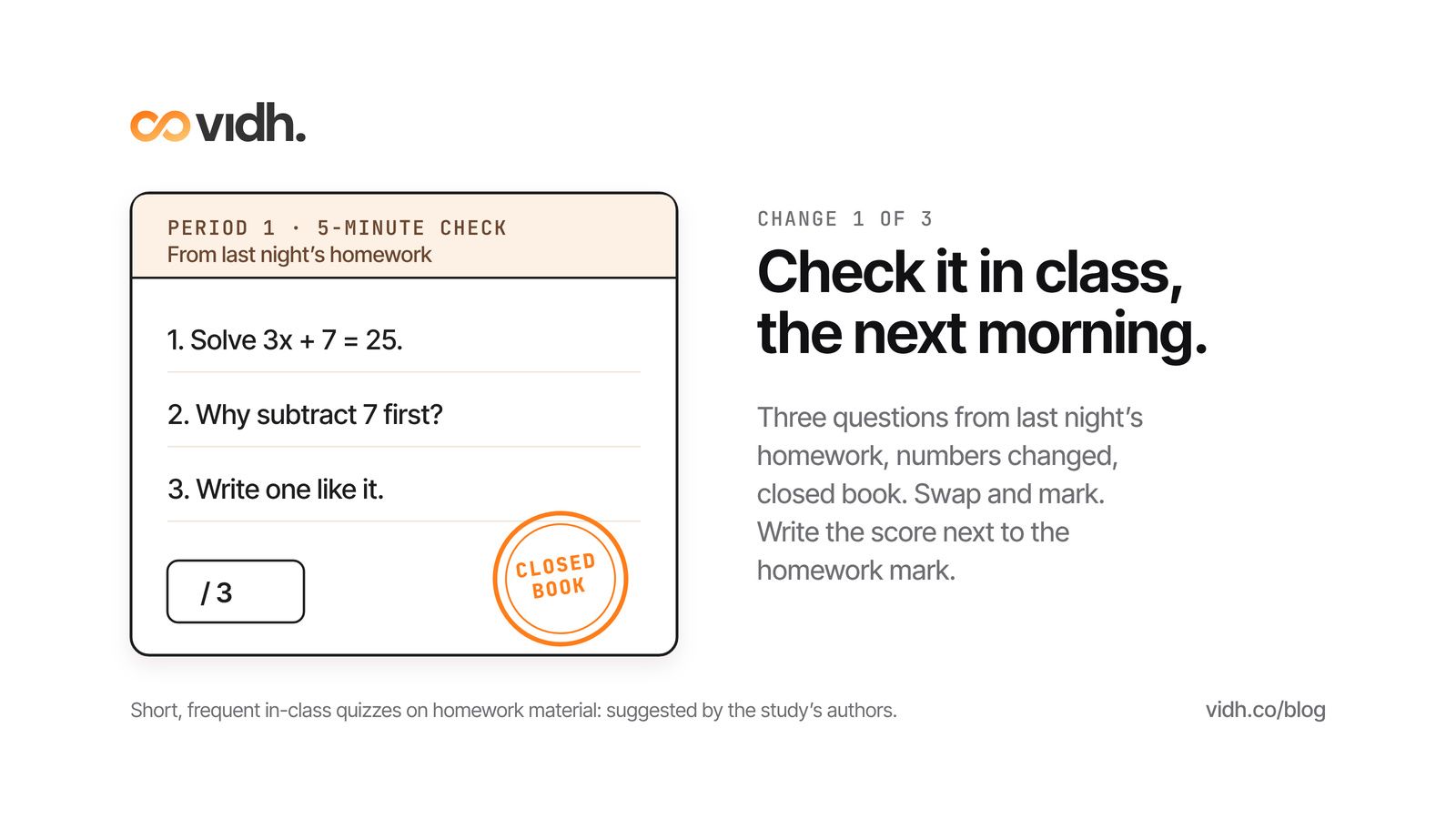
1. A five-minute quiz on last night's homework
Use the first five minutes of the period. Set three questions taken from last night's homework with the numbers or the example changed, closed book. Students swap and mark. Write the score in the register beside the homework mark. When a student's homework marks and quiz marks are far apart week after week, that is the conversation to have, without accusation. Keep the stakes low; the point is the signal, not another test.
2. Oral explain-back
Pick two students at random and ask each to explain one homework answer aloud in under a minute: why this step, why this method. A student who did the thinking can usually manage it, even haltingly. A student who pasted an answer tends to stall at the first "why". Rotate the names so everyone expects to be asked, and it becomes routine rather than a trap.
3. Competency items in unit tests
Give some of the unit-test marks to questions that put the idea in an unfamiliar setting: a short case, a data table, a source to interpret. Those questions test whether a student can use the concept, which is the skill that outsourced homework skips. Our guide to competency-based questions for CBSE has examples you can adapt by subject. If homework marks count towards a term grade, move some of that weight to these in-class checks.
What should schools tell parents?
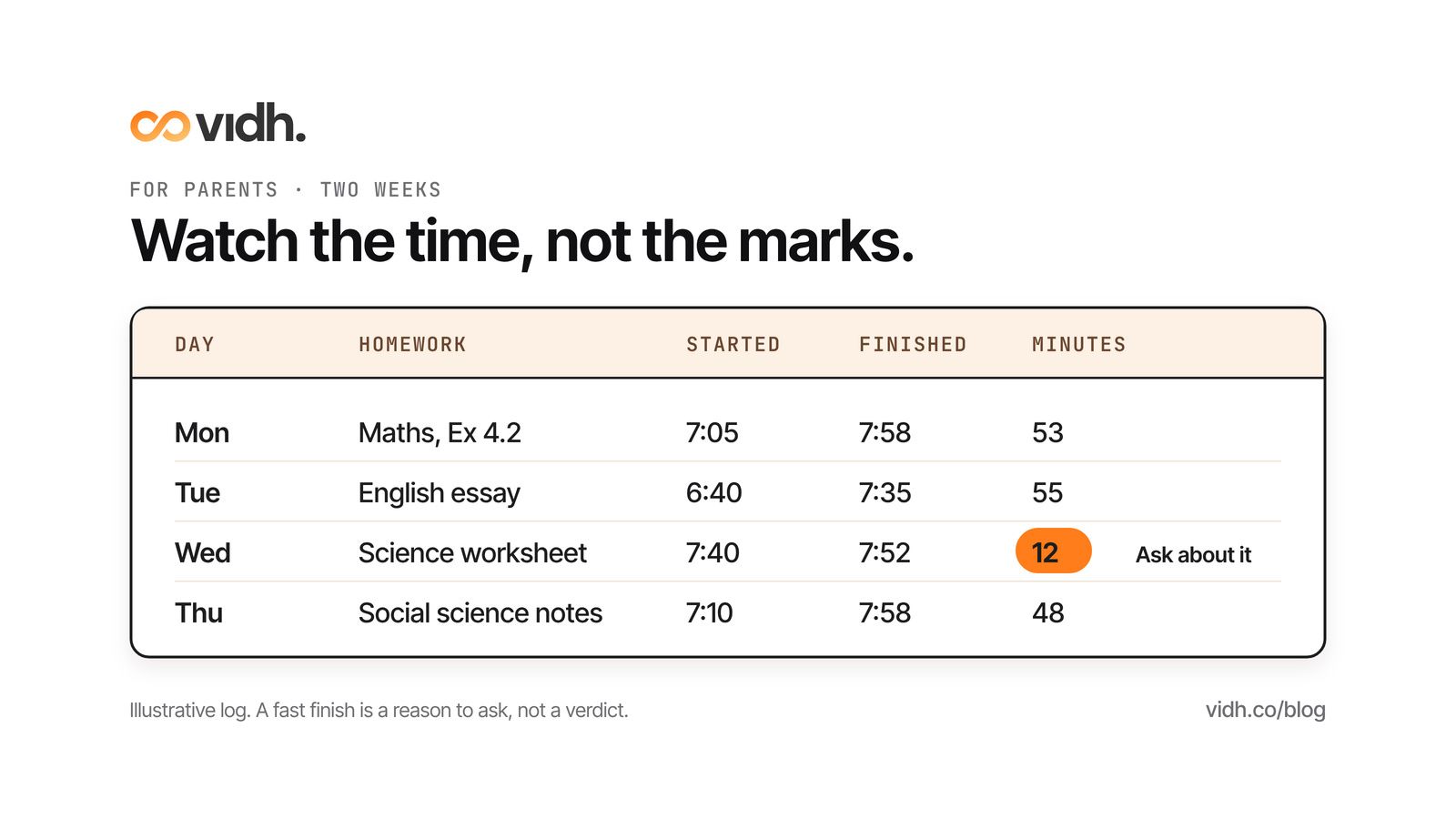
Tell parents to watch the time spent, not the marks. A worksheet that used to take an evening now comes back in 15 minutes with every answer right. That is the pattern the study flagged, and a parent at home is best placed to notice it.
A short note before the next PTM can cover it:
- For two weeks, note when one homework starts and finishes each day.
- If a long task comes back very fast and perfect, ask your child to explain one answer out loud.
- Don't punish the good mark. Ask how they got there.
- Read the school's AI rules together, so everyone knows what counts as help.
UNESCO's guidance for generative AI in education and research calls for a human-centred, age-appropriate approach to how tools are checked and designed, and notes that many schools are still unprepared to validate them. For the day-to-day policy itself (what is allowed, what must be declared and what isn't allowed), plus a copy-paste template and a parent letter, use our AI homework policy guide. This post doesn't repeat it.
What this study doesn't tell you
- How big the effect would be in your school. One county in central China is not an Indian city or village school, and homework loads, exams and devices differ. The authors are direct about it: "Obviously, we cannot directly extrapolate effect sizes to other settings, but they should serve as a warning."
- That every AI tool does this. The students mostly used general-purpose chatbots that hand over answers. Bastani et al. (2025) found the harm was largely mitigated when the tutor gave teacher-designed hints instead of answers; the CEPR column makes a similar point about guarded, pedagogically designed tutors.
- That more homework time is the cure. As above, the authors stop short of that.
So use the 18% and the 20% as a reason to check, not as a prediction for your Class 8.
FAQ
Is AI bad for homework?
It depends on how students use it. In a large non-randomised study of 26,811 students in one county in China, students who used AI got higher homework scores (up 18%) but lower monthly exam scores (down 20% within six months). Students who used AI but kept spending normal time on homework learned as much as non-users. The harm came from outsourcing the work, not from opening the tool.
Does using AI for homework lower exam scores?
In this study, yes, on average: monthly closed-book exam scores fell by 20% within six months of a student starting to use AI, and entrance-exam scores fell by 18–24% after about two years. The authors warn that the effect sizes may not carry over to other settings.
How can teachers tell if AI did the homework?
Don't rely on the homework mark. Watch for a sudden jump in homework scores alongside flat or falling class-test scores, and very fast completion. A five-minute closed-book quiz on the homework and a one-minute oral explain-back will show you quickly who can do the work without help.
Should schools stop setting homework?
The study doesn't suggest that. Students who kept spending normal time on homework learned as much as non-users. The change it points to is in how schools check homework: short in-class quizzes and attention to time spent, rather than trusting the homework mark alone.
Which subjects were hit hardest in the study?
Social science subjects, where exam scores fell by around 27%. The column reports about 22% in STEM, 17% in English and 9% in Chinese. Losses were also larger for junior, male and initially high-performing students.
Was this a randomised controlled trial?
No. It is a large non-randomised study that compares students before and after they started using AI against classmates who had not started yet. The authors read their estimates as causal. A separate randomised trial in high-school maths by Bastani and colleagues (2025), published in PNAS, found that an answer-giving AI tool cut closed-book exam scores by 17% once access was removed.
What should parents look for?
Time, more than marks. If homework that used to take most of an evening is suddenly done in a few minutes with every answer right, ask your child to explain one answer out loud. Our AI homework policy guide has a parent letter schools can send.
Book a 30-min demo
Book a 30-min demo: hi@vidh.co
Sources
- Strömberg, D., Lei, V. and Wu, Y., VoxEU column (CEPR) on the generative AI learning penalty, based on CEPR Discussion Paper 21577 (column date 4 Sep 2026): https://cepr.org/voxeu/columns/generative-ai-learning-penalty-secondary-school
- Bastani, H. et al. (2025), "Generative AI without guardrails can harm learning: Evidence from high school mathematics", PNAS (published online 25 Jun 2025; correction 20 Aug 2025). https://www.pnas.org/doi/10.1073/pnas.2422633122. Preregistered RCT, nearly 1,000 students, grades 9–11, Turkey, Fall 2023, maths. When access is taken away, closed-book scores fall 17% for GPT Base vs never-access peers.
- OECD, Digital Education Outlook 2026 (19 January 2026): https://www.oecd.org/en/publications/oecd-digital-education-outlook-2026_062a7394-en.html
- UNESCO (Miao & Holmes), Guidance for generative AI in education and research (7 Sep 2023; page updated 16 Jan 2026): https://www.unesco.org/en/articles/guidance-generative-ai-education-and-research — policy frame only.