Back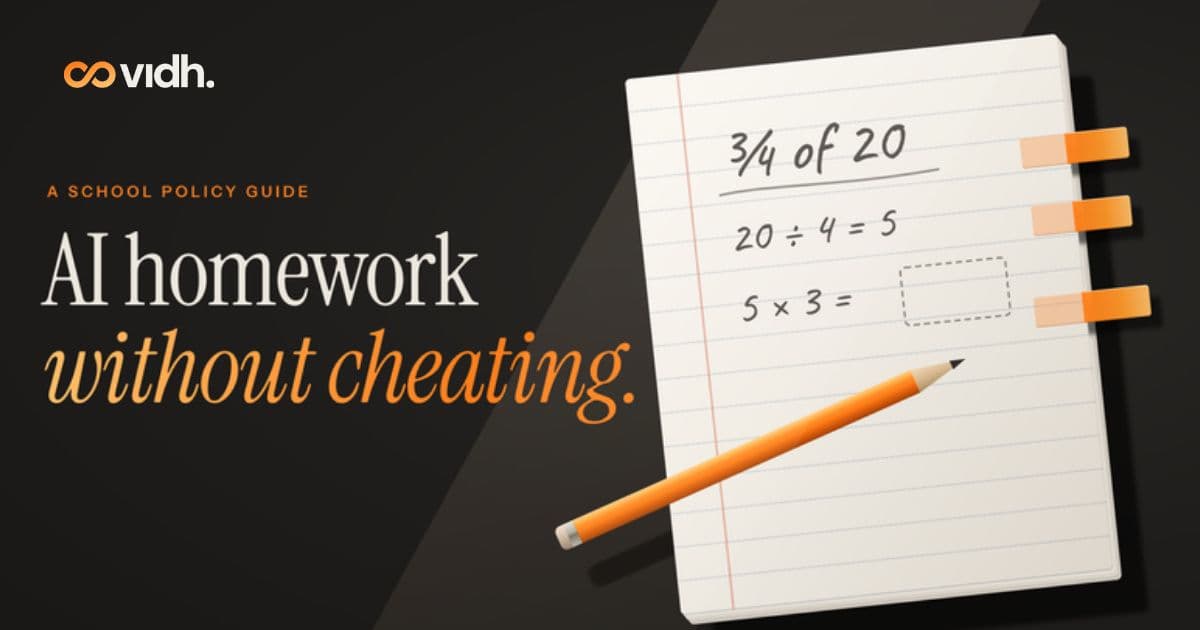
AI Homework Without Cheating: A School Policy Guide
5 min read
How schools and parents can let students use AI for homework without it doing the work: a one-page policy, assignment ideas and a parent checklist.
By the Vidh team · Last updated: 25 October 2026
Short answer: Students can use AI for homework without cheating when three things work together: a tool that gives hints rather than answers, homework that asks students to show and explain their thinking, and a one-page school policy on what is allowed, what must be declared and what is not. Banning AI outright rarely holds, because most senior students already use it.
A Class 8 student types a science question into a chatbot at 9 PM and copies a perfect paragraph into her notebook. The next morning, her teacher asks what one of the words means, and she has no idea. The work got done; the learning didn't. This guide is for school leaders and teachers who want to fix that, and for parents who want to know what to ask.
Key takeaways
- AI use is already routine. In a survey of 910 Class XI and XII students in 10 private CBSE schools in Delhi, nearly 70% used AI for schoolwork at least weekly, and only 13% rarely or never did. It was a purposive sample, not a representative one.
- Answer-giving AI is the risk, not AI itself. In a 2025 trial, students with an unrestricted chatbot scored 17% lower on the exam once it was taken away. A version that gave hints largely avoided that drop.
- Redesign homework so copying doesn't pay: first attempts, worked steps, reasoning notes and quick oral checks.
- Write one page of rules: allowed, allowed if declared, and not allowed, by age band.
- Give parents a checklist and a short letter, so home and school say the same thing.
What does "AI homework without cheating" mean?
AI homework without cheating means a student uses AI to understand, practise or check their own work, while the thinking, the attempt and the final answer stay theirs. Asking an AI tutor to explain a concept, give a hint for the next step or quiz you counts as studying. Pasting the question in and copying the answer is not.
- AI tutor: A chat or voice helper that explains school topics and walks a student through problems step by step.
- Hints, not answers: A tutor design that asks guiding questions so the student does the thinking, instead of printing the final answer.
- Disclosure: A short note on the homework saying how AI was used, for example "Asked an AI tutor to explain photosynthesis; answers are my own."
- Reasoning note: A check where the student gives the reason behind an answer, written or spoken.
Why doesn't banning AI work?
Because students already use it, at home and on their own phones. Bans push use out of sight rather than ending it.
- Use is routine. A Centre for Policy Research and Governance survey of 910 CBSE students across 10 private schools in Delhi found that nearly 70% of Class XI and XII students use AI tools at least once a week, including 19% who use them daily. Only 13% said they rarely or never use AI (Times of India, 27 Feb 2026). Read these figures with care: the CPRG report says schools and students were chosen by purposive, non-probability sampling, and every respondent was in Class XI or XII, surveyed in November and December 2025 (CPRG report). They show a pattern among senior students in some Delhi private schools, not a rate for all students. We found no comparable published survey for Hyderabad or Bengaluru.
- Teachers feel the strain. A Delhi computer science teacher told ThePrint: "I know my students. I know the level of understanding that every child has… I have to decide if this is the capability of the child or, this is AI-generated." ThePrint reported that the majority of Indian schools were yet to evolve guidelines for evaluation and usage (ThePrint, 14 Oct 2025).
- Parents see the cost. In the same report, the mother of a Class 7 student said: "My son's grades have fallen dramatically… he has been using ChatGPT to finish all his homework."
- Students think cheating is common. In the US, 59% of teens told Pew that using AI to cheat is a regular occurrence at their school (Pew Research Center, 24 Feb 2026).
Principals are asking for structure, not a ban. As Dr Jyoti Arora, Principal of Mount Abu Public School, Rohini, put it to ThePrint: "If there are certain broad guidelines, we will be in a better position to use it in a responsible way."
Is the problem AI, or answer-giving AI?
The research points to answer-giving AI. In a 2025 trial with nearly a thousand high school maths students in Turkey, students given an unrestricted chatbot did 48% better on practice problems. When the tool was taken away, they scored 17% lower on the exam than students who never had it. Many had used it as a crutch, asking for solutions and copying them. A version with teacher-designed guardrails, which guided students instead of solving for them, largely removed that drop (Bastani et al., PNAS, 2025).
The lesson for schools is simple: the same technology can help or harm learning, depending on whether it does the thinking for the child.
What does "hints, not answers" look like?
Here is the difference on a Class 6 maths question, "What is three-quarters of 20?"
Answer-giver
- What the student sees: "15."
- What the student learns: How to copy one answer
Hint-giver
- What the student sees: "Let's cut 20 into 4 equal parts. How big is each part?" Then: "So what do three of those parts make?"
- What the student learns: How to find any fraction of a number
The second approach is how Sara, Vidh's AI tutor, handles homework: she asks the next question instead of giving the answer (Meet Sara). It works in any language a tutor supports. This is the same question in Telugu, written by our team to show the style:
Student: Sara, 20 లో 3/4 ఎంత? అర్థం కావడం లేదు.
Sara: పర్వాలేదు, కలిసి చేద్దాం. ముందు 20ని 4 సమాన భాగాలు చేయాలి. ఒక్కో భాగం ఎంత?
Student: 5
Sara: సరిగ్గా! ఇప్పుడు అలాంటి 3 భాగాలు కలిపితే ఎంత?
(Student: "Sara, what is 3/4 of 20? I don't get it." Sara: "No problem, let's do it together. First split 20 into 4 equal parts. How much is each part?" Student: "5." Sara: "Right! Now what do 3 of those parts add up to?")
How can teachers design homework so copying doesn't pay?
Change what you mark. If the grade rests only on the final answer, a chatbot can supply it. Marks for the first attempt, the steps and the explanation make the student do the work.
First attempt first
- How it works: Students write their own attempt, even if wrong, before using any help, and hand it in with the final version
- Why copying doesn't help: The teacher sees the starting point and the change
Show the steps
- How it works: Marks go to the method, with the answer worth a small share
- Why copying doesn't help: A pasted answer without steps earns little
Reasoning note
- How it works: Two lines at the end: "This works because…"
- Why copying doesn't help: Students must understand to justify
Two-minute oral check
- How it works: The teacher picks three students next day to explain one answer
- Why copying doesn't help: ThePrint's teacher asked a student to explain the command and give another use case; he couldn't
Local and personal
- How it works: Questions use the child's own data: their family's water use, their street's shops, their bus route
- Why copying doesn't help: A chatbot can't know the child's own data
In-class finish
- How it works: Research at home, write the final paragraph in class
- Why copying doesn't help: The graded writing happens in front of the teacher
Start with one subject and one class for a month, then share what worked. For help building lessons faster, see our piece on the 20-minute lesson plan.
What should a school AI homework policy say?
A good AI homework policy fits on one page and answers three questions: what is allowed, what is allowed if declared, and what is not allowed. Adapt the template below to your board, your classes and your devices policy.
Allowed
- Examples: Asking a tutor to explain a concept; asking for a hint on the next step; asking to be quizzed; checking spelling
- Rule: No note needed
Allowed if declared
- Examples: Using AI to check a finished answer; getting feedback on a draft; translating a hard paragraph to understand it
- Rule: Write one line saying what you used and how
Not allowed
- Examples: Copying AI answers; submitting AI-written paragraphs, projects or code as your own; using AI in tests
- Rule: Treated like any other copying under the school's existing rules
Copy-paste template: AI homework policy
[School name] AI homework policy (from [date])
- Purpose. AI tools can help you learn. They must not do your learning for you.
- Allowed. You may ask an AI tool to explain an idea, give a hint for the next step, or quiz you.
- Allowed if declared. If you use AI to check or give feedback on your work, add one line saying what you used and how.
- Not allowed. Copying AI answers, or handing in AI-written work as your own, is copying. It is handled under our existing rules.
- Tests and exams. No AI tools, unless your teacher says so in writing.
- Age. Classes 1–7 use only AI tools the school has approved, with a parent nearby. General chatbots are for students who meet the provider's minimum age and have a parent's permission.
- Your own work. Teachers may ask you to talk them through any answer.
- Privacy. Don't type your full name, phone number, address or photos into an AI tool.
- Review. We will review this policy every term. Questions: [name, contact].
Which rules suit which age?
UNESCO's 2023 guidance sets an age limit of 13 for the use of AI tools in the classroom (UNESCO). OpenAI's terms require ChatGPT users to be at least 13, and under-18s to have a parent's or guardian's permission (OpenAI Terms of Use). A simple split you can adapt:
- Classes 1–5: no general chatbots; only school-approved tools built for children, with an adult nearby.
- Classes 6–8: school-approved tutors only; general chatbots only where the student meets the provider's age rule and a parent agrees.
- Classes 9–12: the full policy above, with disclosure.
What can teachers and parents see?
Decide this before you choose a tool. Ask each vendor what teachers and parents can see of a student's AI activity: progress only, or the actual conversations, and whether the school can set rules. For Sara, see the section on Sara below.
How should schools tell parents?
Send a short letter in the language parents read most. A Telugu or Hindi version helps in Hyderabad, and Kannada in Bengaluru. Keep it to one page:
"Dear parents, from [date], [school] is introducing a simple AI homework policy. Students may use AI tools to understand a topic, get a hint or practise. They may not copy AI answers or hand in AI-written work as their own. Teachers will sometimes ask your child to walk them through an answer. At home, please ask your child to show you how they used AI, and check that the tool gives hints rather than answers. The full policy is attached. Questions: [name, contact]."
What should parents check when their child uses AI?
Print this and keep it near the homework table.
- Ask to see it. "Show me how you used it last time."
- Hint or answer? Type in one homework question yourself. If the tool prints the full answer straight away, it is an answer-giver.
- Attempt before help. Your child works on it alone for a few honest minutes first.
- Reason in two lines. Ask them to write why the answer works, in any language.
- Check against the textbook. If the AI disagrees with the NCERT or State Board book, trust the book and ask the teacher.
- Know the school's rule. Read the school's AI policy together.
- Set the limit at home. You decide screen time, not the app.
What should a school ask any AI tutor vendor?
- Does it follow our syllabus?: It explains topics the way the NCERT or State Board book does, in the same order and terms
- Does it give hints, not answers?: You can test it with your own homework question and it asks the next question instead of solving it
- Which languages does it really support?: It answers in the language the child asked in, at the same quality
- Can parents set limits?: Screen time is set at home, not by the app
- What happens to student data?: A plain-language answer on who sees the questions, where data is stored and whether it trains models
- What can teachers see?: A clear answer: progress, conversations, or neither
How does Sara, Vidh's AI tutor, help without giving answers?
Sara is Vidh's AI tutor, in the Vidh Shine app, and we built her around the hint-first rule. Her method is Socratic: with homework and assignments she gives hints, asks guiding questions and breaks problems into steps, but she doesn't reveal the final answer, so the child gets there themselves (Meet Sara). If a student types "answer of question 3", she still replies with a hint.
Take a Class 6 student stuck on "What is three-quarters of 20?" Sara doesn't say 15. She asks, "What's 20 ÷ 4?", then "So three parts are 5 + 5 + 5. That makes…?", and the student works out 15 herself (Meet Sara).
She covers every subject across CBSE and State Boards, and parents set screen time at home (vidh.co). She speaks 15+ Indian languages, including Hindi, Telugu and Tamil (and mixes such as Hinglish), and 50+ international languages, and she answers in the language the child used. Read more in Sara: the AI tutor that gives hints, not answers.
If you want Sara to help your students or your child with homework this way, message hi@vidh.co.
When is an AI tutor the wrong tool?
- When it is wrong. AI makes mistakes. The textbook and the teacher come first.
- When a child is stressed. A person helps more than an app. Our piece on how educational intelligence can reduce student anxiety looks at what schools can do.
- When the child is very young. Follow the age bands above, and sit with young children.
- When it replaces sleep, play or talk. Homework help should take minutes, not the whole evening.
FAQ
Is using AI for homework cheating?
Not always. Asking an AI tutor to explain a concept, give a hint or quiz you counts as studying. Copying its answers, or handing in AI-written work as your own, is cheating. A clear school policy that separates "allowed", "allowed if declared" and "not allowed" removes most of the confusion.
Should schools ban ChatGPT for homework?
A ban is hard to enforce, because most senior students use AI at home: in one Delhi survey of Class XI and XII students (a purposive sample), nearly 70% used it weekly (Times of India). Most schools do better with a one-page policy, age bands, process-based homework and hint-giving tools.
Can AI detectors prove a student cheated?
No detector should be treated as proof. OpenAI withdrew its own AI-text classifier in July 2023 "due to its low rate of accuracy" (OpenAI). Use detectors, if at all, as a prompt for a conversation, and rely on first attempts, worked steps and a short oral check.
Does CBSE have an AI homework policy?
When we checked on 19 October 2026, we found no CBSE circular setting rules for students' use of AI in homework. CBSE's computational thinking and AI curriculum for Classes 3 to 8 teaches ethical use of technology (CBSE Acad-15/2026). Until board guidance exists, schools can set their own policy.
Is there an AI tutor that gives hints instead of answers?
Yes. Sara, Vidh's AI tutor in the Vidh Shine app, is built this way. With homework and assignments she gives hints, asks guiding questions and breaks problems into steps, but she doesn't reveal the final answer (Meet Sara). Whatever tool you choose, test it yourself with a real homework question before your child uses it.
Can teachers see a student's AI tutor conversations?
It depends on the tool, so ask the vendor directly: can teachers and parents see progress only, the actual conversations, or neither, and can the school set the rules? Get the answer in writing before students start.
Make the honest route the easy one
Students will keep using AI. Choose tools built to teach, set homework that rewards thinking, and explain the rules to parents in plain words. Start with one page and one class this term.
Book a 30-min demo
If you lead a school and would like to see how Sara handles a real homework question from your syllabus, book a 30-min demo. We'll show you how Sara guides a student to the answer with hints in Vidh Shine, and answer your questions.
Parents or schools who want Sara to help their kids or students with homework the same way — hints, not answers — can write to hi@vidh.co. That is the only contact address for Vidh.
About Sara and Vidh: Sara is the child-safe AI tutor in the Vidh Shine app. She gives students hints and guiding questions instead of answers, across CBSE and State Board subjects, in 15+ Indian languages and 50+ international languages. Vidh (vidh.co) is an AI-powered platform for schools, built by Vidh Labs in Bengaluru, that connects management, teachers, parents and students around each child.
Sources
- Times of India, "AI no longer a shortcut, it's part of students' daily study routine now" (CPRG survey), 27 Feb 2026: https://timesofindia.indiatimes.com/city/delhi/ai-no-longer-a-shortcut-its-part-of-students-daily-study-routine-now/articleshow/128835840.cms
- ThePrint, "Students use AI, parents panic — how Indian schools are finding ways to live with ChatGPT", 14 Oct 2025: https://theprint.in/feature/students-ai-parents-indian-schools-chatgpt/2763446/
- Pew Research Center, "How Teens Use and View AI", 24 Feb 2026: https://www.pewresearch.org/internet/2026/02/24/how-teens-use-and-view-ai/
- Bastani, H. et al. (2025), "Generative AI without guardrails can harm learning: Evidence from high school mathematics", PNAS: https://doi.org/10.1073/pnas.2422633122
- UNESCO, "UNESCO: Governments must quickly regulate Generative AI in schools", 7 Sep 2023: https://www.unesco.org/en/articles/unesco-governments-must-quickly-regulate-generative-ai-schools
- OpenAI Terms of Use: https://openai.com/policies/terms-of-use/
- OpenAI, "New AI classifier for indicating AI-written text" (withdrawal note, 20 Jul 2023): https://openai.com/index/new-ai-classifier-for-indicating-ai-written-text/
- CBSE Circular Acad-15/2026 (computational thinking and AI curriculum, Classes III–VIII), 1 Apr 2026: https://cbseacademic.nic.in/web_material/Circulars/2026/15_Circular_2026.pdf
- Vidh homepage, Sara section: https://vidh.co
- Vidh blog, "Sara: The AI Tutor That Gives Hints, Not Answers": https://vidh.co/blog/meet-sara-the-ai-mentor
- Centre for Policy Research and Governance (CPRG), "AI in School Education" (survey report; sample and method): https://www.cprgindia.org/wp-content/uploads/2026/09/AI-in-School-EducationV2.pdf
All accessed 19 Oct 2026 (IST).