Back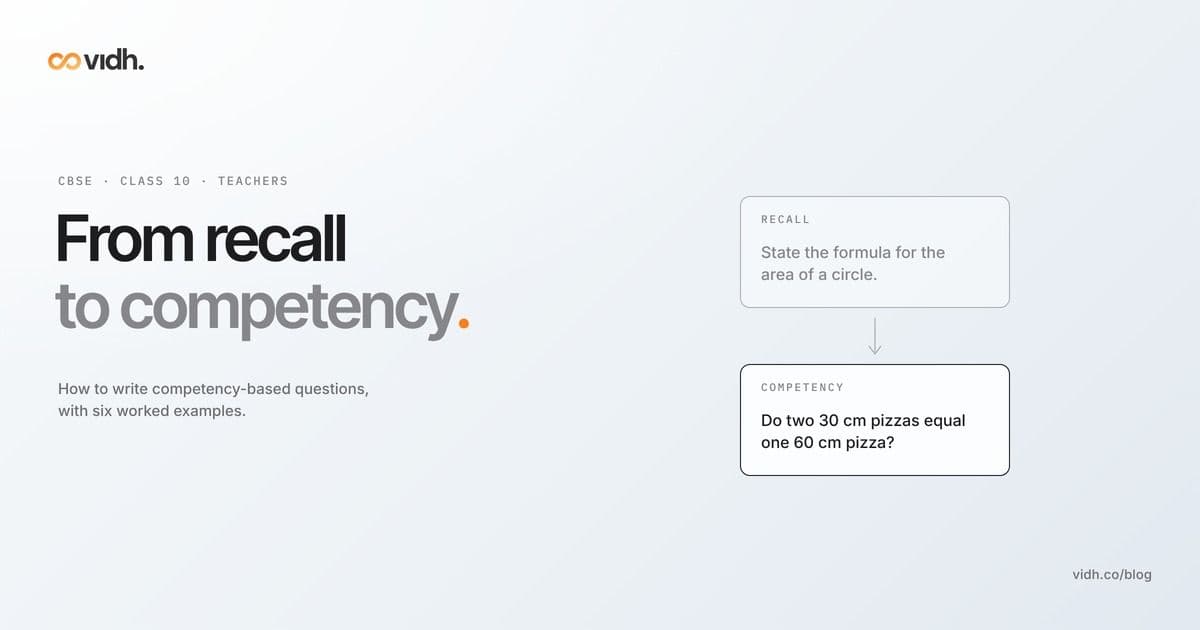
Competency-Based Questions for CBSE: Guide + Examples
5 min read
What competency-based questions are, what CBSE says for 2026–27, a 4-step method to turn recall into application, 6 worked examples and a pre-board checklist.
By Bhagya · Last updated: 29 October 2026
Short answer: A competency-based question asks a student to use a concept in a situation they have not seen before, rather than repeat a fact or definition from the textbook. CBSE describes competency-based education as an approach that focuses on "the student's demonstration of learning outcomes" and "emphasizes real-world applications of knowledge and skills". If a student can answer from memory alone, it is a recall question.
Pre-board papers are being set in staff rooms right now. Somewhere in most departments, a teacher is looking at a draft and asking the same question: is this really a competency-based question, or a recall question with a longer story in front of it?
Most of what turns up when you search for "competency based questions" is a PDF of past items with no explanation of why they work. This guide is for teachers and heads of department who want to write their own. It covers what CBSE says for 2026–27, a four-step method for turning a recall question into a competency one, six worked before-and-after pairs, how to write better MCBy Bhagya · Last updated: 29 October 2026
Short answer: A competency-based question asks a student to use a concept in a situation they have not seen before, rather than repeat a fact or definition from the textbook. CBSE describes competency-based education as an approach that focuses on "the student's demonstration of learning outcomes" and "emphasizes real-world applications of knowledge and skills". If a student can answer from memory alone, it is a recall question.
Pre-board papers are being set in staff rooms right now. Somewhere in most departments, a teacher is looking at a draft and asking the same question: is this really a competency-based question, or a recall question with a longer story in front of it?
Most of what turns up when you search for "competency based questions" is a PDF of past items with no explanation of why they work. This guide is for teachers and heads of department who want to write their own. It covers what CBSE says for 2026–27, a four-step method for turning a recall question into a competency one, six worked before-and-after pairs, how to write better MCQs and case-based items, and a checklist for reviewing a pre-board paper as a department.
The examples use CBSE Class 10 subjects; the method works for any board and year group.
Key takeaways
- Recall vs competency: a recall question checks whether a student remembers; a competency question checks whether they can use what they remember in a new situation.
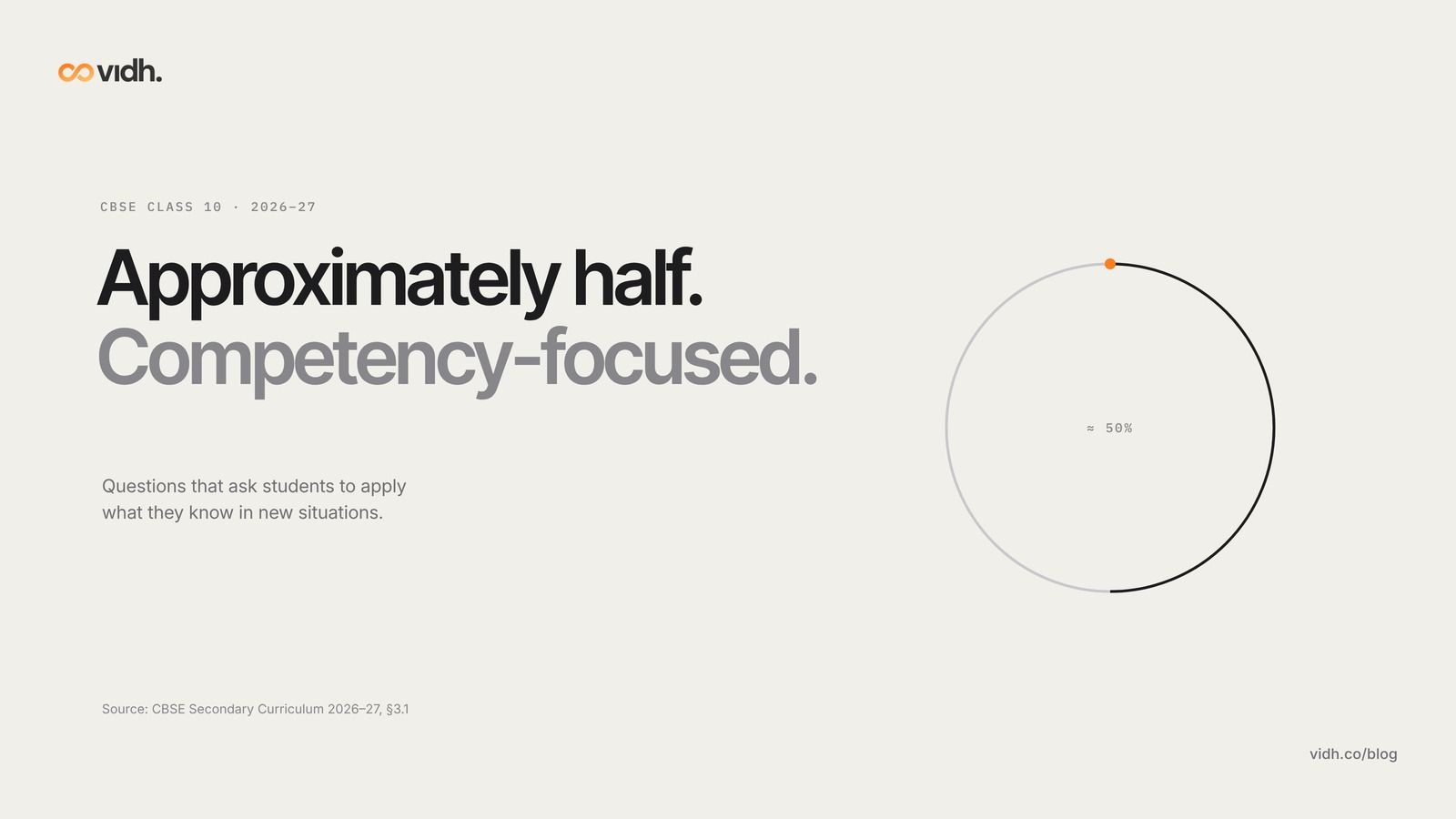
- CBSE 2026–27: the curriculum says "approximately 50% of the questions are competency-focused" in board papers, and that this structure "may be reviewed periodically".
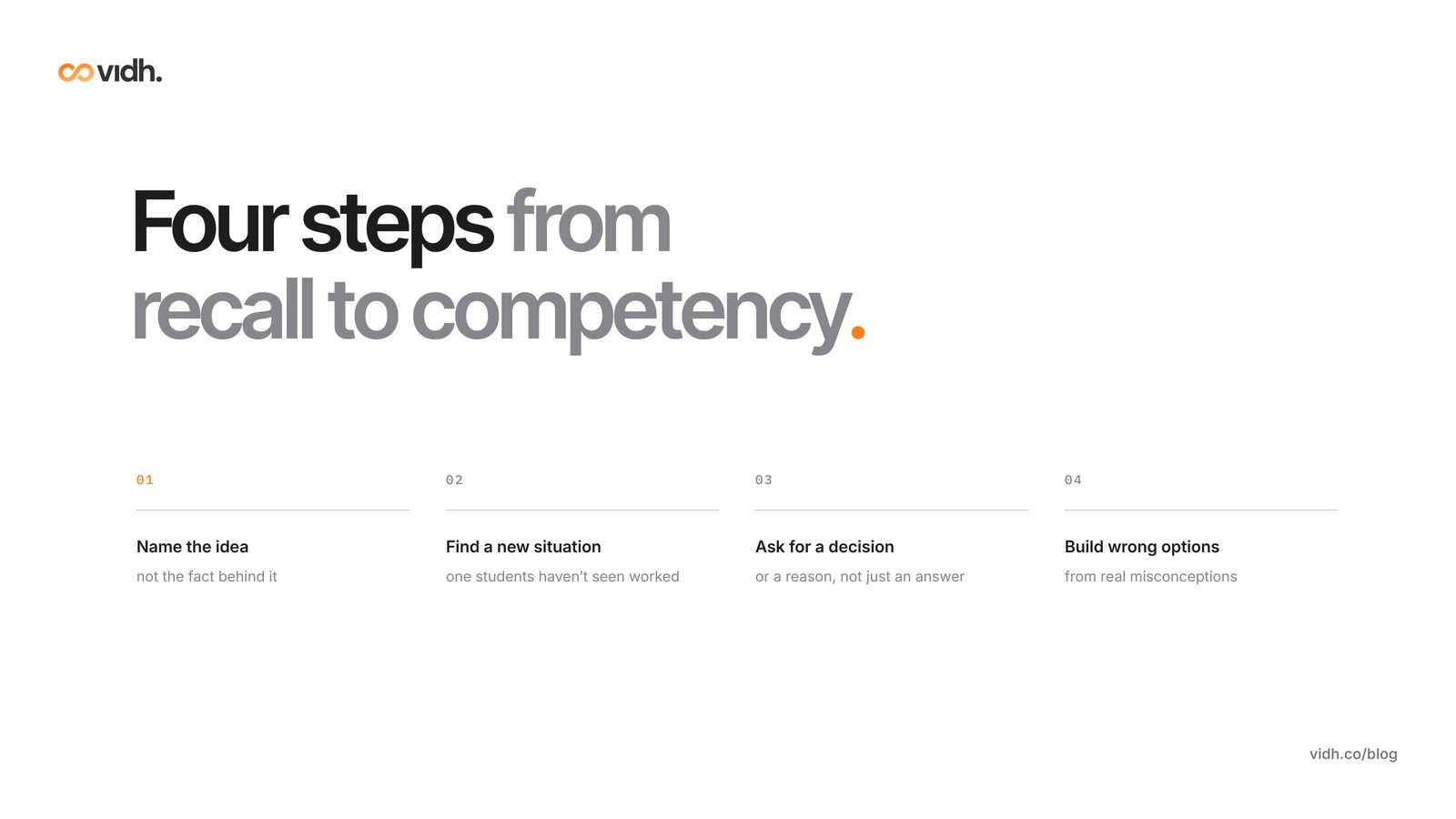
- Four steps: name the idea you are really testing, put it in a new situation, ask students to do something with it, and build wrong options from real misconceptions.
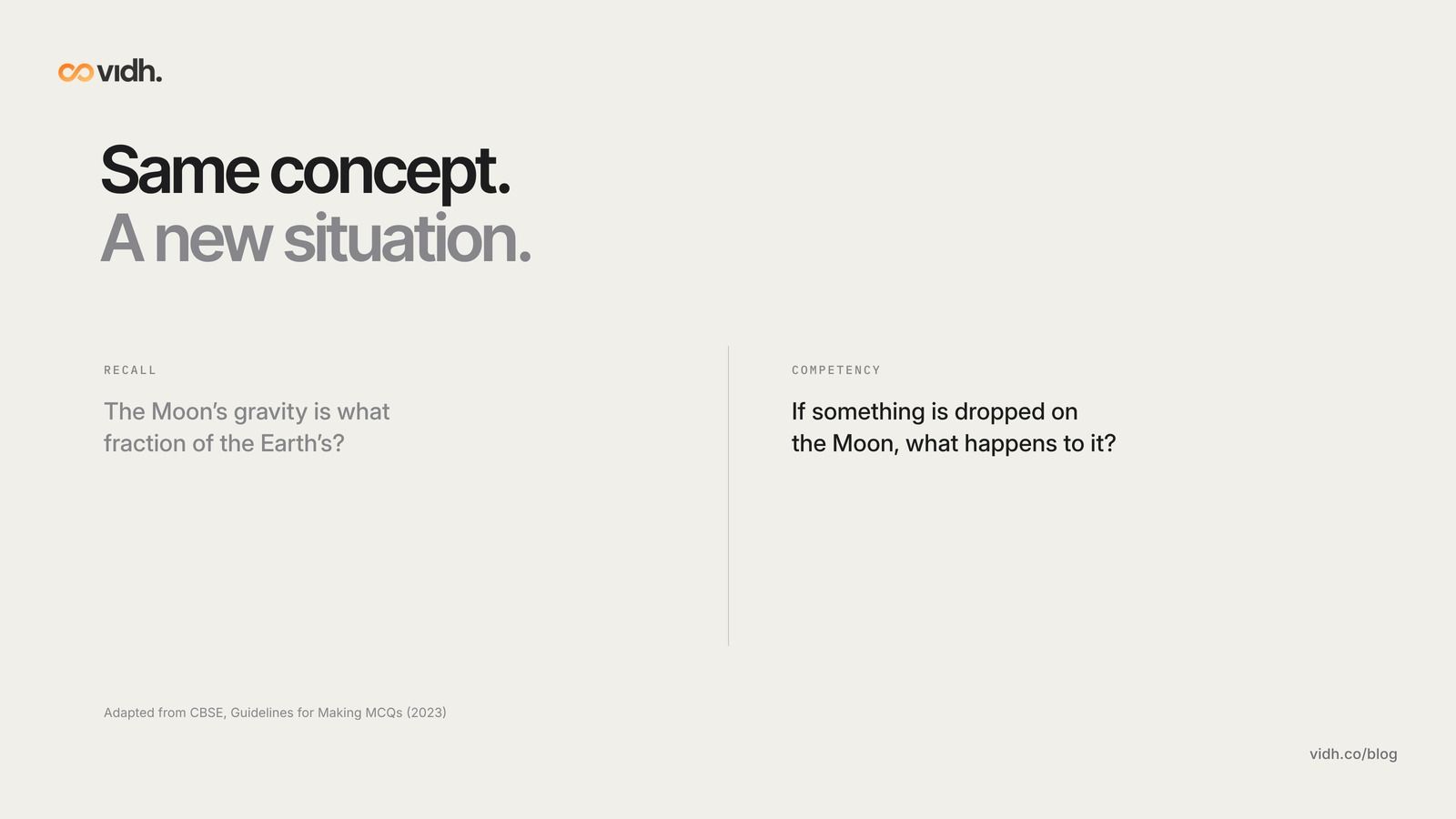
- MCQs can be competency-based. CBSE's own guidelines show a recall MCQ about the Moon's gravity rewritten as a concept MCQ.
- Review as a department. Check every competency item against the official 2026–27 sample papers before the pre-board goes out.
What is a competency-based question?
A competency-based question tests whether a student can apply, analyse or evaluate, not just remember. The student meets a situation, a short case, a source, a data table or a problem, and has to decide which idea fits and use it.
CBSE's Competency-Based Education portal defines the approach as "an approach to teaching, learning, and assessment that focuses on the student's demonstration of learning outcomes and attaining proficiency in particular competencies in each subject", and adds that "it emphasizes real-world applications of knowledge and skills" (CBSE CBE portal). The same portal quotes NEP 2020's call to move away from assessment that "primarily tests rote memorization skills" towards one that tests "higher-order skills, such as analysis, critical thinking and conceptual clarity".
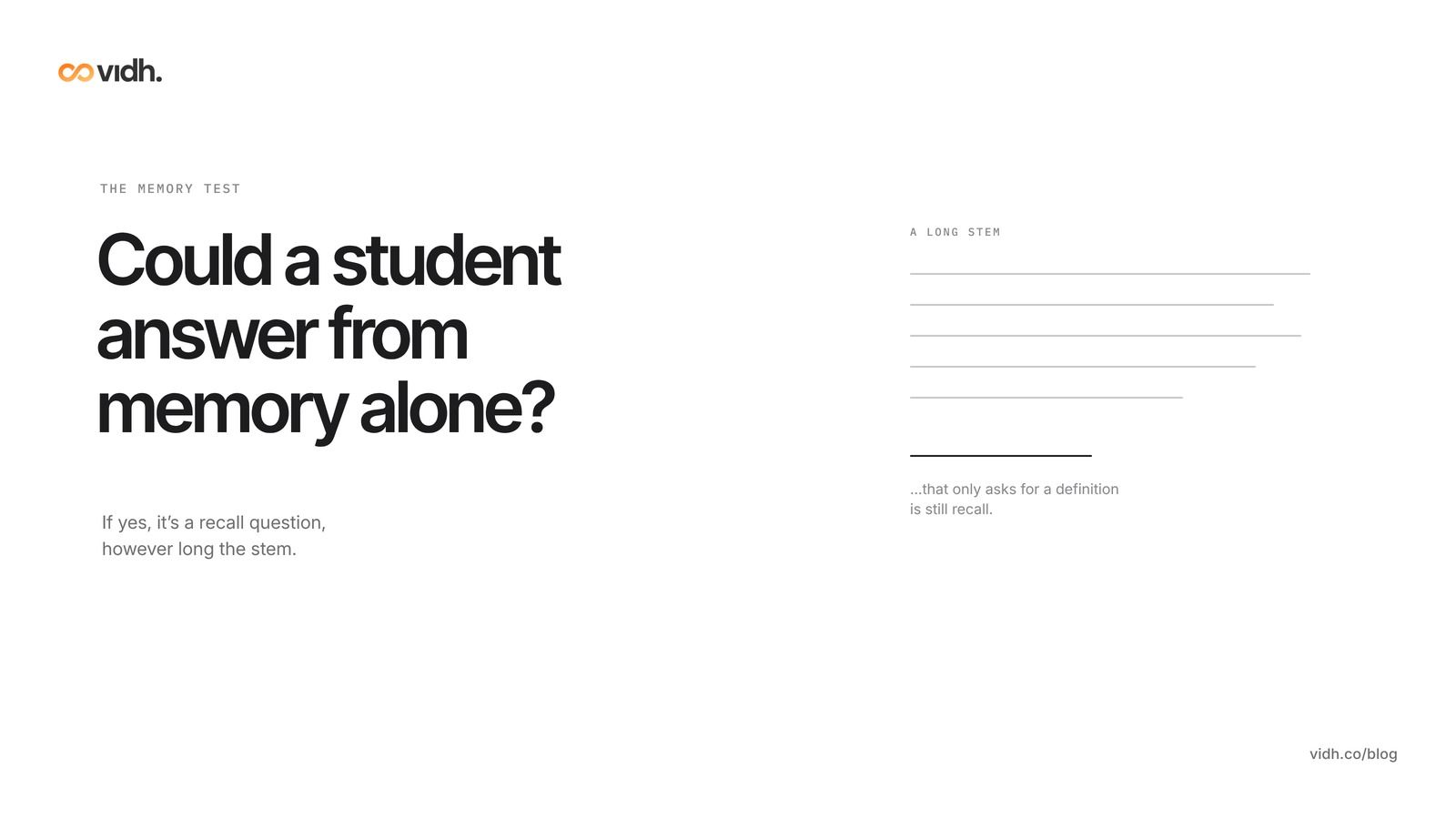
A simple test for any question you write: could a student who has memorised the chapter, but not understood it, still get full marks? If yes, it is a recall question, however long the stem.
Recall still has a place; CBSE papers include it. The point is knowing which kind of question you have written.
What does CBSE say about competency-based questions for 2026–27?
The clearest statement is in CBSE's Secondary School Curriculum 2026–27. Section 3.1, "Nature of Question Papers", says board papers "are designed to assess application, analysis, and evaluation", and continues:
"Presently, approximately 50% of the questions are competency-focused—such as case-based, source-based, integrated, data interpretation, situational, and application-oriented. Remaining items include select-response (MCQs) and constructed-response (short- and long-answer) questions. This structure may be reviewed periodically." (CBSE Secondary Curriculum 2026–27)
Three things are worth noticing:
- The figure is "approximately 50%". CBSE does not give a fixed split for the rest of the paper in this section, and says the structure may change. Avoid quoting more exact numbers to students or parents unless you have a current CBSE document that states them.
- Competency is a family of formats. Case-based, source-based, integrated, data interpretation, situational and application-oriented items all count. A case-based question is one kind of competency question, not the only kind.
- It reaches classroom practice. Among the curriculum's salient features is to "shift assessment from testing memorisation to evaluating competencies and higher-order thinking", and teachers are asked to "incorporate case-based, source-based, and application-oriented questions" in their own teaching and testing.
Subject sections follow the same line. Mathematics is to be assessed on "understanding, reasoning, and application rather than routine memorisation", and Science through "case-based items, data interpretation, experimental analysis, and problem-solving tasks".
If your school is also planning for the new two-exam pattern, our guide to CBSE two board exams in 2027 covers the rules parents ask about most.
How do you turn a recall question into a competency question? Four steps
Start with a recall question you already use and rebuild it.
- Name the idea you are really testing. Not the fact ("the formula for the area of a circle") but the understanding behind it ("area grows with the square of the radius"). If you cannot name the idea, the question will drift back to recall.
- Put it in a new situation. Choose a context students have not seen worked in the textbook: an everyday object, a short passage, a small table of data, a scenario. Keep the reading load fair; the context should carry the concept, not hide it.
- Ask students to do something with it. Decide, predict, compare, explain, justify or choose. Ask for the reason as well as the answer, so the marking scheme can reward thinking and not just the final word.
- Build the wrong answers from real misconceptions. For an MCQ, each distractor should be an answer a student with a specific wrong idea would choose. For a written item, list the likely wrong answers in the marking scheme so markers can spot them.
Then run the memory test again: could a student answer from memory without understanding? If yes, go back to step 2.
Six worked examples: recall vs competency
The first pair is CBSE's own. The other five are our examples, written to show the method; they are not CBSE items. Adapt the numbers and contexts for your class.
1. Science: the Moon's gravity (CBSE's example)
- Recall: The Moon's gravity is what fraction of the Earth's? (1/2, 1/3, 1/4, 1/6)
- Competency: If something is dropped on the Moon, what happens to it? (It floats away / it floats where it is / it falls to the ground / it floats towards the Earth)
- Why it works: CBSE's MCQ guidelines point out that most textbooks stress the "1/6" fact, so students choose it instantly. That does not show they understand that the Moon has gravity and that a dropped object would fall. The second question uncovers it, and its "thoughtfully designed distractors, based on alternate student conceptions" about gravity in space show which wrong idea a student holds (CBSE, Guidelines for Making MCQs).
2. Maths: area of a circle
- Recall: Write the formula for the area of a circle.
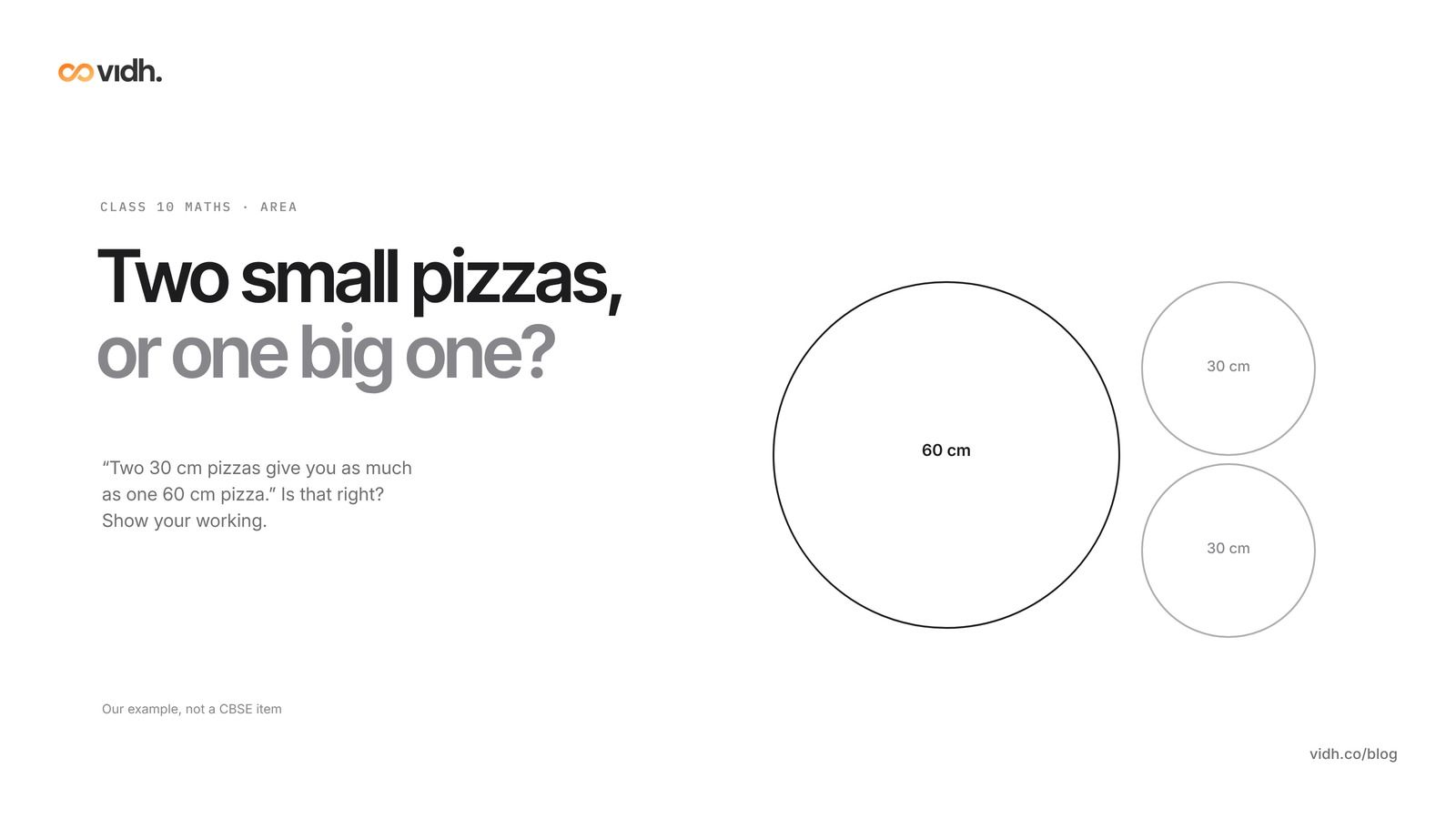
- Competency: A café sells pizzas in two sizes: 30 cm and 60 cm across. A friend says two 30 cm pizzas give you as much as one 60 cm pizza. Is your friend right? Show your working.
- What it tests: applying the formula, and seeing that doubling the diameter makes the area four times larger, so one 60 cm pizza equals four 30 cm pizzas, not two.
3. Science: photosynthesis
- Recall: Define photosynthesis.
- Competency: A potted plant is kept in a dark cupboard for two weeks. Its leaves turn pale and some start to drop. Using what you know about how plants make food, explain what has happened.
- What it tests: linking light to food-making, and reasoning from an observation back to the process.
4. Science: boiling and pressure
- Recall: At what temperature does water boil at sea level?
- Competency: A family on holiday in the hills notices that rice takes much longer to cook than at home, even though the water is boiling. Explain why.
- What it tests: understanding that boiling point depends on air pressure, and applying it to a familiar situation.
5. Social science: causes of a war
- Recall: List three causes of the First World War.
- Competency: Read this short passage, written for the class: "Several countries had promised to defend each other. When a quarrel broke out between two of them, the others were pulled in one by one." Which cause of the war does this passage describe? Quote two phrases from it that support your answer.
- What it tests: recognising a cause (the alliance system) in a source and backing the answer with evidence, which is the core skill in source-based items.
6. English: similes
- Recall: What is a simile? Give an example.
- Competency: Here is a line from a weather report: "Heavy rain is expected this afternoon." Rewrite it for a seven-year-old, using one simile. Then explain in one sentence what your simile helps the child picture.
- What it tests: using the device for a purpose and audience, and explaining the choice.
In each pair the concept stays the same; the situation is new, and the student must decide or explain.
How do you write better MCQs and case-based questions?
MCQs
An MCQ is not automatically a recall question. CBSE's guidelines show that a well-built MCQ can test a concept, and that the wrong options matter as much as the right one. A few rules follow from the Moon example:
- Write distractors from real misconceptions. Collect the wrong answers students actually give in class or in last year's papers, and use them. A distractor nobody would choose tells you nothing.
- Test an important idea, not a trivial fact. The guidelines note that even two recall questions can differ in value: one checks a minor detail, another an idea that matters for the rest of the subject.
- Keep options parallel in length and grammar, so the answer doesn't stand out.
Case-based and source-based items
- Make the case necessary. If a student can answer the sub-questions without reading the case, it is decoration. Every sub-question should need something from the stem.
- Climb in difficulty. Start with one item that checks the student has understood the case, then move to apply, then to explain or evaluate.
- Keep the stem short and fair. A long passage tests reading speed as much as the subject. Use plain language and familiar contexts.
- Write the marking scheme with the question. If two teachers would mark the same answer differently, the item needs work.
Study the official items before you write your own. CBSE publishes Class 10 sample question papers and marking schemes for 2026–27 (CBSE SQP 2026–27). Look at how the case-based and source-based items are built and marked, rather than copying the questions.
Why bother? Questions that make students explain and check their thinking also build the habits teachers want in class. The Education Endowment Foundation's Teaching and Learning Toolkit rates metacognition and self-regulation approaches, which teach pupils to plan, monitor and evaluate their own learning, at an average of +8 months' additional progress, while noting "it can be difficult to realise this impact in practice" (EEF). That evidence is about teaching approaches, not question formats, but it points the same way.
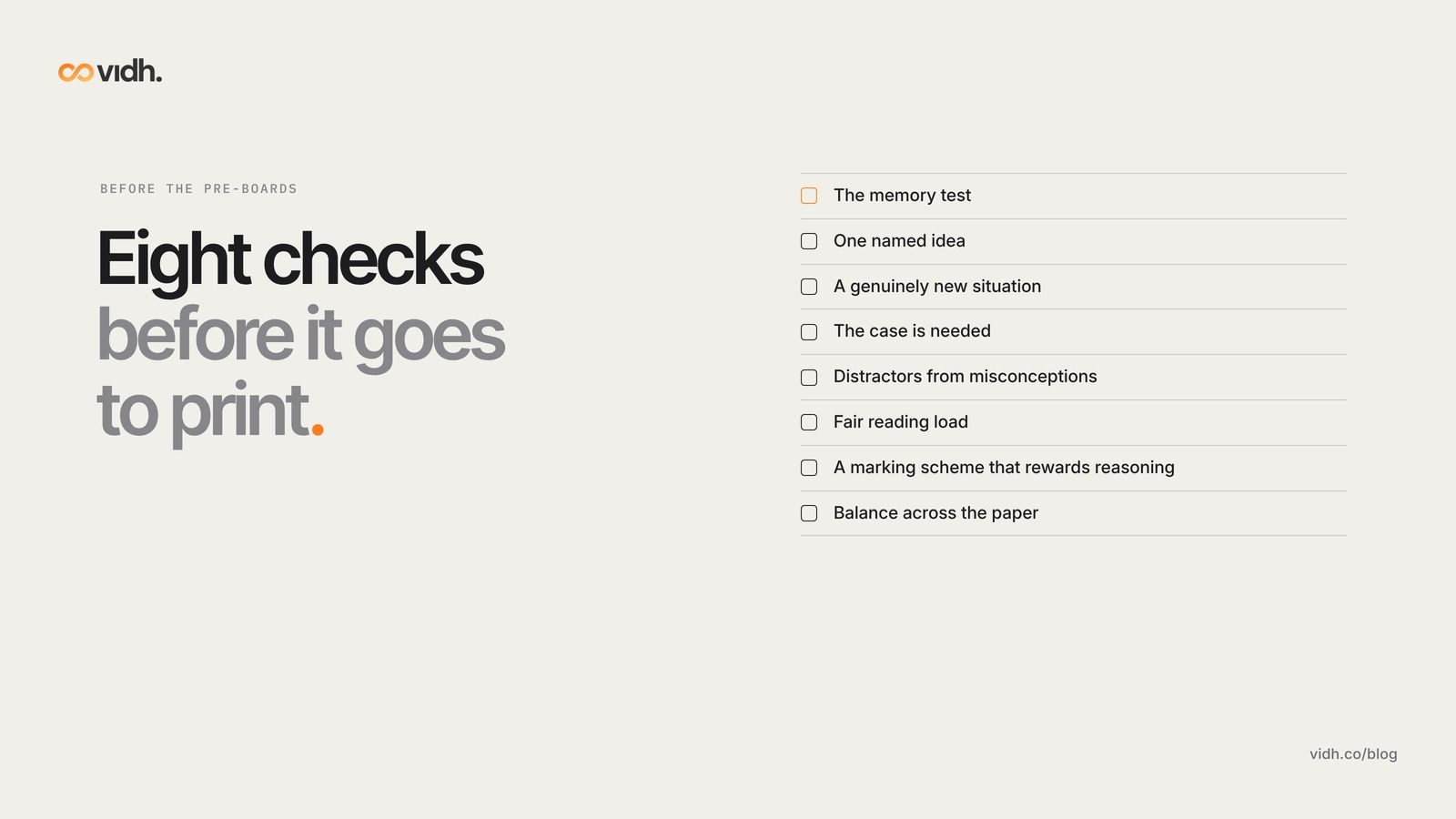
Pre-board review checklist for departments
- The memory test. Could a student who memorised the chapter, without understanding it, answer this? If yes, relabel it as recall or rewrite it.
- One named idea. Can the setter say in one line which concept the item tests?
- A genuinely new situation. The context is not a worked example from the textbook or a well-known guide.
- The case is needed. Every sub-question uses information from the stem or source.
- Distractors from misconceptions. Each wrong option matches a real error students make.
- Fair reading load. Plain language, no unnecessary length, and no cultural knowledge some students won't have.
- A marking scheme that rewards reasoning. It lists what a full answer includes, and how part-marks work.
- Balance across the paper. A rough tally of competency and recall items, compared with the CBSE 2026–27 sample paper for the subject.
Keep the reviewed items: a tested bank, with notes on how students answered, beats a new set written in a hurry.
FAQ
What is a competency-based question?
It is a question that asks students to apply a concept in a new situation, such as a case, a source, data or a real-life problem, instead of repeating a fact. CBSE describes competency-based education as focusing on students demonstrating learning outcomes and applying knowledge and skills to real-world situations.
How many CBSE questions are competency-based in 2026–27?
CBSE's Secondary School Curriculum 2026–27 says that presently "approximately 50% of the questions are competency-focused" in board papers, with the remaining items being MCQs and short- and long-answer questions. CBSE adds that this structure may be reviewed periodically.
What is the difference between competency-based and case-based questions?
Case-based questions are one type of competency-based question. CBSE's list of competency-focused formats also includes source-based, integrated, data interpretation, situational and application-oriented items.
How do I write a competency-based question?
Start from a recall question. Name the idea you are really testing, put it in a new situation, ask students to decide, predict or explain, and build wrong answers from real misconceptions. Then check that a student could not answer from memory alone.
Can MCQs be competency-based?
Yes. CBSE's guidelines for making MCQs show a recall question about the Moon's gravity rewritten as a concept question about what happens to an object dropped on the Moon, with distractors based on common student misconceptions.
Where can I find official CBSE competency-based questions?
Start with CBSE's Class 10 sample question papers and marking schemes for 2026–27 on cbseacademic.nic.in, and the resources on CBSE's Competency-Based Education portal. Study how items are built and marked rather than copying them.
Book a 30-min demo
If you lead a school and want to talk through how your teachers plan, assess and report across the year, book a 30-min demo. In 30 minutes we talk through pricing, data and migration from your current system, and what happens next, and answer your questions.
About Vidh: Vidh (vidh.co) is an AI platform for schools, built by Vidh Labs in Bengaluru, that keeps one shared record for every child across the school office, the classroom and home.
Sources
- CBSE, Secondary School Curriculum 2026–27 (Part 1), section 3.1 "Nature of Question Papers", salient features and subject assessment notes: https://cbseacademic.nic.in/web_material/CurriculumMain27/SecPart1/Curriculum_SecP1_2026-27.pdf
- CBSE Centre for Excellence in Assessment and Educational Initiatives, "Guidelines for Making Multiple Choice Questions" (1st edition, July 2023): https://cbseacademic.nic.in/web_material/Manuals/Guidelines_Making_MCQs.pdf
- CBSE, Competency-Based Education portal: https://cbseacademic.nic.in/cbe/index.html
- CBSE, Class X Sample Question Papers and Marking Schemes 2026–27: https://cbseacademic.nic.in/sqp_classx_2026-27.html
- Education Endowment Foundation, Teaching and Learning Toolkit, "Metacognition and self-regulation": https://educationendowmentfoundation.org.uk/education-evidence/teaching-learning-toolkit/metacognition-and-self-regulation
All sources were opened on 29 Oct 2026 (IST) and returned HTTP 200; quoted text was checked on the page or PDF.