Back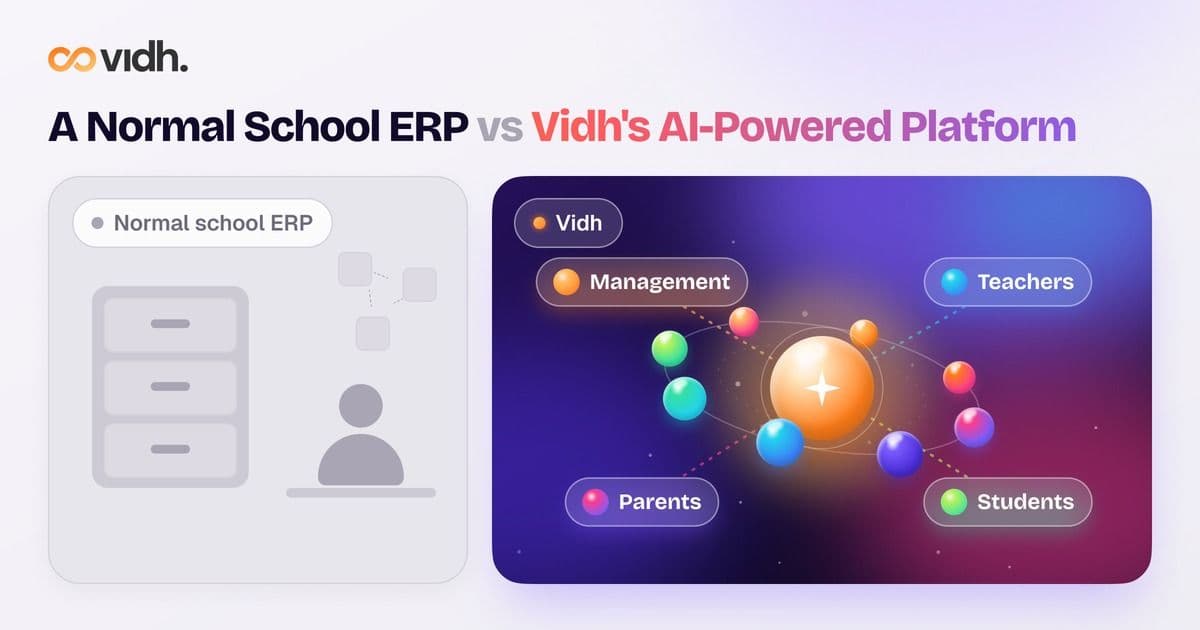
A Normal School ERP vs Vidh's AI-Powered Platform
21st October 2026 · 5 min read
A normal school ERP stores records for the office. Vidh's AI-powered platform connects management, teachers, parents and students around each child.
By the Vidh team · Last updated: 19 October 2026 · Vidh product details checked on vidh.co on 19 Oct 2026 (IST)
A school ERP keeps records for the office. Vidh's AI-powered platform connects everyone around each child, and helps each of them act.
Short answer: A normal school ERP stores records and automates office tasks, mainly for administrators. AI-powered school management software like Vidh's platform is a different category: an ecosystem of 8 apps, powered by Vidh Intelligence, that connects management, teachers, parents and students and gives each of them help, with every child in focus.
Key takeaways
- A normal ERP is a system of record. It stores data and automates office tasks such as fee receipts, admissions and attendance registers, and it is built mainly for administrators.
- Vidh's AI-powered platform is a system of action. It is an ecosystem of 8 apps that connects management, teachers, parents and students on one shared record for each child.
- Vidh Intelligence is live today. It reads across the whole record and suggests next steps, and a person approves each one before it happens.
- Each person gets real help: after-school support for students through Sara, teaching support for teachers, parents connected to academics, and early issue-spotting, with next steps to approve, for management.
- The focus is each child, not each department.
- Ask any platform the same seven questions, listed below.
What is a school ERP?
A school ERP is software that runs a school's operations, such as admissions, fees, attendance, exams, staff and transport, in one system. ERP stands for enterprise resource planning. In Indian schools, the term usually covers the student information system plus fee accounting, HR, transport and report cards.
A good ERP is valuable. It swaps registers, ledgers and spreadsheets for one database, cuts manual errors and produces the reports that boards and inspections ask for. Some ERPs now add AI features, such as plain-language questions for staff.
What an ERP is not usually designed to do is bring parents and students into the same daily loop as the office and the classroom. Its main users are the office and administrators. Teachers often use only part of it, and parents tend to see notices and fee dues rather than learning. The information is there, but it often stays in its own module until someone pulls a report.
What is AI-powered school management software?
AI-powered school management software is a school platform where management, teachers, parents and students work on the same record for each child, and AI reads across that record to flag issues and suggest next steps for each of them.
You will also see it called an AI school management system, an AI-powered school platform or school management software with AI. The label matters less than two tests: does everyone work on the same record, and does the AI help each of them act on it? In India, "school management software" is often used as another name for a school ERP. This post uses "AI-powered school management software" for a different category: one built to connect management, teachers, parents and students around each child, with AI that helps each person act.
Three things set it apart from a normal ERP:
- One shared record per child. Attendance, marks, homework and transport link to the same student, so a fact entered once is seen by everyone who should see it (What is a single student record?).
- An app for every stakeholder. The principal, the teacher, the parent and the student each have their own app on that record, built for their job.
- An AI layer across all of it. Because the AI sees the whole record, it can connect things that no single app can, such as a weak topic in a test and the practice a child does at home.
School ERP vs Vidh's AI-powered platform: what's the difference?
The short version: a normal ERP keeps the school's records; Vidh's AI-powered platform connects the school's people around each child.
Category
- Normal school ERP: A system of record
- Vidh's AI-powered platform: A system of action
Who it serves
- Normal school ERP: Mainly the office and administrators
- Vidh's AI-powered platform: Management, teachers, parents and students, each with their own app
Built around
- Normal school ERP: Processes and departments
- Vidh's AI-powered platform: Each child, with one shared record
How it is delivered
- Normal school ERP: Separate modules, often with a parent app on the side
- Vidh's AI-powered platform: An ecosystem of 8 apps that work together on one record
What happens to data
- Normal school ERP: Stored, then pulled into reports when someone asks
- Vidh's AI-powered platform: Reaches the right person the same day
What AI does
- Normal school ERP: Where offered, usually helps with reports or staff queries
- Vidh's AI-powered platform: Vidh Intelligence reads the whole record and suggests next steps; a person approves
After school
- Normal school ERP: Not usually part of the product
- Vidh's AI-powered platform: Sara, the AI tutor in Vidh Shine, supports students at home
For parents
- Normal school ERP: Mostly notices and fee dues
- Vidh's AI-powered platform: Homework, marks and the teacher's note on one screen, with a reply
Main focus
- Normal school ERP: Running processes reliably
- Vidh's AI-powered platform: Noticing and helping each child
A normal ERP is built to keep records straight. Vidh's AI-powered platform is built to connect people and help each child.
What is Vidh Intelligence?
Vidh Intelligence is the AI layer under every Vidh app: it reads one shared record for each child, across the school office, the classroom and home, and suggests next steps, such as a revision group or a note to a parent, that happen only when a person approves.
It is live in the Vidh Platform today, and its rule is simple: AI suggests, a person approves. Vidh's website describes it as "One layer under everything": every Vidh product "writes to the same record, so the layer sees what no single app can: the fee that is late, the child who is slipping, the bus that is behind, the lesson that did not land" (vidh.co, checked 19 Oct 2026). The site lists four things the layer does:
- Sees the whole child: attendance, marks, homework and the bus "in one record, not five logins."
- Answers in plain language: staff can ask a question "the way you would ask a colleague", for example "Who is slipping in Class 7 Maths?" The site labels this feature, "Ask Vidh", as a Preview.
- Acts, with your permission: it plans the revision or reaches the parent, and "You approve, it does."
- Child-safe by design: "Every school's data stays its own."
At the end of a school day, for example, it can propose a revision group for a weak topic. As the site puts it, "The principal approves in one tap" (vidh.co).
What does Vidh's platform do for each person in the school?
The real test of a platform is whether each person's day gets easier. Here is how Vidh's platform serves each stakeholder, quoting what Vidh's own pages state.
Students: after-school support through Sara
Most homework happens at home, often without an adult who can explain the topic. Sara is the child-safe AI tutor in Vidh Shine. Vidh's site says she covers "Maths, science, spoken English, computing, languages and more, across CBSE and State Boards" (vidh.co), and she speaks 15+ Indian languages and 50+ international languages. For homework, she gives hints instead of handing over the answer (Meet Sara). That design matters: a 2025 trial found that students given an unrestricted chatbot scored 17% lower on the exam once it was taken away, while a version that guided them with hints largely avoided the drop (Bastani et al., PNAS, 2025).
Parents set screen time at home, and Shine offers "a personal path through the syllabus", with progress "the teacher and the parent both see" (vidh.co).
Teachers: teaching support, not more admin
Vidh Hub is the teacher's daily app: "Attendance, homework, marks entry, exam correction, leave requests and parent follow-ups." Vidh Teach drafts "the plan, the activity and the question paper, shaped by how last week's class went. The teacher edits, then teaches" (vidh.co). The teacher stays in charge; the AI handles the first draft.
Parents: connected to their child's academics
Vidh Parents brings "homework, marks, notices and the teacher's follow-ups" into "one app, one conversation with the school" (vidh.co), and parents can track the school bus live. Its Google Play listing adds attendance tracking with "timely alerts for absences or late arrivals" (Google Play). The point is not more notifications. It is that a parent sees the score and the teacher's note on the same screen, and can reply.
Management: early issue-spotting and next steps to approve
When teachers enter marks in Vidh Hub, Vidh School turns them into "class averages, weak topics and a list of who needs help this week" (vidh.co). Vidh Intelligence adds the next step, such as a revision group or a note to a parent, for a person to approve. For a principal, that means fewer reports to compile and a clearer view of where to act: an absence pattern, a class that did not grasp a topic, a child who is slipping.
How does it help a school focus on each child?
India's National Education Policy 2020 lists, as its first guiding principle, "recognizing, identifying, and fostering the unique capabilities of each student, by sensitizing teachers as well as parents" (NEP 2020). Most schools agree. The hard part is doing it for every child in a class of forty, every week.
A connected platform makes that practical, because each step feeds the next. Here is a typical day's loop on Vidh's platform:
- A teacher enters unit-test marks in Vidh Hub.
- Vidh School shows the class average and the weak topic, and lists who needs help.
- The teacher assigns targeted practice in Vidh Shine, where Sara explains the topic at home.
- The parent sees the score and the teacher's note in Vidh Parents, and replies.
- Vidh Intelligence suggests a revision group for the next day, and the principal approves it.
None of these steps is new on its own. What changes is that they happen on one record, so a fact entered once is seen by everyone who should see it, and a child who is slipping can be noticed within days, not at the end of term.
Which problems does each one solve?
Start with the problem you want to solve. Keeping records in order and automating office tasks is what a normal school ERP is designed for. Helping every child, by connecting management, teachers, parents and students and giving each of them support, is what Vidh's AI-powered platform is built for.
A quick way to decide is to name your biggest gap:
- Children slipping between the classroom and home? Look for one shared record and after-school support.
- Teachers short of time? Look for teaching support that drafts, so the teacher can edit and teach.
- Parents out of the loop on learning? Look for homework, marks and the teacher's note in one place, with a way to reply.
- Problems spotted too late? Look for AI that flags issues early and suggests a next step for a person to approve.
If your biggest gaps are on this list, those are the problems an AI-powered platform is built for.
What should you ask any school platform?
Whichever product you look at, ask the same seven questions and get written answers:
- Show me one child's record as each person sees it: the principal, a teacher, a parent and the student.
- What does the AI do on its own, and what needs a person to approve it?
- Where is our data stored, and will you put that in the contract?
- Can we export all our data (for example as CSV or Excel) at any time, including if we leave?
- Show me role-based access and an audit log, including what the AI and the AI tutor can see.
- What is the price for our student count, and which apps and AI features does it include?
- How do you record verifiable parental consent for children's data under the DPDP Act, 2023?
For a longer list, see our principal's software evaluation checklist and why most school ERPs fail after implementation.
FAQ
What is AI-powered school management software?
AI-powered school management software is a platform where management, teachers, parents and students work on one shared record for each child, and AI reads across it to flag issues and suggest next steps for each person. Its focus is people and each child's progress, not office records.
What is the difference between a school ERP and an AI-powered school platform?
A school ERP is a system of record: it stores data and automates office tasks, mainly for administrators. An AI-powered school platform is a system of action: it connects every stakeholder on one shared record per child and uses AI to suggest next steps for each person.
What is Vidh Intelligence?
Vidh Intelligence is the AI layer under every Vidh app: it reads one shared record for each child, across the school office, the classroom and home, and suggests next steps, such as a revision group or a note to a parent, that happen only when a person approves. It's live.
Will AI take the place of teachers?
No. In a well-designed platform, AI drafts and suggests, and people decide. Vidh Intelligence works this way: it suggests a next step, such as a revision group for a weak topic, and a person approves it before anything happens. The aim is more time with children, not fewer teachers.
Is it safe to use AI with children's data?
It can be, with careful setup. Under the DPDP Act, 2023, the school is responsible for children's personal data and needs verifiable parental consent before processing it (DPDP Act, 2023). Ask any platform where data is stored, who sees what and how consent is recorded.
How does an AI tutor help students after school?
A good AI tutor explains the topic and gives hints rather than answers, so the student still does the thinking. Sara, the AI tutor in Vidh Shine, gives hints instead of handing over the answer, and parents set screen time at home (Meet Sara).
How is Vidh different from a school ERP?
A school ERP stores records and automates office tasks, mainly for administrators. Vidh is an AI-powered platform: an ecosystem of 8 apps, powered by Vidh Intelligence, that connects management, teachers, parents and students around each child and gives each of them help. AI suggests; a person approves.
Book a 30-min demo
If you'd like to see how Vidh's AI-powered platform would connect your school's management, teachers, parents and students, book a 30-min demo. You can also contact our team.
About Vidh: Vidh (vidh.co) is an AI-powered platform for schools, built by Vidh Labs in Bengaluru, that connects management, teachers, parents and students around each child.
Sources
- Vidh homepage (product descriptions, Vidh Intelligence, Sara, demo agenda): https://vidh.co
- Vidh blog, "Sara: The AI Tutor That Gives Hints, Not Answers" (18 Oct 2026): https://vidh.co/blog/meet-sara-the-ai-mentor
- Vidh Parent app, Google Play listing (attendance alerts, teacher and school communication): https://play.google.com/store/apps/details?id=co.parents.vidh
- Vidh privacy policy (Vidh Labs Private Limited): https://vidh.co/privacy-policy
- Bastani, H. et al. (2025), "Generative AI without guardrails can harm learning: Evidence from high school mathematics", PNAS: https://doi.org/10.1073/pnas.2422633122
- National Education Policy 2020, Ministry of Human Resource Development (now Ministry of Education), "Principles of this Policy" (PIB copy): https://static.pib.gov.in/WriteReadData/userfiles/NEP_Final_English_0.pdf
- Digital Personal Data Protection Act, 2023 (MeitY PDF; s. 9, children's data): https://www.meity.gov.in/static/uploads/2024/06/2bf1f0e9f04e6fb4f8fef35e82c42aa5.pdf
All accessed 19 Oct 2026 (IST).