Back


Better Than 'How Was School?': Dinner Questions That Actually Work
5 min read
Tired of hearing 'fine'? Try specific dinner questions instead of 'How was school?', with lists by age, what the research says and how to listen.
By Bhagya · Last updated: 27 October 2026
Short answer: Instead of "How was school?", ask one specific, light question, such as "What's one thing that made you laugh today?", "What was the hardest part of your day?", "If you were the teacher today, what would you change?" or "Who did you help today?". Then stop, wait and listen without correcting or advising. Broad questions ask a tired child to sum up a whole day in one word, so they get "fine". Specific questions ask for one moment, and moments turn into stories.
You know the scene. Everyone sits down to dinner, you ask "How was school?", and the answer is "fine". Or "good". Or a shrug. You try "What did you do today?" and get "nothing", from a child who has just spent six hours learning, playing, arguing, laughing and worrying.
It isn't that children don't want to talk. It's that the question is too big, and often asked at the wrong moment. This guide gives you better questions to try tonight, lists for different ages, what child-development research says about why they work, and a simple routine for turning dinner into a conversation rather than an interview.
Key takeaways
- Broad questions get one-word answers. "How was school?" asks for a verdict on a whole day. Specific questions ask for one moment, which is easier to answer.
- Listening matters more than the question. Children tell parents more when they feel heard, not checked on. Avoid correcting, lecturing or fixing in the first few minutes.
- Timing helps. Many children need time to unwind after school. Dinner, bedtime and car journeys are often better than the school gate.
- Go first. Share a moment from your own day. It shows what kind of answer you are hoping for.
- Match the question to the age. Young children do best with concrete "who" and "what" questions; teenagers with opinions and "what if" questions.
Why does "How was school?" get "fine"?
There are three reasons, and none of them is that your child is shutting you out.
1. The question is too big. "How was school?" asks a child to scan six or seven hours, choose what matters and turn it into a summary. That is hard work for an adult, let alone a tired eight-year-old. "Fine" is the easiest honest answer. The US learning-differences charity Understood puts it simply: open-ended questions "can help make kids think about what's going on" and "let you get more than a one-word answer" (Understood). UNICEF gives the same advice for teenagers: instead of "How was school?", ask something focused like "What was the best or hardest part of your day?", because teens "are more likely to open up if we steer clear of broad topics in favour of more specific subjects" (UNICEF Parenting).
2. The timing is wrong. Straight after school, many children are hungry, tired or still processing the day. Writing for UC Berkeley's Greater Good Science Center, sociologist Christine Carter notes that the right moment "probably isn't when they, or you, walk in the door", because "most kids need time to rest and make the transition from school to home" (Greater Good).
3. It can feel like a check-up. If "How was school?" is usually followed by "Did you finish your homework?" or "What marks did you get?", children learn that the question is really a test. Research on teenagers suggests that feeling checked on can backfire, which we come to below.
What does research say about talking with children about their day?
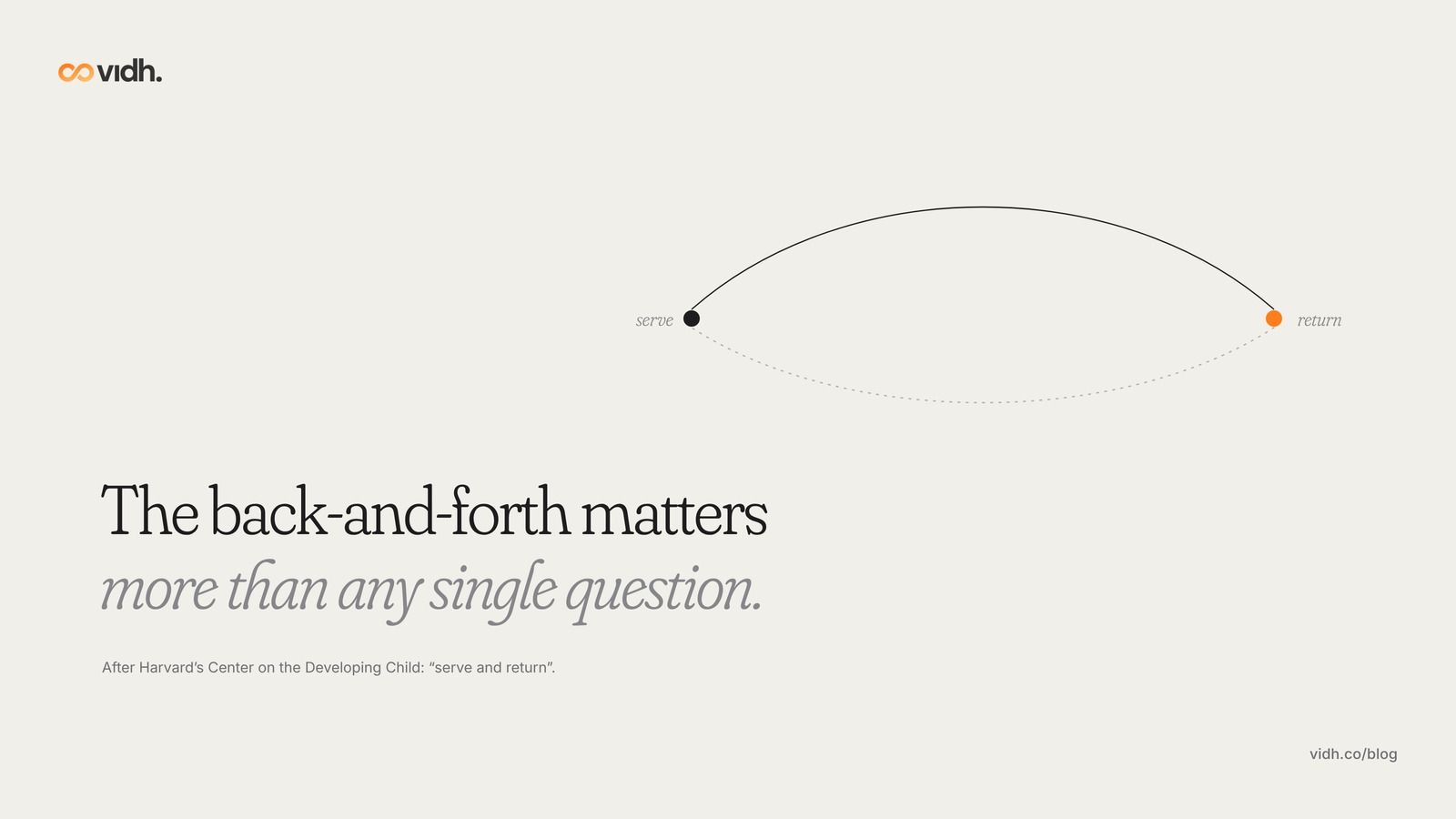
The research is clear on one big idea: the back-and-forth matters more than any single question.
- Back-and-forth builds young brains. Harvard's Center on the Developing Child describes "serve and return" interactions, responsive back-and-forth exchanges between a young child and a caring adult, as playing "a key role in shaping brain architecture" and supporting early language and social skills (Center on the Developing Child).
- Rich questions about the past help children remember and tell stories. In a New Zealand study, mothers were trained in "elaborative reminiscing" (asking open questions and adding detail when talking about shared past events) while their children were aged one and a half to two and a half. Their children later gave richer memories than children of untrained mothers, both at two and a half and at three and a half (Reese and Newcombe, Child Development, 2007).
- Talking about the day builds language. The BBC's early-years programme Tiny Happy People says talking about the past "encourages children to use longer sentences" and helps them practise the past tense and make sense of their experiences. Its first suggested question is the same as tonight's: "What's one thing that made you laugh today?" (BBC Tiny Happy People).
- With older children, sharing beats checking. A well-known study of 1,186 fourteen-year-olds and their parents in Sweden found that teenagers' own willingness to tell their parents mattered more than parents' tracking and checking. Teens who felt controlled tended to be less well adjusted (Kerr and Stattin, Developmental Psychology, 2000). In other words, the way to know more is to be someone they want to tell.
- Family meals are a good place for it. The American Academy of Pediatrics' parenting site says children who eat with their families at least three times a week enjoy physical, emotional, social and academic benefits, and advises parents to "ask open-ended questions and actively listen", give the floor "(mostly)" to children, and "avoid long lectures or pop quizzes" at the table (HealthyChildren.org).
None of this needs special training. It needs a slightly better question, and a parent who is ready to listen to the answer.
What should you ask instead of "How was school?"
Start with these four. Use one a night, not all four at once.
"What's one thing that made you laugh today?"
- Why it works: Light, easy to answer, and it starts the conversation on a good note
- What you might learn: Who your child's friends are, and what they enjoy
"What was the hardest part of your day?"
- Why it works: Tells your child that hard moments are normal and safe to share
- What you might learn: Worries, struggles with work, friendship problems
"If you were the teacher today, what would you change?"
- Why it works: Lets your child give an opinion without having to complain
- What you might learn: What they find boring, confusing or unfair, and what they enjoy
"Who did you help today?"
- Why it works: Frames school as a place of people, not just lessons, and invites a story of kindness
- What you might learn: Friendships, confidence and how they see themselves
After you ask, stop. Count to five in your head if you need to. Many children need a few seconds to find an answer, and the BBC's early-years advice is to give children "lots of time to think about the question" (BBC Tiny Happy People).
Which questions work best at each age?
Children's language and inner lives change a lot between preschool and the teenage years. These lists are a starting point; adapt them to your child.
Ages 3 to 5: concrete and simple
Young children remember people, food, sounds and play, not "learning". Keep questions short and about things they can picture.
- Who did you play with today?
- What did you eat at lunch?
- What's one thing that made you laugh today?
- What did you build, draw or make?
- Was anyone sad today? What happened?
- What was the best bit of your day, and what was the worst bit?
Ages 6 to 9: moments and people
Children this age can tell a short story if you ask about one moment.
- Who did you sit next to today?
- What was the hardest part of your day?
- What's something your teacher said that you remember?
- Did anyone do something kind today?
- What game did you play at break?
- What's one thing you learned that I might not know?
Ages 10 to 13: opinions and "what if"
Pre-teens enjoy being asked what they think. Questions that invite an opinion feel less like a check-up.
- If you were the teacher today, what would you change?
- Who did you help today, or who helped you?
- What's something that felt unfair this week?
- Which lesson went fastest today, and which went slowest?
- What's one thing you'd like to get better at?
- What can you teach me?
That last one comes from speech pathologist and Harvard lecturer Rebecca Rolland, who suggests asking children to show you how to do something you can't do yourself (Harvard Graduate School of Education).
Ages 14 and up: respect, not interrogation
Teenagers often talk most when the conversation is short, side by side and on their terms. UNICEF notes that many teens open up more on a walk, in the car or when the conversation won't last long, and that simply being around "without an agenda" matters (UNICEF Parenting).
- What was the best or hardest part of your day?
- What's everyone talking about at school this week?
- Is there anything you're looking forward to, or dreading?
- What's something you changed your mind about recently?
- What do you think about [a news story, a show or a song you both know]?
- What do you need from me this week? (another of Rolland's questions)
How do you turn dinner into a conversation, not an interview?
The question opens the door. What you do next decides whether your child walks through it.
- Put phones away, including yours. The American Academy of Pediatrics suggests putting phones and tablets in another room and turning off TVs before you sit down (HealthyChildren.org).
- Go first. Share a small moment from your own day: something funny, something hard. The American Psychological Association suggests starting conversations "by sharing what you have been thinking about", rather than beginning with a question (APA).
- Ask one question, then wait. Silence is not failure. Let it sit.
- Listen without correcting. Let your child finish before you respond. The APA notes that children may test you by sharing only a small part of what is bothering them, and may share the rest "if you are empathic and avoid teaching early in the discussion" (APA).
- Reflect, don't fix. UNICEF suggests "acting like a mirror": repeat back what your child said in different words, such as "You are not playing with your friend?" (UNICEF Parenting). The APA adds: "Try to understand their perspective before offering suggestions" (APA).
- Follow up with "what", "how" and "then what?" Short prompts like these keep the story going and, UNICEF notes, help children learn how to tell a story (UNICEF Parenting).
- Let everyone answer. When parents and siblings answer the same question, it becomes a family game rather than a spotlight on one child.
- Keep it light. Laughter is allowed. Save marks, homework and discipline for another time.
A simple way to keep it going: a question jar. Write questions on slips of paper, and let a different person pull one out each night. Understood offers a printable question-jar activity (Understood).
What if your child still says "nothing"?
Some days, "nothing" is the honest answer to "I'm tired". Try these before you give up:
- Change the moment. The APA suggests noticing when your children are most likely to talk, "for example, at bedtime, before dinner, in the car", and being fully available to listen then (APA).
- Change the question. If "best part" gets nothing, try "worst part", or "anything boring?". Some children find it easier to complain than to praise.
- Make it smaller. "Who did you sit with at lunch?" is easier than "What happened today?".
- Stay nearby. Do something together, such as cooking, walking or drawing, without asking anything. Conversation often starts when no one is waiting for it.
- Don't punish silence. If talking about school always leads to a lecture, children can learn to stop talking about school.
When should a conversation worry you?
Most quiet days are just quiet days. But keep an eye on patterns rather than single evenings: a child who used to chat and has gone silent for weeks, who avoids talking about one person or one lesson, who seems frightened of school, or whose sleep, eating or mood has changed. The APA notes that significant avoidance of parents can be a sign that a teenager is distressed (APA). If you are concerned, talk to your child's teacher or school counsellor, or to a doctor or licensed mental health professional. If you think your child is in danger, contact your local emergency services.
What can schools do to help?
Parents ask better questions when they know a little about the school day. "I heard you started fractions today; what was tricky?" goes further than "What did you learn?". Schools can help with small, regular notes home about what each class did, rather than more messages. One line about the day is often worth more than a long newsletter.
At Vidh we build tools that help schools share the school day with families. But no app replaces the question at the table, or the parent who listens to the answer.
FAQ
What can I ask instead of "How was school?"
Ask about one moment rather than the whole day. Try "What's one thing that made you laugh today?", "What was the hardest part of your day?", "If you were the teacher today, what would you change?" or "Who did you help today?". Then wait, and listen without correcting.
Why does my child always say school was "fine"?
"How was school?" asks a child to sum up a whole day in one word, often when they are tired and still unwinding. "Fine" is the easiest answer. Specific questions about one moment, asked later in the evening, usually get more.
What are good dinner conversation questions for kids?
Questions that are specific, light and open: who they played with, what made them laugh, what was hard, what they would change if they were the teacher, and who they helped. Let everyone at the table answer, including adults, so it feels like a game rather than a test.
How do I get my teenager to talk about school?
Keep questions focused and short, such as "What was the best or hardest part of your day?". Many teens talk more side by side, on a walk or in the car, than face to face. Listen more than you advise, and spend time together without an agenda.
Should I correct my child when they share something at dinner?
Not straight away. Let them finish, repeat back what you heard, and try to understand their view before offering advice. The American Psychological Association notes that children may share more of the story when parents are empathic and avoid teaching early on. Come back to the lesson later if you need to.
How often should we eat together as a family?
The American Academy of Pediatrics' parenting site says children who eat with their families at least three times a week enjoy physical, emotional, social and academic benefits. Meals can be simple, and breakfast or weekend meals count too.
Try it tonight
Pick one question. Ask it at dinner. Go first if you need to. Then listen, without correcting or advising, and see where it goes.
If you lead a school and want to talk about how families hear about the school day, book a 30-min demo or write to us at hi@vidh.co.
About Vidh: Vidh (vidh.co) is an AI platform for schools, built by Vidh Labs in Bengaluru, that keeps one shared record for every child across the school office, the classroom and home.
Sources
- Understood, "7 questions to ask your child about how school is going", updated 3 Oct 2023: https://www.understood.org/en/articles/open-ended-questions-to-ask-child-about-school
- UNICEF Parenting, "3 ways to help get your teen to open up": https://www.unicef.org/parenting/mental-health/3-ways-help-teen-open-up
- UNICEF Parenting, "How to communicate effectively with your young child": https://www.unicef.org/parenting/child-care/9-tips-for-better-communication
- Christine Carter, "How to Get Your Kid to Talk about What Happened at School", Greater Good Science Center, UC Berkeley, 19 Aug 2015: https://greatergood.berkeley.edu/article/item/how_to_get_your_kid_to_talk_about_what_happened_at_school
- Center on the Developing Child at Harvard University, "Serve and Return": https://developingchild.harvard.edu/key-concept/serve-and-return/
- Reese, E. and Newcombe, R. (2007), "Training mothers in elaborative reminiscing enhances children's autobiographical memory and narrative", Child Development 78(4), doi:10.1111/j.1467-8624.2007.01058.x: https://pubmed.ncbi.nlm.nih.gov/17650131/
- BBC Tiny Happy People, "Taking time to chat with your 3 year old": https://www.bbc.co.uk/tiny-happy-people/articles/zhynscw
- Kerr, M. and Stattin, H. (2000), "What parents know, how they know it, and several forms of adolescent adjustment: Further support for a reinterpretation of monitoring", Developmental Psychology 36(3), 366–380: https://pubmed.ncbi.nlm.nih.gov/10830980/
- HealthyChildren.org (American Academy of Pediatrics), "Benefits of Family Meals: Eat Together, Thrive Together", Natalie D. Muth, MD, updated 14 May 2024: https://www.healthychildren.org/English/family-life/family-dynamics/Pages/Family-Meals-Eat-Together-Thrive-Together.aspx
- American Psychological Association, "Talking with your children about stress": https://www.apa.org/topics/stress/talking
- American Psychological Association, "Talking to kids when they need help", updated 21 Mar 2022: https://www.apa.org/topics/parenting/helping-kids
- Rebecca Rolland, "The Art of Talking With Children", Harvard Graduate School of Education, 7 Jun 2022: https://www.gse.harvard.edu/ideas/ed-magazine/22/06/art-talking-children
All sources were opened on 27 Oct 2026 (IST).