Back
Children's Day: Let Your Child Plan the Day
5 min read
A Children's Day idea for 14 November: hand your child the plan, keep three limits (time, budget, safety), and use age menus for children aged 4 to 14.
By Bhagya · Last updated: 3 November 2026
Short answer: This Children's Day, Saturday 14 November, hand your child the plan for the day and agree to follow it. You set three limits first: how much time, how much money, and what stays safe. Inside those limits, they decide. A four-year-old picks from three options you have already approved. A twelve-year-old can plan the whole day, costs and all. If a whole day isn't possible, twenty focused minutes of their choosing still counts. Age menus, a planner card and a version for teachers are below.
Ask a seven-year-old what they would do if they were in charge for a day and the answer usually comes fast. Pancakes for lunch. The long way to the park. A board game where the grown-ups have to play properly, with no phones on the table. Most of what children want is smaller and cheaper than the outings we plan for them, and it comes with one thing an outing rarely has: it was their idea.
That is the whole idea behind this guide. Children's Day activities don't need tickets or a theme. They need an adult who says "you plan, I'll follow" and means it.
Key takeaways
- Hand over the plan, keep the limits. You decide the time, the budget and the safety rules. Your child decides everything else.
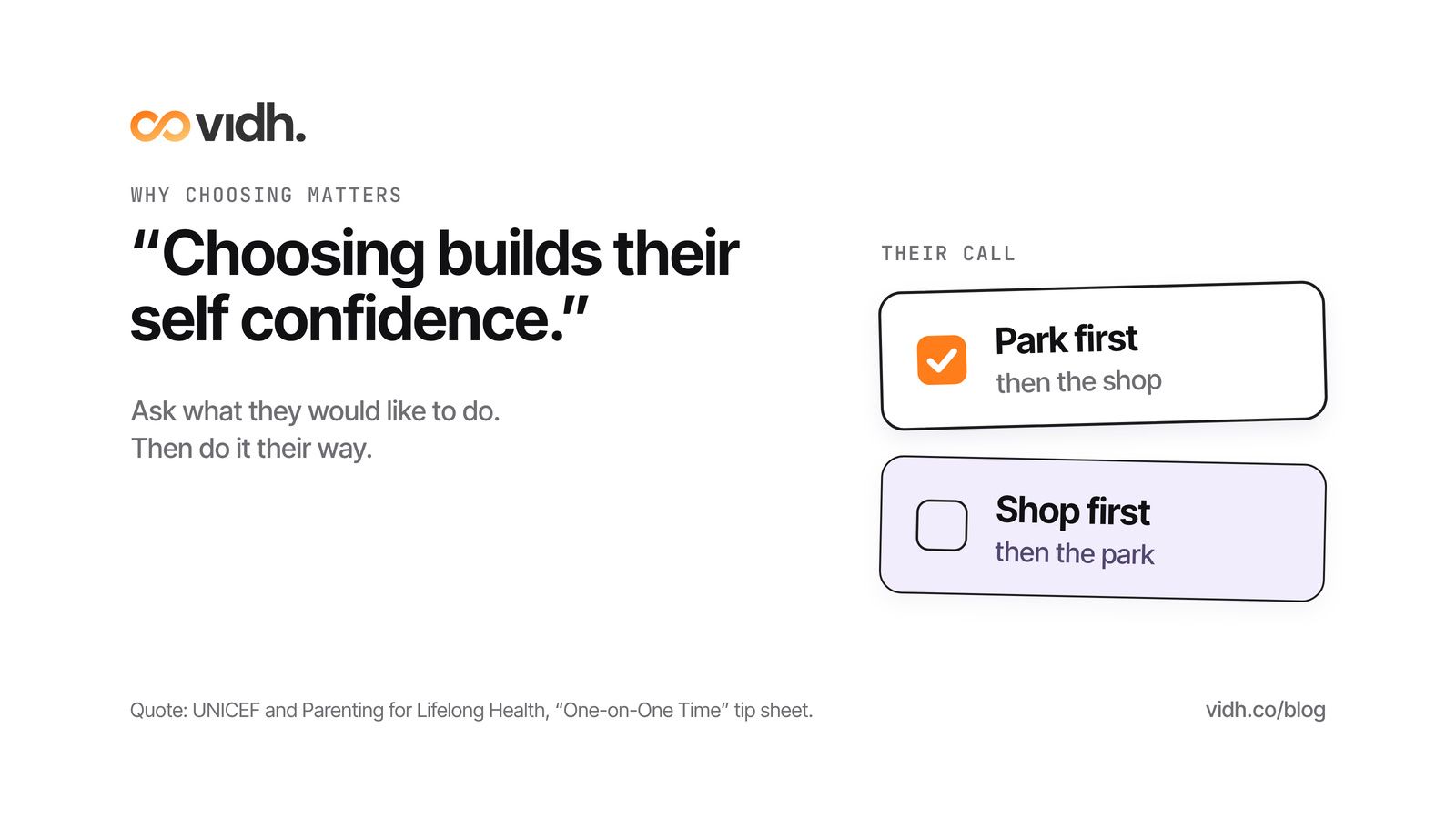
- Choosing is the point. UNICEF's one-on-one time tip sheet puts it simply: "Choosing builds their self confidence."
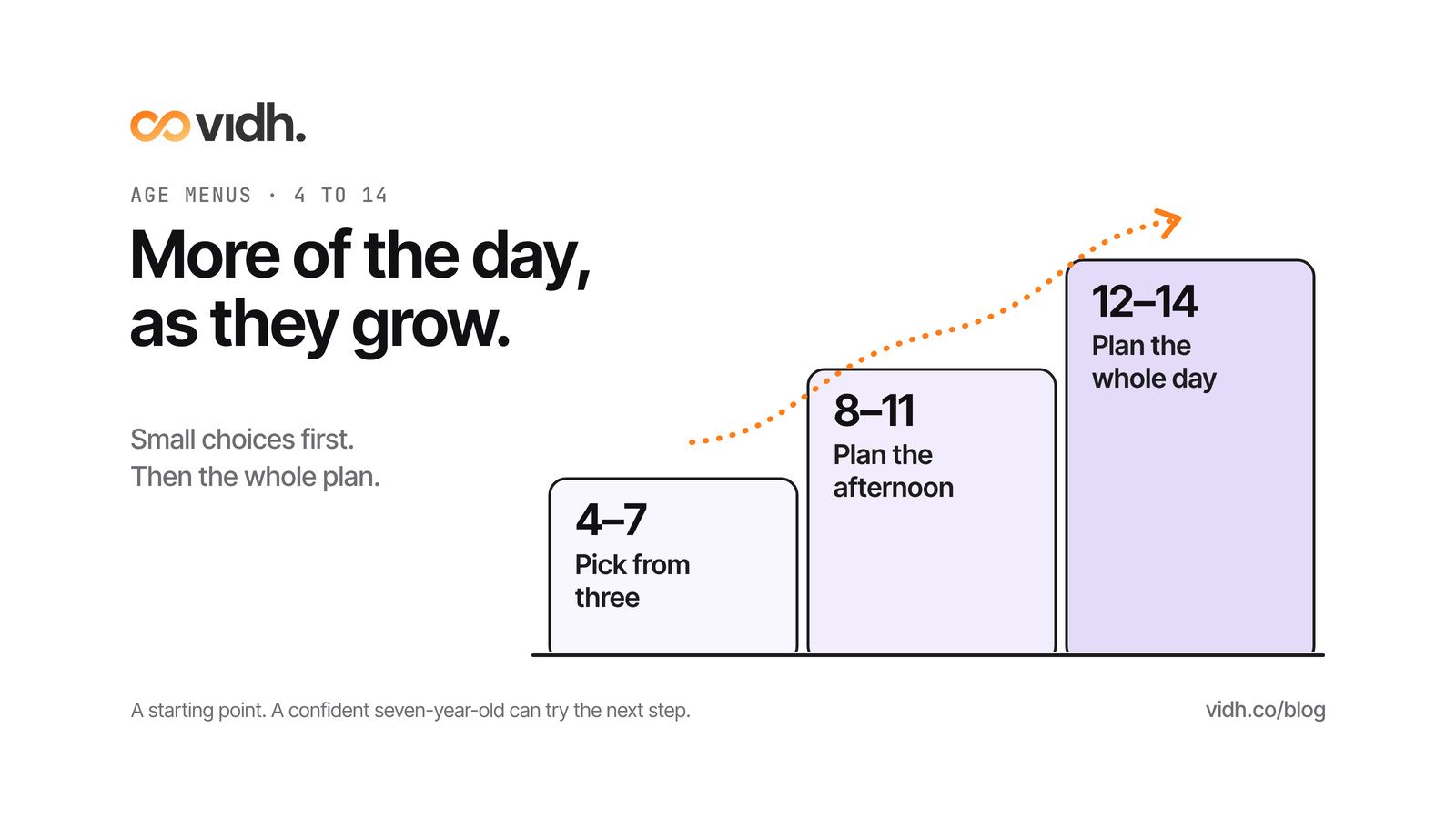
- Match the size of the plan to the age. Pick-from-three for 4–7, plan the afternoon for 8–11, plan the whole day for 12–14.
- On a busy day, twenty focused minutes works. Phone away, their choice of activity, your full attention.
- Teachers can do this too, with one period that the class plans for itself.
Hand over the plan, with three limits
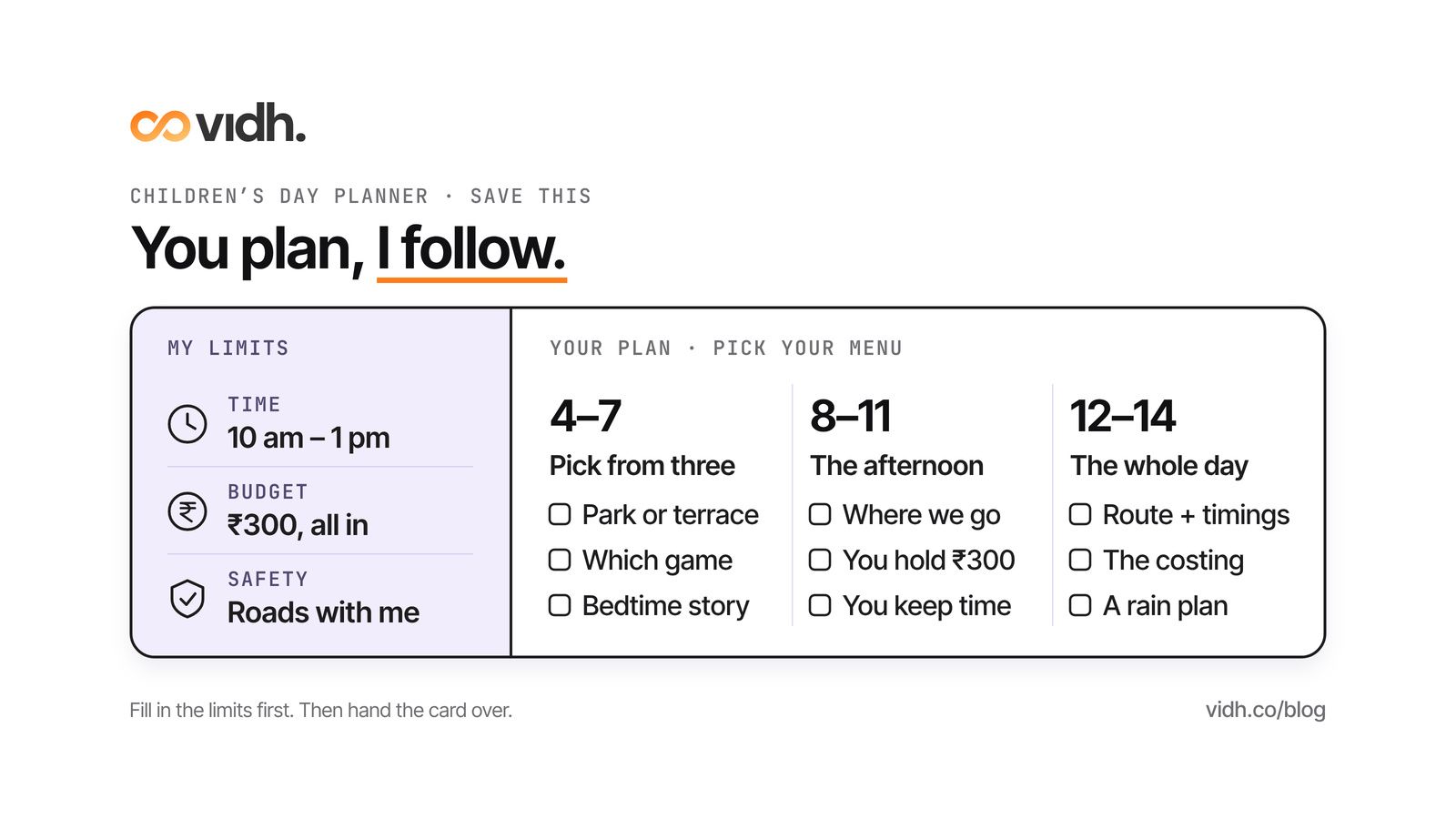
Before you hand anything over, settle three things on your own or with your partner. These are yours. Everything outside them belongs to your child.
- Time. Give a clear window: "10 am to 1 pm is yours", or "after lunch until dinner". A start and an end make the plan feel real and stop it spreading across a day you also need for other things.
- Budget. Name a number, even a small one. In many places, ₹200 to ₹500 can cover a snack, a bus ride and a small treat. Zero also works, if you say so up front. Children plan better when they know the number than when they have to guess what you'll say yes to.
- Safety. Keep this list short and non-negotiable: roads, water and the stove only with an adult; younger children stay where you can see them; nothing new online without you. This is the one area where you keep a veto.
Then say the words out loud: "You plan Children's Day. I'll follow." Write the limits on a card or a sheet of paper and stick it where they can see it while they plan. When a request lands outside the limits, point to the card instead of saying no. "That's over the budget. What would you swap?" teaches more than a flat refusal, and it keeps the plan theirs.
Following means following. If they want to eat dinner first and lunch at 4, and nobody is harmed, go with it. The day will be a little odd, and that is fine.
Why letting them choose matters
UNICEF's one-on-one time tip sheet, written with Parenting for Lifelong Health, gives parents a short instruction: "Ask your child what they would like to do." The reason it gives is just as short: "Choosing builds their self confidence." (UNICEF one-on-one time tip sheet).
There's a rights angle too. In the children's version of the UN Convention on the Rights of the Child, UNICEF explains that children have the right to give their opinions on things that affect them, and that adults should listen and take them seriously. The same text names a right to rest, relax and play (UNICEF, CRC children's version). A day planned by a child, for a child, is a small and very practical way of living both.
The listening matters as much as the plan. UNICEF's tips on talking with children start with active listening, which helps children feel heard and understood (UNICEF Parenting). When your child explains why the park has to come before the shop, hear the reason out, even if you'd have done it the other way round. For more ways to get children talking, try our dinner questions that work better than "How was school?".
Children's Day activities by age: three planning menus
How much of the day you hand over depends on age. These menus are starting points. A confident seven-year-old can try the 8–11 menu, and a tired thirteen-year-old may only want to choose lunch.
Ages 4–7: pick from three
At this age, a whole day is a big, abstract thing. Offer small, concrete choices you have already approved, and let them choose between three.
- Breakfast: dosa, poha or paratha. They choose, and they help stir or sprinkle.
- The morning: the park, the terrace with chalk, or a blanket fort indoors.
- The game: hide and seek, a board game, or a dance-off to their songs.
- The story: they pick the book, and you do the voices.
- One "boss" job: they hold the timer, choose the music, or decide who sits where at lunch.
Three options is a sweet spot. Two feels like a test and ten feels like homework.
Ages 8–11: plan the afternoon
Now they can plan a block of time with an order to it. Give them a sheet of paper with three hours marked out and the budget written at the top.
- The outing: somewhere within walking or auto distance: a park, a library, a market, a friend's building.
- The money: they carry the budget and pay at the shop, with you nearby. Change is counted at home.
- The food: they choose a snack or plan one simple dish to cook with you, and make the shopping list.
- The order: they write out what happens first, second and third, and they keep time.
Expect a plan that runs long or short. Let it. Talking afterwards about what took longer than they expected is half of the learning.
Ages 12–14: plan the whole day
Young teenagers can plan a real day, with logistics. Give them the time window, the budget and the safety rules, and get out of the way.
- The route and timings: where you go, how you get there, and what time you need to leave.
- The costing: a written budget that adds up, with a little spare for surprises.
- The checks: opening hours, tickets or entry fees, and the weather. If something needs booking, they draft it and you confirm it.
- The plan B: what happens if it rains or a place is shut.
- Someone else: one thing in the day for a younger sibling or a grandparent.
A teenager who plans the day well has done real work: they've estimated, negotiated and taken responsibility. Tell them which part of their plan you enjoyed most.
Short on time: twenty focused minutes
Children's Day falls on a Saturday this year. For many families that means a school function in the morning, a working parent, or a house full of relatives. A whole day may not be realistic, and that's all right.
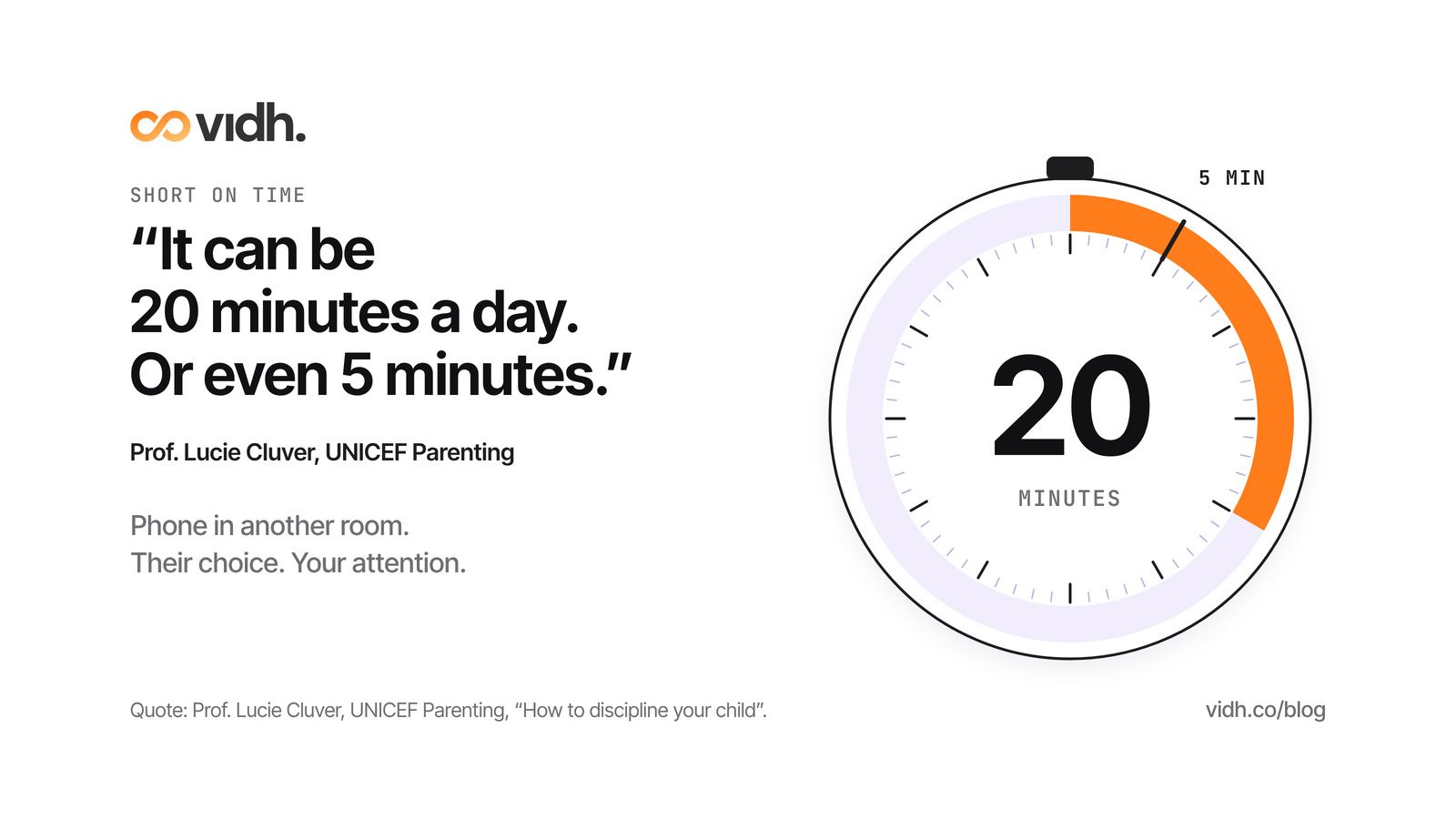
UNICEF's tip sheet on one-on-one time says it can be "for just 20 minutes, or longer – it's up to us" (UNICEF one-on-one time tip sheet). In UNICEF's parenting guidance on discipline, Professor Lucie Cluver goes further: "It can be 20 minutes a day. Or even 5 minutes." (UNICEF Parenting).
What she stresses is attention, not length: "What's really important is that you focus on your child." She describes turning off the TV and the phone and getting down to their level. So on a busy 14 November:
- Set a timer for 20 minutes and tell your child it's theirs.
- Put your phone in another room rather than face-down on the table.
- Let them choose the activity, and follow their lead inside it.
- When the timer goes, say what you enjoyed. If you can, offer the same 20 minutes again on Sunday.
Twenty minutes where you follow their plan can feel bigger to a child than a whole outing where they trail behind yours.
For teachers: a student-voice period
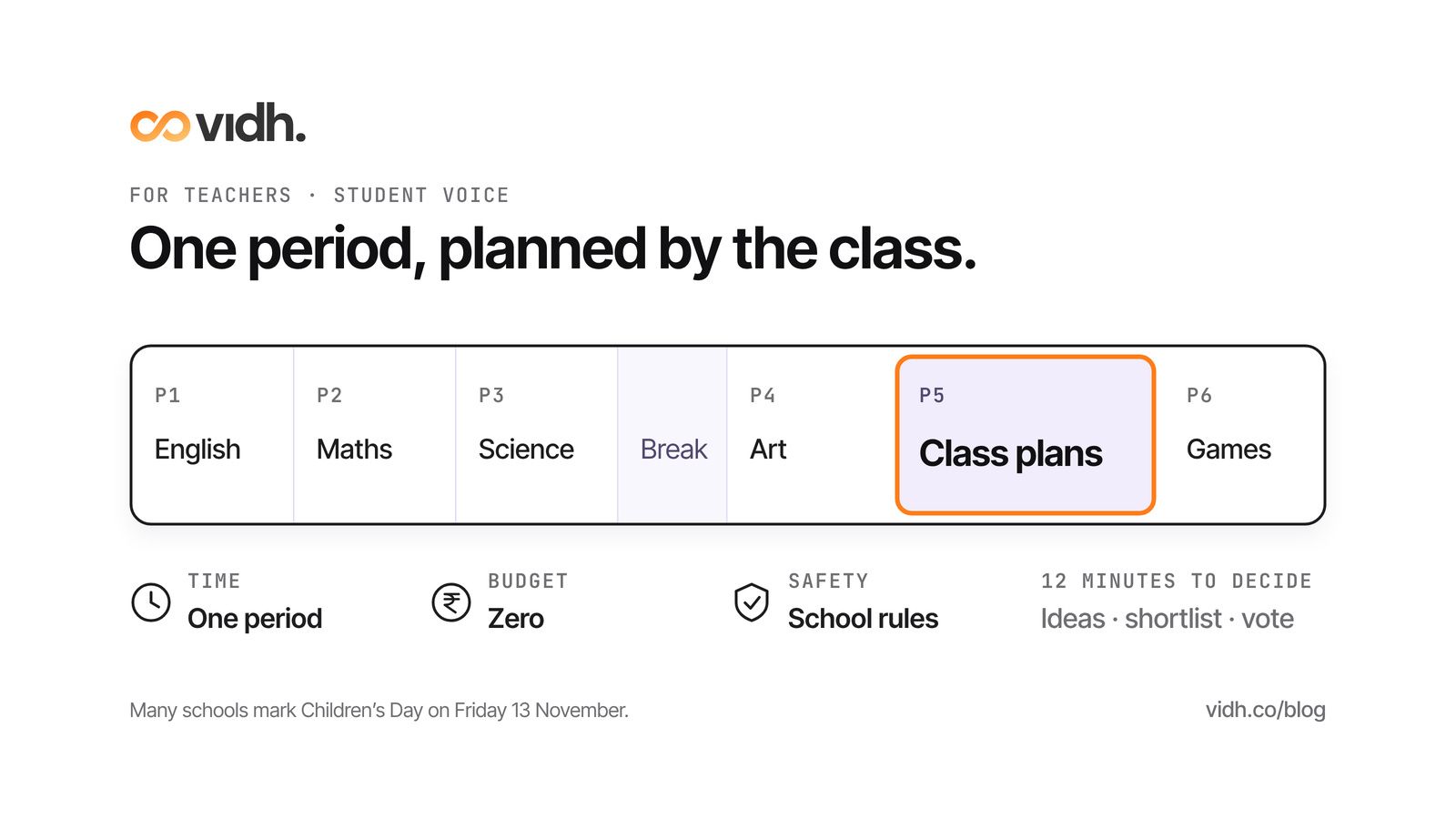
Many schools mark Children's Day on Friday 13 November, or with a function on the day itself. Alongside the cultural programme, try handing one period over to the class to plan, using the same three limits.
- Time: one period, start and end on the timetable.
- Budget: zero, or whatever is already in the classroom.
- Safety: school rules apply, and everyone stays in the room or on the agreed ground.
Give the class five minutes to suggest ideas, five to shortlist, and two to vote. A small student team of three runs the period. Your job is to keep time and step in only for safety. Popular choices tend to be a class quiz written by students, a show-and-tell, a group game, a reading circle, or students teaching a short lesson on something they love.
Afterwards, ask two questions: what worked, and what they would change next time. Then use one of their answers in a lesson the following week, and tell them you did. That last step is what turns a fun period into student voice.
Your Children's Day planning checklist
- Choose the time window: a full day, an afternoon, or twenty minutes.
- Set the budget, and say the number out loud.
- Agree the safety rules. Keep them short.
- Write all three on a card where your child can see it.
- Hand over the plan by Wednesday 11 November so there is time to think.
- Help with logistics only when asked, and only inside the limits.
- On the day, follow. Phone away.
- In the evening, ask what their favourite part was, and tell them yours.
FAQ
What are some easy Children's Day activities at home?
Let your child choose from three simple options you've approved: a blanket fort, cooking one dish together, a board game, chalk on the terrace or a dance-off to their music. The activity matters less than the fact that they picked it.
What age can a child plan Children's Day?
From about four, a child can choose between three options. By eight to eleven, most can plan an afternoon with a budget. By twelve to fourteen, many can plan a whole day, including route, timings and costs.
What if my child wants screens all day?
Make screen time one of your limits before you hand over the plan, for example "up to one hour of screens inside the plan". Then let them decide when that hour happens and what they watch or play, within your usual rules.
How much should I budget for Children's Day?
Whatever suits your family. ₹200 to ₹500 can cover a snack, a short trip and a small treat in many places, and zero also works if you say so up front. What helps is naming a clear number before your child plans.
My child has a school function on 14 November. Can we still do this?
Yes. Give them the afternoon or evening instead, or twenty focused minutes of their choice. You can also move the plan to Sunday 15 November and keep the same three limits.
What if siblings want different plans?
Split the time. Each child plans one block, or they take turns choosing each activity. An older child can also be asked to include one thing for a younger sibling in their plan.
Save this, or send it to a parent
Save the planner card for 14 November, or send this to a parent in your class group who is still deciding what to do on Children's Day. For more short, practical guides for parents, follow Vidh on Instagram.
About Vidh: Vidh (vidh.co) is an AI platform for schools, built by Vidh Labs, that keeps one shared record for every child across the school office, the classroom and home. Questions or ideas for a guide: hi@vidh.co.
Sources
- UNICEF, "Convention on the Rights of the Child: the children's version": https://www.unicef.org/child-rights-convention/convention-text-childrens-version
- UNICEF and Parenting for Lifelong Health, "One-on-One Time" tip sheet (PDF): https://www.unicef.org/media/66146/file
- UNICEF Parenting, "How to discipline your child the smart and healthy way": https://www.unicef.org/parenting/child-care/how-discipline-your-child-smart-and-healthy-way
- UNICEF Parenting, "9 tips for better communication with your child": https://www.unicef.org/parenting/child-care/9-tips-for-better-communication
All four sources were re-read on 2 Nov 2026 (IST) and returned HTTP 200. Quoted phrases are verbatim from the live pages; the children's version of the CRC (1) and the communication tips (4) are paraphrased only.