Back
Class WhatsApp Group Rules for UK Parents (Free Template)
5 min read
UK Year-group WhatsApp house rules from published school codes: keep it to school business, no child discussions in-chat, and a free pin template.
By Bhagya, Vidh · Last updated: 9 November 2026
Class WhatsApp groups help UK parents and carers share kit days, trips and non-uniform reminders. At Vidh we collect house rules from published school codes so Year-group chats stay useful without turning into a complaints thread.
Short answer: Keep Year-group WhatsApp to school logistics. Do not discuss individual children or staff. Take worries to the class teacher or school office. Follow your school's photo guidance. Move one-to-one chats to a private message.
What is a class WhatsApp group in a UK school?
Many UK primary classes and Year groups run parent-and-carer chats that operate independently of the school. Schools such as Goring CE Primary (policy adopted September 2026) and Grove Primary say the school does not post in those groups. Messages come from parents in a personal capacity.
That is why schools publish a code of conduct: the chat is useful for logistics, and risky when it becomes a forum for grievances. For a broader school policy template that also covers school-run groups, see School WhatsApp Group Rules for Parents and Teachers.
Why schools publish WhatsApp house rules
Parentkind's School Complaints Report 2025 (Censuswide survey of 2,000 UK parents, fieldwork 5 to 10 June 2025) found that 62% of parents are in a parent-run class or school message group, and that 39% of those members see complaints about teachers at least four times a month.
UK school codes we opened for this guide (Goring CE Primary, Grove Primary, Birches First School, Ashurst Primary, and Wimbledon Chase Primary) keep returning to the same practical lines.
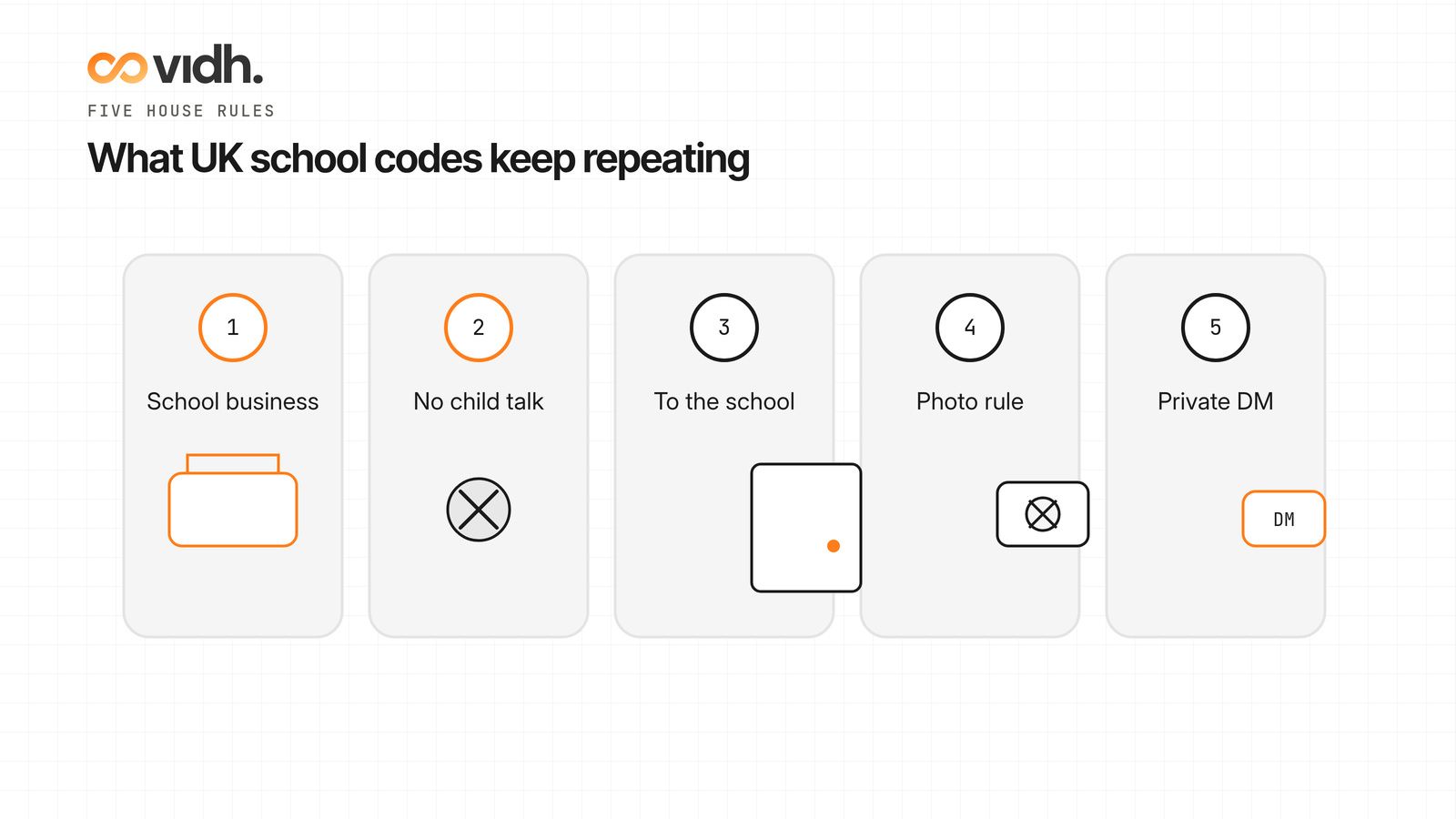
5 house rules UK schools ask parents to follow
These are school-specific published codes, not national law. There is no DfE WhatsApp ban in the sources we checked. Always follow your own school's written guidance if it differs.
- Keep it to school business. What it means: Kit, trips, non-uniform day, reading-record reminders, volunteering asks. Do this instead: Check the newsletter or school app before posting a question the school already answered.
- Never discuss another child. What it means: No names, behaviour stories, marks chatter, or sensitive family detail. Do this instead: If something concerns a child, contact the class teacher or office privately.
- Worries go to school, not the group. What it means: No grievances about teachers, staff, pupils or other parents in the chat. Do this instead: Speak with the class teacher first; escalate through the school's channels.
- Follow your school's photo guidance. What it means: Wimbledon Chase's code bans photos and names of children in the group; other schools word the photo rule differently. Do this instead: Ask the school before sharing any image that includes other children.
- One-to-one stays one-to-one. What it means: Private conversations do not belong in the Year-group thread. Do this instead: Use a direct message; leave the group for whole-Year logistics.
Wimbledon Chase: avoid messaging very early or late at night. Follow your own school's code.
Copy-paste template for a Year-group chat admin
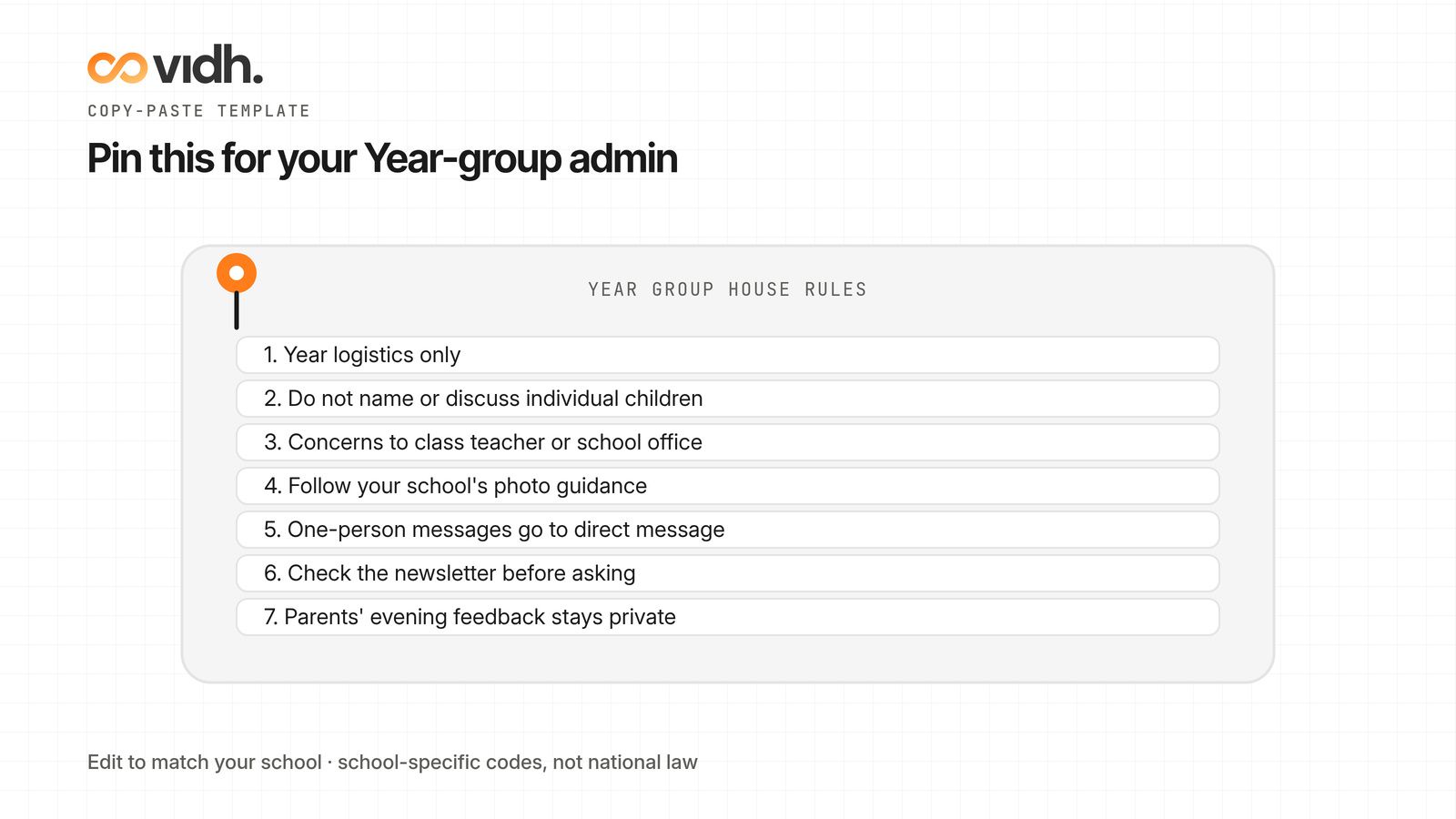
Pin this (edit to match your school):
- This chat is for Year logistics only (kit, trips, non-uniform day, volunteering).
- Do not name or discuss individual children, staff or families.
- Concerns go to the class teacher or school office, not this group.
- Follow your school's photo guidance; when unsure, do not post images of other people's children.
- If a message is for one person, send a direct message.
- Check the school newsletter or app before asking a question already answered.
- Parents' evening feedback stays private between you and the teacher.
Where you are
England and UK schools: Use your school's own WhatsApp or social-media code if it has one. The examples above are real school documents, not a government template.
If your school has no written code yet: Offer the pin template to the Year-group admin and ask the school office whether they want a short parent note on the website.
For schools
Say the expectation before the first parents' evening or nativity season. Publish a one-page code, name the class teacher and office route for concerns, and state your photo rule in plain English.
If your school already uses one-to-one parent replies, keep the group for logistics and use a private thread for a named child. Keep those channels separate.
Questions parents ask
Are class WhatsApp groups run by the school?
Often no. Several UK school codes say the groups operate independently and that the school does not post there.
Can I complain about a teacher in the Year-group chat?
School codes we read say no. Take concerns to the class teacher or school office so the conversation can stay confidential.
Can I post a photo from sports day?
Only if it matches your school's photo guidance and does not identify other children without the right permission. Wimbledon Chase's code bans photos and names of children in the group entirely.
What if someone breaks the rules?
Contact the group admin and, if needed, the school senior leadership team. Schools list follow-up steps in their codes (warning, meeting, or further action).
About Vidh
Vidh (vidh.co) is an AI-powered platform for schools, built by Vidh Labs, that connects management, teachers, parents and students around each child.
Questions: hi@vidh.co