Back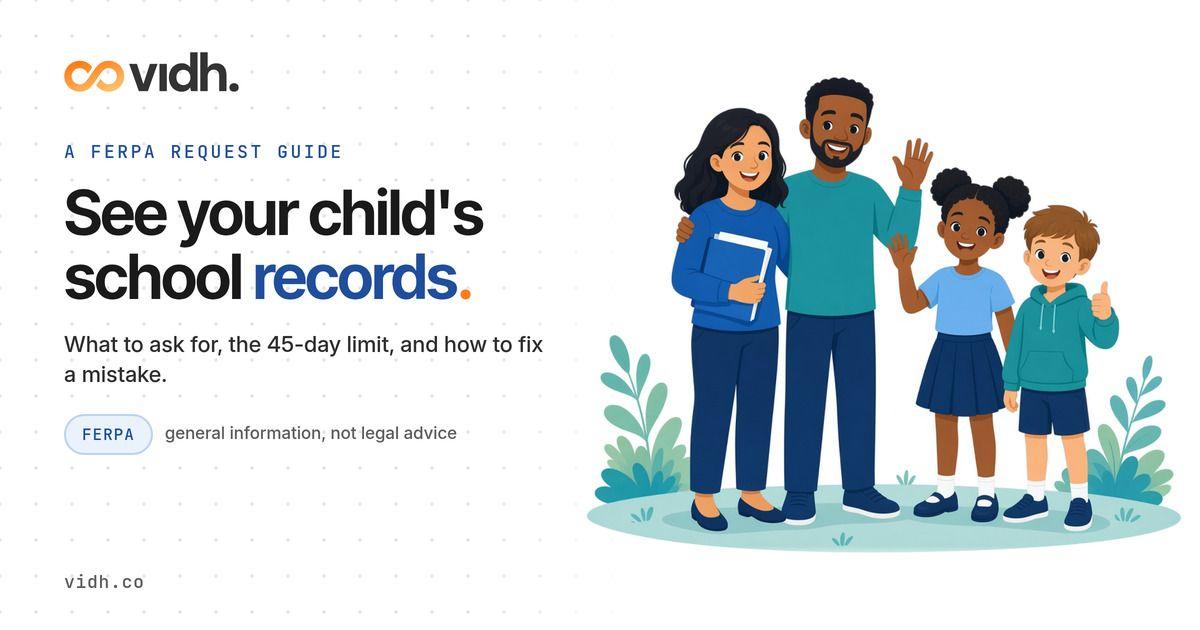
See Your Child's School Records: A FERPA Request Guide
5 min read
How to request your child's school records under FERPA: what counts, the 45-day limit, fees, fixing errors, and a request letter you can copy.
By Bhagya, Vidh
Short answer: Under FERPA, parents can ask to see their child's education records. The school must give access within a reasonable time, no more than 45 days after receiving the request. It cannot charge a search fee, though copies may cost money. If a record looks inaccurate or misleading, ask in writing to amend it, and request a hearing if refused.
This guide is general information for families, not legal advice.
Some districts close their first grading period around now, and a report card often raises a question the grade cannot answer: what is behind it? Here is how to ask for the record, what to expect, and what to do if something is wrong.
Can I see my child's school records?
Yes. The U.S. Department of Education's Student Privacy Policy Office describes FERPA (the Family Educational Rights and Privacy Act) as "a federal law that affords parents the right to have access to their children's education records, the right to seek to have the records amended, and the right to have some control over the disclosure of personally identifiable information from the education records."
Under the FERPA regulations, 34 CFR 99.10 says "a parent or eligible student must be given the opportunity to inspect and review the student's education records."
What counts as an "education record"?
Under 34 CFR 99.3, education records are records that are "directly related to a student" and "maintained by an educational agency or institution or by a party acting for the agency or institution."
The Department's own FAQ gives examples: "grades, transcripts, class lists, student course schedules, health records (at the K-12 level), student financial information (at the postsecondary level), and student discipline files." Records can be in any format, including handwriting, print and email.
Some things are not education records under 99.3, for example a teacher's private memory-aid notes that are not shared, and grades on peer-graded papers before a teacher collects and records them.
If a record also includes information about other students, such as a class list, 99.12 says you may see or be told only the part about your own child.
How do I ask, and what should the request say?
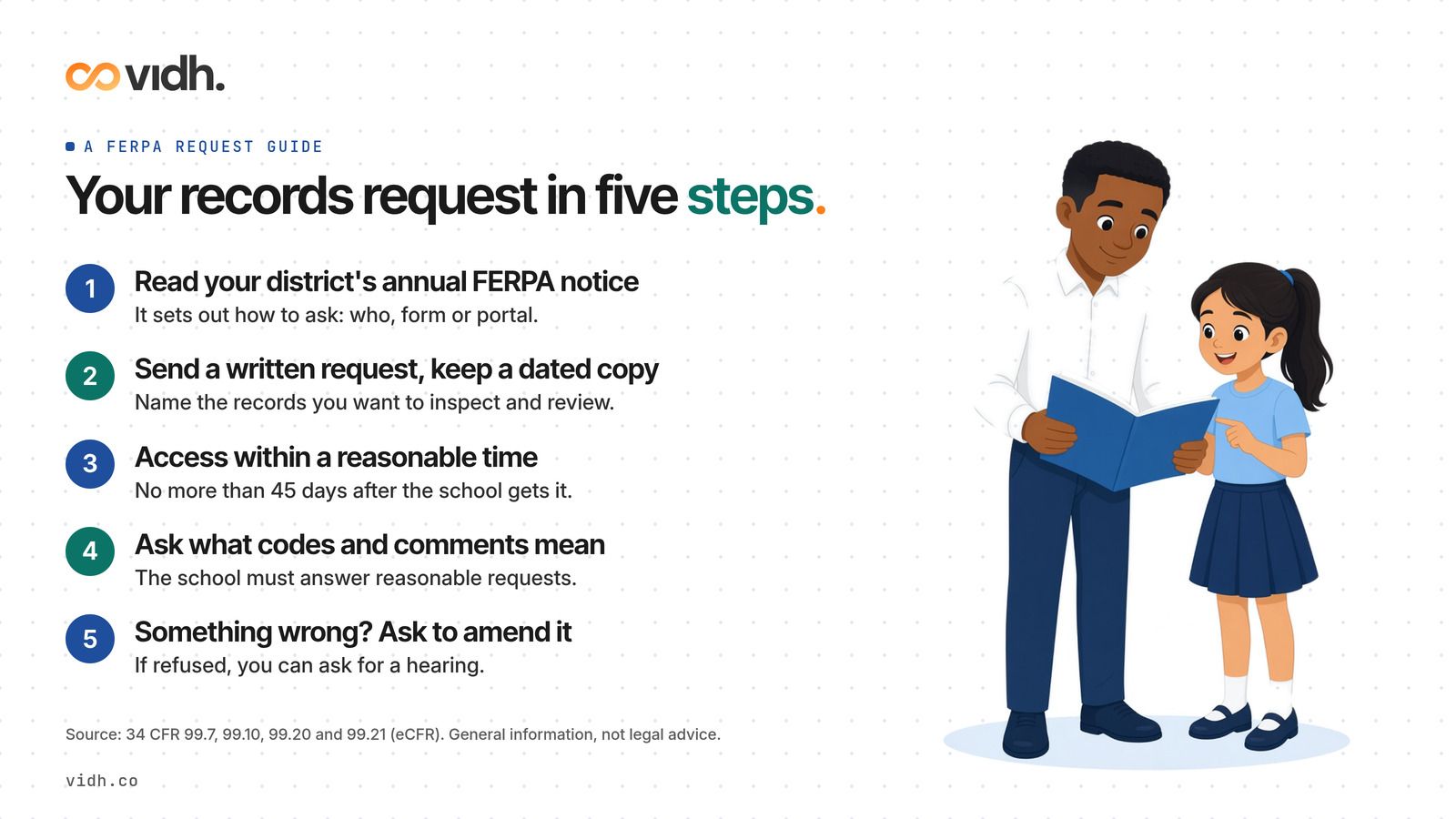
Start with your district's annual FERPA notice. Under 34 CFR 99.7, schools must notify parents each year of their rights, and the notice must include "the procedure for exercising the right to inspect and review education records." That is where you will find who to write to and whether there is a form or portal.
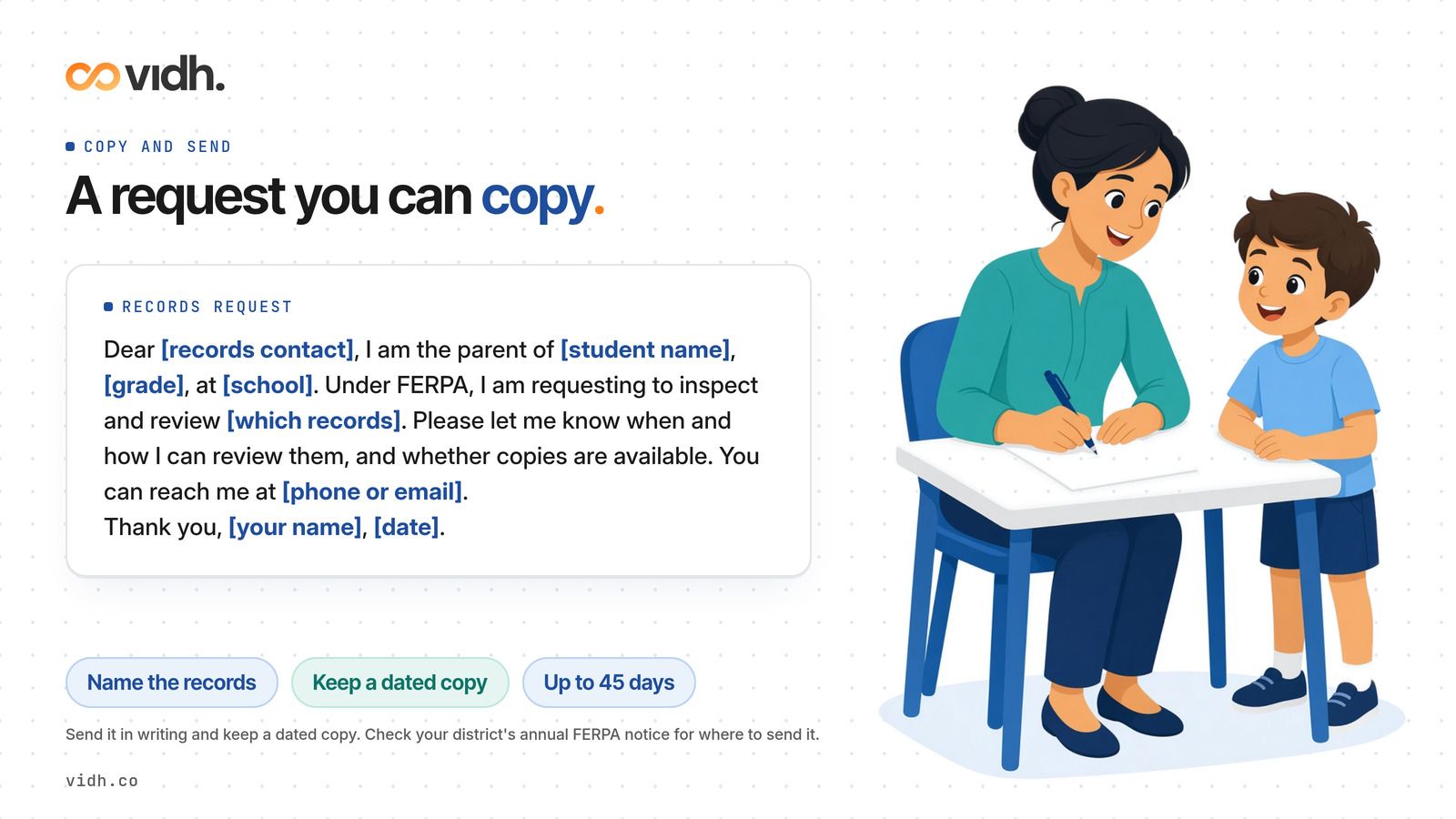
Then put your request in writing and keep a dated copy. A short request is enough:
Dear [records contact], I am the parent of [student name], [grade], at [school]. Under FERPA, I am requesting to inspect and review [which records, for example: grades and course schedule for this school year, health records, discipline file]. Please let me know when and how I can review them, and whether copies are available. You can reach me at [phone or email]. Thank you, [your name], [date].
Naming specific records makes the request easier for the school to find and easier for you to check.
How long does the school have to respond?
Section 99.10 says the school "shall comply with a request for access to records within a reasonable period of time, but not more than 45 days after it has received the request." Count from the day the school received it, which is why the dated copy matters.
While a request is open, the school "shall not destroy any education records if there is an outstanding request to inspect and review the records." The school also "shall respond to reasonable requests for explanations and interpretations of the records," so ask about any code or comment that does not make sense.
Can the school charge me?
Under 34 CFR 99.11, a school "may not charge a fee to search for or to retrieve the education records of a student." It may charge for copies, unless the fee "effectively prevents" you from exercising your right to inspect and review. The regulation does not set an amount, so check your district's notice.
What if something in the record is wrong?
Under 34 CFR 99.20, if you believe a record contains information that is "inaccurate, misleading, or in violation of the student's rights of privacy," you may ask the school to amend it. The school "shall decide whether to amend the record as requested within a reasonable time."
If it decides not to amend, it must tell you its decision and your right to a hearing. Under 99.21, if the hearing still goes against you, the school must tell you of your right to place a statement in the record "commenting on the contested information," and keep that statement with the record.
Put the amendment request in writing: quote the exact entry, say why it is wrong, and attach anything that shows it.
What happens when my child turns 18?
The Department explains: "When a student turns 18 years old, or enters a postsecondary institution at any age, the rights under FERPA transfer from the parents to the student." From then on, the student is the "eligible student" who makes the request.
What if the school does not respond?
Talk to the school first. The Student Privacy Policy Office says you are "strongly encouraged (but not required)" to contact your school or district to try to resolve the concern before filing a complaint. If that does not work, you can file a complaint with SPPO. A timely complaint is one submitted "within 180 days of the date of the alleged violation or of the date that you knew or reasonably should have known of the alleged violation."
Taking the records into a meeting? Our three questions for a short parent-teacher conference turn what you read into one next step. If the record explains a low grade, see what to say after a low report card.
Quick answers
Does FERPA apply to every school?
Under 34 CFR 99.1, the rules apply to schools and education agencies that receive funds under a program run by the U.S. Secretary of Education.
Does the school have to send me copies?
The federal right is to inspect and review. Under 99.10(d), the school must give you a copy or make other arrangements when circumstances effectively prevent you from inspecting and reviewing the records.
Can I see a teacher's private notes?
Not under FERPA if they are sole-possession notes: kept only by the person who made them, used as a memory aid and not shared with anyone except a temporary substitute (99.3).
Where do I find my district's process?
In its annual FERPA notice, which 99.7 says must include the procedure for inspecting and reviewing records.
For schools: make records requests easy
- Name one records contact in your annual FERPA notice, with an email address that is checked.
- Reply to every request with a short acknowledgment that gives the date received.
- Put the 45-day ceiling on a calendar the day a request arrives.
- Offer a time to review the records together, so staff can explain codes and comments.
On who can see student data in the tools you use, see our data security questions for school edtech.
Where Vidh fits
Vidh connects management, teachers, parents and students around each child, and clear written communication between home and school makes requests like this easier. For your rights, rely on your district's annual notice and the Department of Education's guidance.
About Vidh
Vidh (vidh.co) is an AI-powered platform for schools, built by Vidh Labs, that connects management, teachers, parents and students around each child. Questions? Write to hi@vidh.co.