Back
Low Report Card? 5 Phrases That Don't Crush Them
5 min read
What to say after a low report card: five phrases that react to effort and the next step, not the number, and one small plan for the next test.
By Bhagya · Last updated: 1 November 2026
Short answer: After a low report card, react to the effort and the next step, not to the number, and never to what you think the number says about who your child is. Name the feeling you can see. Look at the paper together, not at anyone else's. Then make one small plan for the next test. The five swaps below show what that sounds like at the dining table.
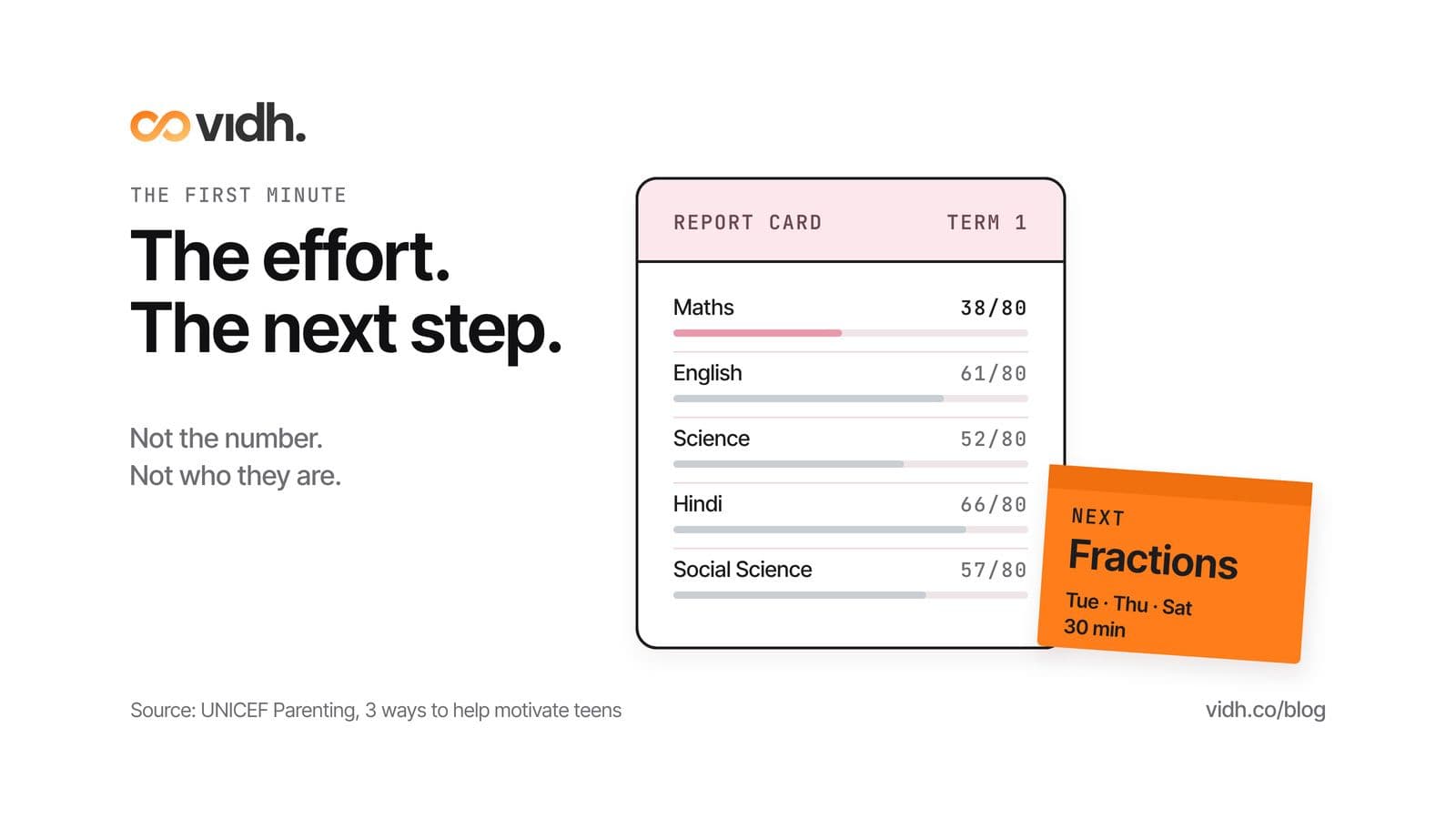
The report card arrives in a plastic folder, or as a PDF in the class WhatsApp group at 9 pm. Maths: 38 out of 80. Before you have finished reading the line, your child is already reading your face. Whatever you say in the next minute is the part they will carry into the next test, long after the number itself has faded.
Most of us know the lines we grew up with. "Why not more?" "Look at Sharma ji's son." "No phone until this improves." They come out fast because they were said to us. None of them is cruel in intent. Each one, though, moves the conversation away from the paper and onto the child, and a child who feels judged stops telling you what went wrong.
Key takeaways
- React to effort and the next step, not to the number or to labels like "weak" or "not a maths person".
- Only praise effort you actually saw. UNICEF says praise should be sincere. If you did not see the effort, skip the praise and go straight to the next step.
- Name the feeling first. "You look disappointed" opens a conversation that "What happened?" in a sharp voice closes.
- Compare the paper with last term's paper, never with a sibling's, a cousin's or a classmate's.
- Make one small plan together: one topic, a few short sessions a week, one day to check in.
The first minute
Read the whole card before you say anything, including the teacher's remarks. Remarks often tell you more than marks: "careless errors", "incomplete homework" and "finds word problems hard" each point to a different next step.
Then, before any question, say something true about how your child seems to feel. UNICEF's advice on communicating with children is to help them put words to feelings such as proud, sad, helpless or embarrassed (UNICEF). A child who hears their feeling named feels seen rather than judged, and will tell you much more about what happened in the exam hall.
5 things to stop saying, and what to say instead
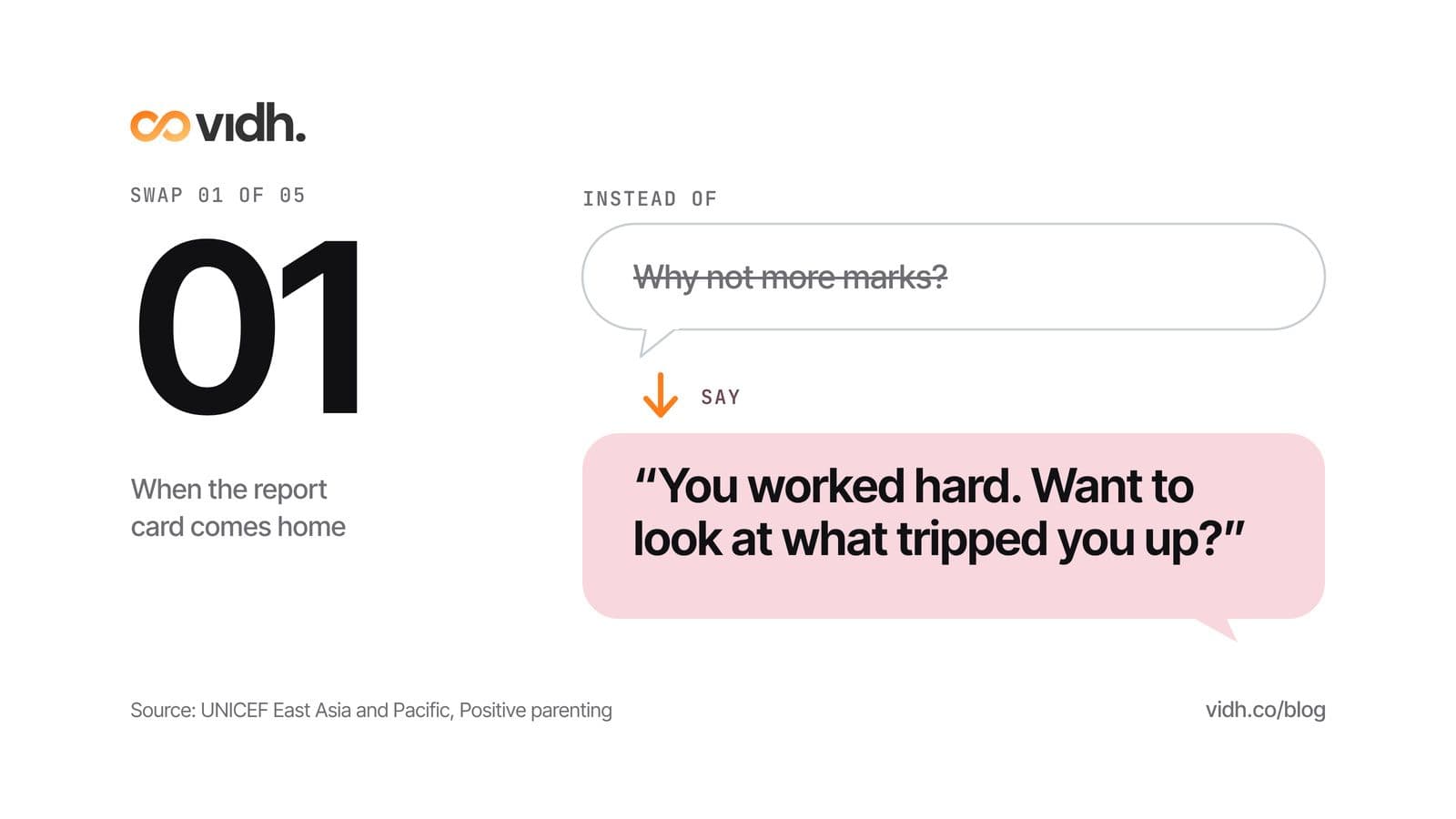
1. Instead of "Why not more marks?", say "You worked hard. Want to look at what tripped you up?"
UNICEF's positive-parenting examples include exactly this moment. A child brings home 90% and the parent says, "Why not 100%?" UNICEF notes that this "ignores the child's effort and can make them feel their best isn't good enough, even when they've tried hard". The alternative it gives: "Great job! You worked really hard. Do you want to look at the questions you missed together so we can learn for next time?" (UNICEF).
If that is the risk with 90%, it is far bigger with 38. Keep the shape and drop "Great job" if it would not be honest: "You worked hard. Want to look at what tripped you up?" If you did not see much work this term, leave out the first sentence. The second one still stands.
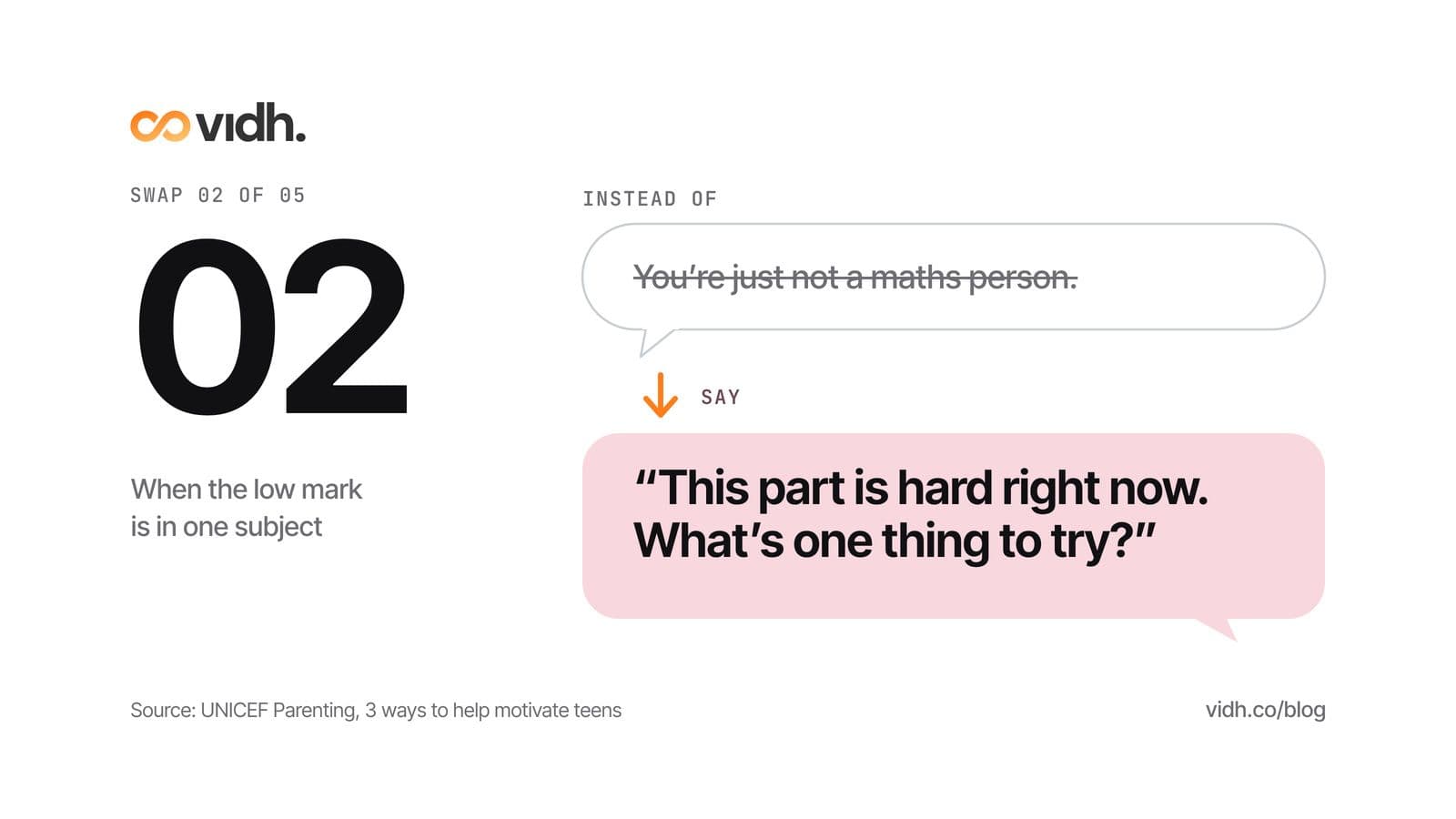
2. Instead of "You're just not a maths person", say "This part is hard right now. What's one thing to try?"
Labels stick. "Not a maths person", "weak in science" or "too lazy for studies" tell a child the problem is who they are, which is the one thing they cannot change before the next test. UNICEF's advice for motivating teenagers is to praise effort and "celebrate effort, not talent". It suggests phrases like "I see how hard you worked" or "I see how much care you put into this" (UNICEF).
"This part is hard right now" does three useful things in six words. It agrees with your child that it is hard. It limits the problem to "this part". And "right now" quietly says it will not always be hard.
3. Instead of "Your cousin got 90", say "Let's look at your paper, not anyone else's."
Comparison comes easily at family gatherings, and early November, with relatives visiting for Diwali, is when it comes most easily. A cousin's 90 tells your child nothing about which questions they lost marks on or why. Their own answer sheet does.
The only fair comparison is with their own last test. "Last time you lost marks on long answers. This time it was the graphs" is useful. It turns a verdict into a direction. If a relative raises marks at the table, you can change the subject for your child: "We're working on it together."
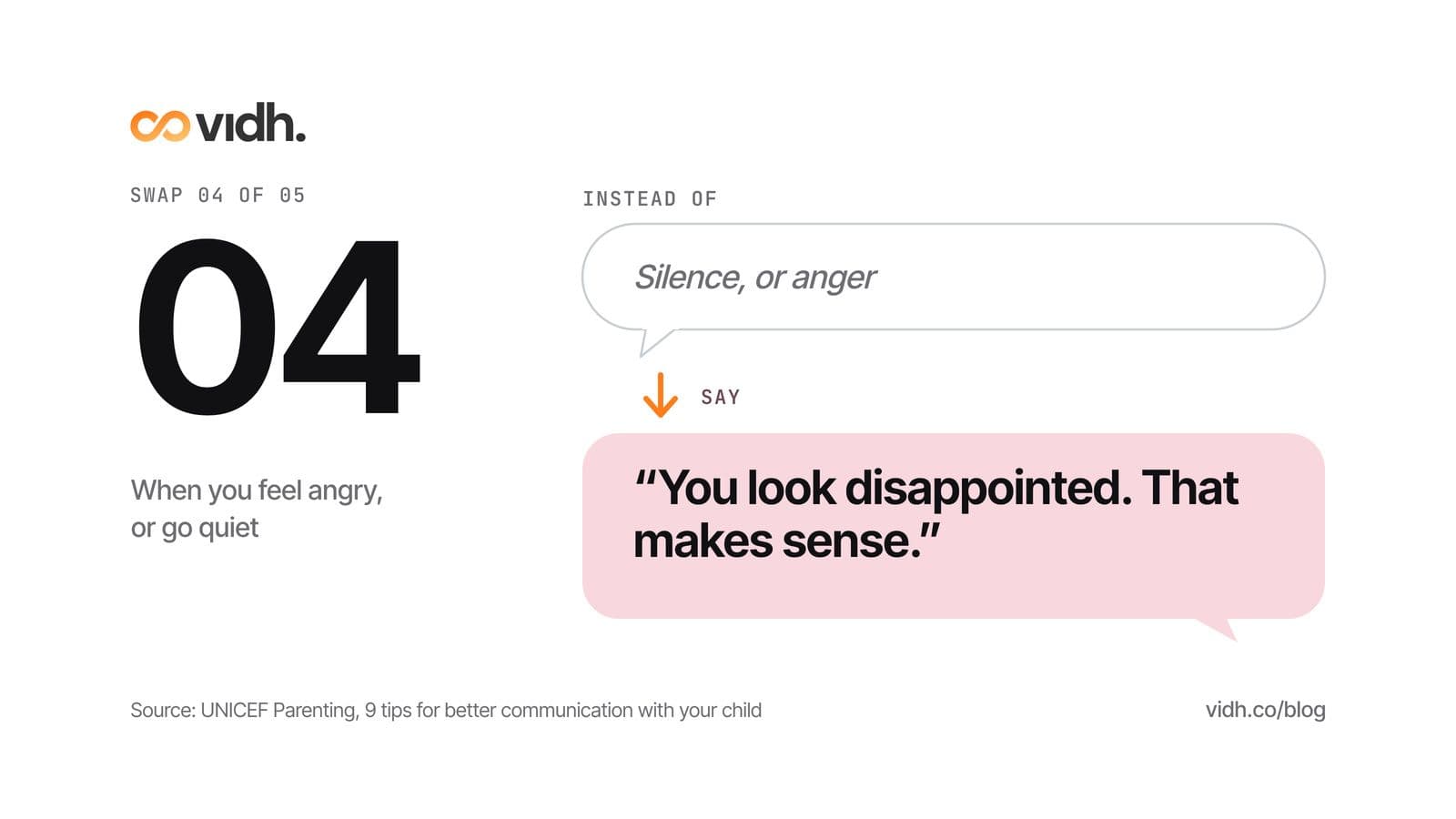
4. Instead of silence or anger, say "You look disappointed. That makes sense."
Some of us shout. Many more of us go quiet, put the card down and leave the room, which a child can find worse. Either way, the child is left alone with a feeling they cannot yet put into words.
Naming the feeling helps them do it. "You look disappointed. That makes sense" shows that you have noticed, and that the feeling is allowed. Once the feeling has a name, the next move is a specific "noticing" statement. UNICEF suggests replacing a vague "good job!" with something more specific, such as "I noticed that you put all of your toys away after playtime" (UNICEF). For a report card, that might be: "I noticed you did your science revision before dinner most evenings."
5. Instead of "No phone till marks go up", say "Let's make a small plan together for the next test."
A ban feels like action, but it does not tell your child what to do differently on Monday. It also turns the marks into a fight about the phone. UNICEF's positive-parenting examples warn against responses that use "punishment instead of teaching" (UNICEF).
If screens really are eating study time, put that inside the plan rather than above it. "Phone goes in the kitchen during your 30 minutes" is a rule your child helped to make. "No phone until marks go up" is a sentence with no end date.
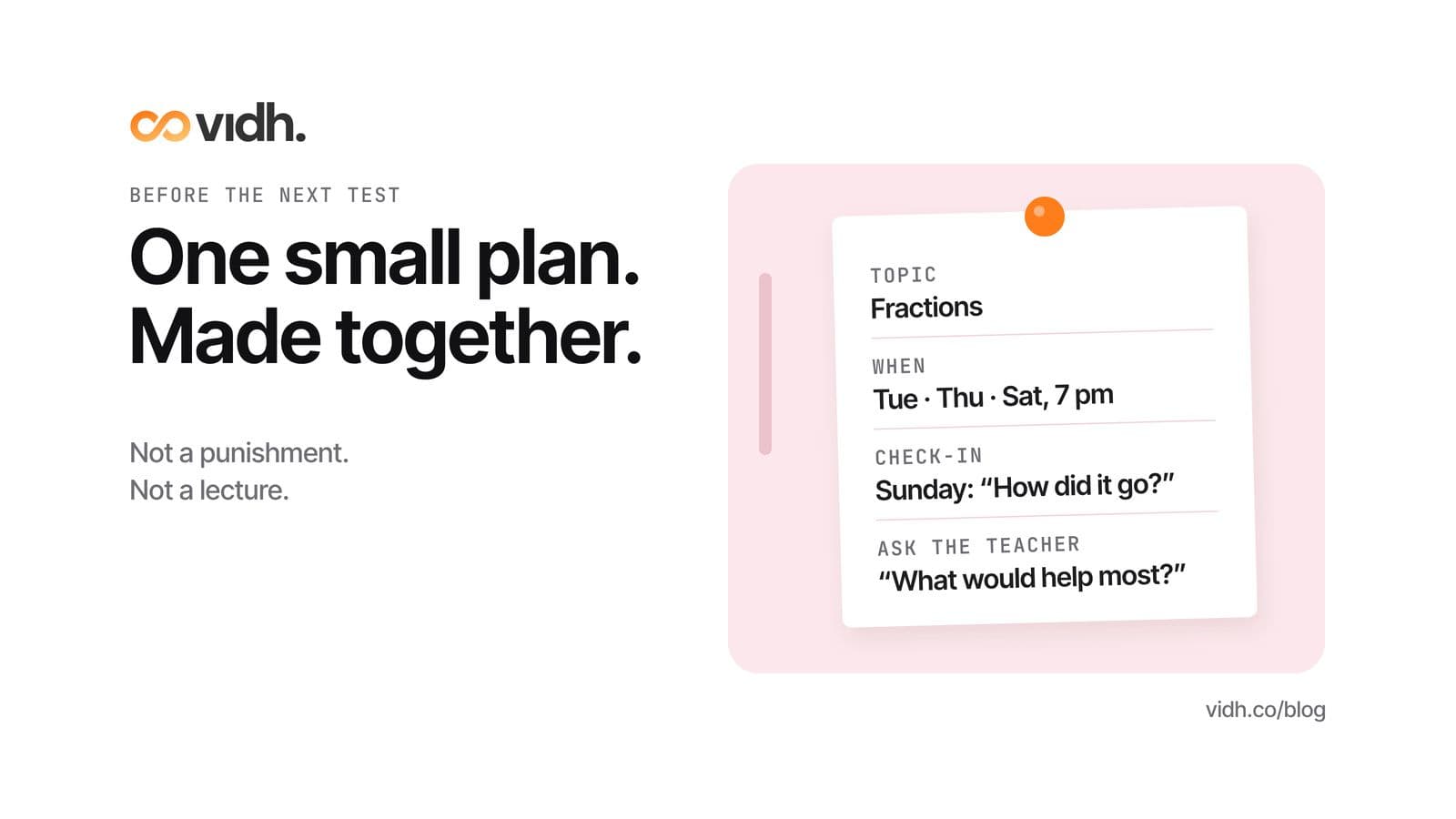
Make one small plan for the next test, together
Small is the point. A plan to "study harder" fails by Wednesday. A plan your child can describe in one breath has a chance.
- One topic. Sit with the answer sheet and find the one topic or question type that cost the most marks. Let your child find it first.
- One slot. Pick two or three evenings a week and a fixed time, 20 to 30 minutes each. Let your child choose the time.
- One check-in. Agree a day (Sunday works for many families) to ask "How did it go?" and nothing more.
- One question for the teacher. At the next parent-teacher meeting, ask the class teacher what one thing would help most before the next test.
Write the plan on a sticky note where both of you will see it. When the next test comes back, start with the plan, not the mark: "Did the 30 minutes on fractions help?"
When low marks are not only about marks
Sometimes low marks are the first visible sign of something else. If they come with your child withdrawing from friends, changes in sleep or appetite, or not seeming like themselves for a few weeks, talk to the class teacher or the school counsellor. They see your child in a different setting and can tell you whether something has changed at school too.
This is general information, not a diagnosis or medical advice. For more on parenting through hard moments, the American Psychological Association's parenting resources are a good next read.
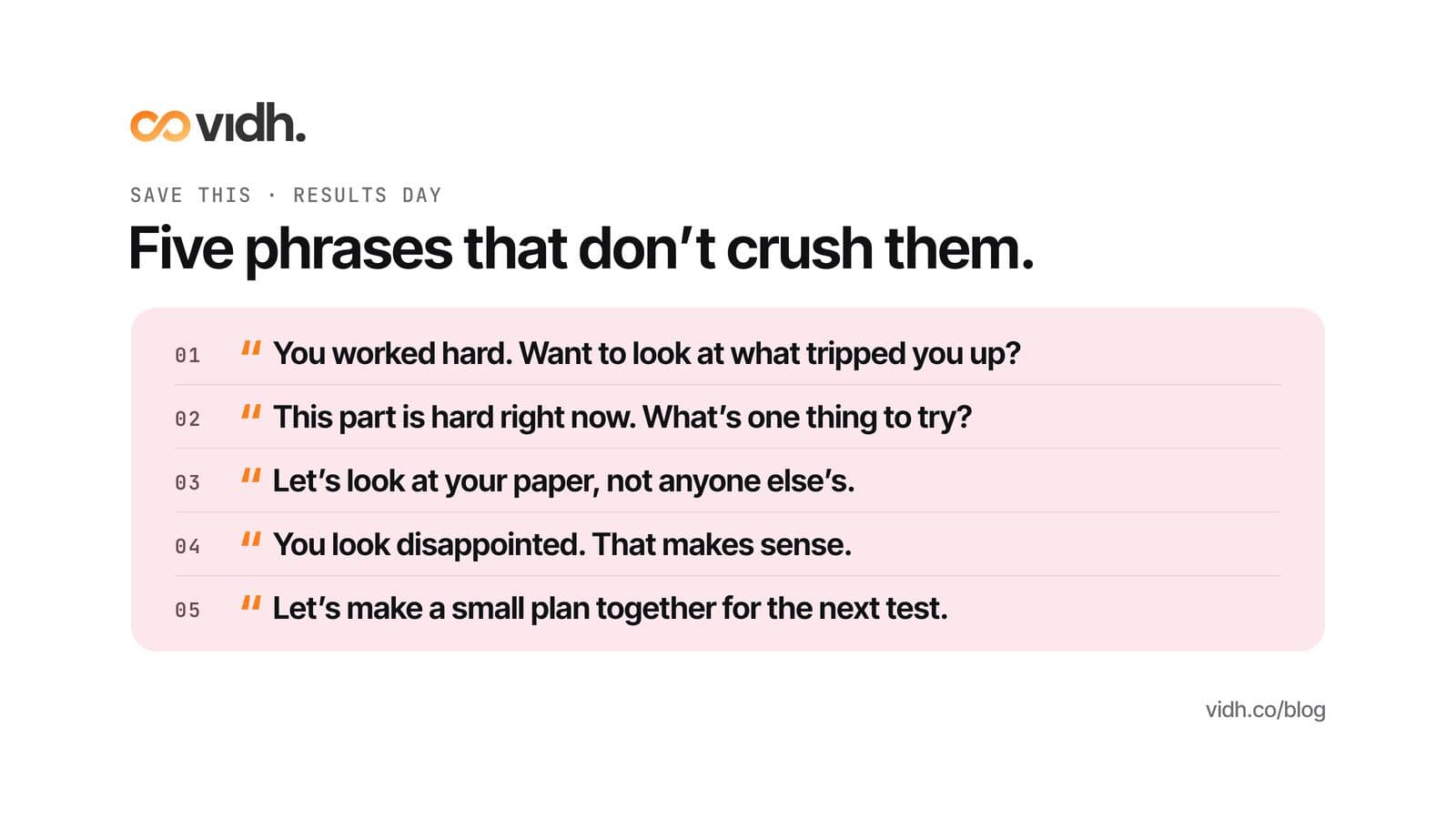
The five phrases
Keep these where you will see them on results day:
- "You worked hard. Want to look at what tripped you up?"
- "This part is hard right now. What's one thing to try?"
- "Let's look at your paper, not anyone else's."
- "You look disappointed. That makes sense."
- "Let's make a small plan together for the next test."
FAQ
What should I say when my child gets a low report card?
Start by naming the feeling you can see, such as "You look disappointed. That makes sense." Then react to the effort and the next step rather than the number, look at the answer sheet together and make one small plan for the next test.
Should I punish my child for bad marks?
A punishment such as a phone ban does not tell your child what to do differently next time. UNICEF warns against responses that use punishment instead of teaching. If screens are eating study time, agree a screen rule inside a small study plan you make together.
Is it OK to praise effort when the marks are low?
Yes, if the effort was real. UNICEF says praise should be sincere and should celebrate effort, not talent. If you did not see much effort, skip the praise and move straight to "Want to look at what tripped you up?"
How do I stop comparing my child with siblings or cousins?
Compare your child's paper only with their own last paper. Say "Let's look at your paper, not anyone else's," and if relatives raise marks at a family gathering, step in with "We're working on it together."
What if my child does not want to talk about the report card?
Give it time. Name the feeling, say you are there when they are ready, and come back to it the next day. Pressing for answers in the first hour usually gets silence.
When should I talk to the school counsellor about low marks?
Talk to the class teacher or the school counsellor if low marks come with your child withdrawing from friends, changes in sleep or appetite, or not seeming like themselves for a few weeks. This is general guidance, not medical advice.
Save this, or send it to a parent
Save the five phrases for results day, or send this to a parent in your class group whose child's report card comes home this week. For more short, practical guides for parents, follow Vidh on Instagram.
About Vidh: Vidh (vidh.co) is an AI platform for schools, built by Vidh Labs in Bengaluru, that keeps one shared record for every child across the school office, the classroom and home.
Sources
- UNICEF Parenting, "3 ways to help motivate teens": https://www.unicef.org/parenting/mental-health/3-ways-help-motivate-teens
- UNICEF Parenting, "9 tips for better communication with your child": https://www.unicef.org/parenting/child-care/9-tips-for-better-communication
- UNICEF East Asia and Pacific, "Positive parenting": https://www.unicef.org/asia-pacific/place-for-parents/positive-parenting
- American Psychological Association, "Parenting": https://www.apa.org/topics/parenting
All four sources were opened on 1 Nov 2026 (IST) and returned HTTP 200. Quoted wording was checked on the UNICEF pages the same day. The APA page is linked as a general resource only and nothing is quoted from it.