Back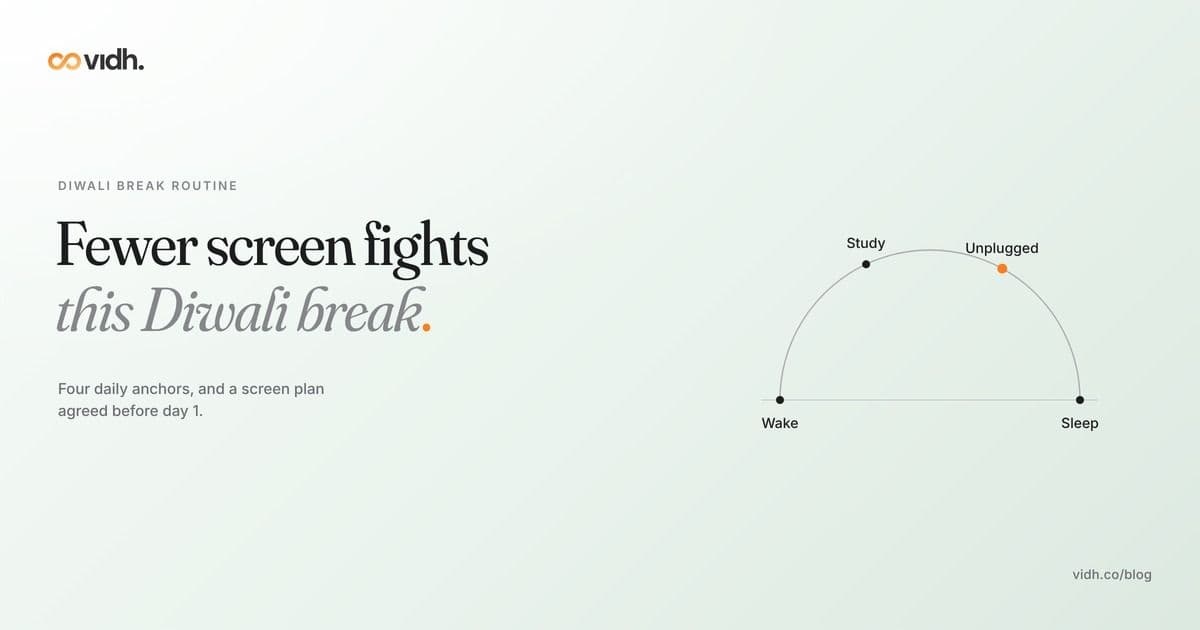
Diwali Break Routine: Fewer Screen Fights at Home
11 min read
A Diwali holidays routine for kids: four daily anchors, a screen plan agreed before day 1, daily movement and a sleep anchor for late nights.
By Bhagya · Last updated: 30 October 2026
Short answer: You don't need a timetable for the Diwali holidays. You need four anchors a day: a wake-up time, one study block, one unplugged hour and a bedtime. Agree the screen rules with your child before the first day off, not in the middle of an argument. Everything else in the day can stay loose.
Day three of a long break. It's 11 am, the curtains are still half shut, and a voice from the sofa says, "Just ten more minutes." You said yes to ten minutes an hour ago. Now you are the bad guy for asking for the tablet back, and nobody can remember what the rule was meant to be.
Most screen fights in a holiday aren't really about screens. They happen because the rules are being made up on the spot, by a tired parent, at the worst possible moment.
With Diwali on Sunday 8 November, many children are about to get a long stretch at home. News reports list Maharashtra's school break as 2 to 14 November, Goa's as 2 to 21 November and Gujarat's as 5 to 25 November (Education Times, Business Standard). Dates differ by state and by school, so check your own school's circular. Whether your break is four days or three weeks, the plan below works the same way.
Key takeaways
- Four anchors, not a timetable. Fix wake-up, one study block, one unplugged hour and bedtime. Let the rest move.
- Agree the screen plan before day 1. Make it together, write it down and put it where everyone can see it.
- Move every day. Outdoors on clear days; on poor-air days, check your local AQI and take the active hour indoors.
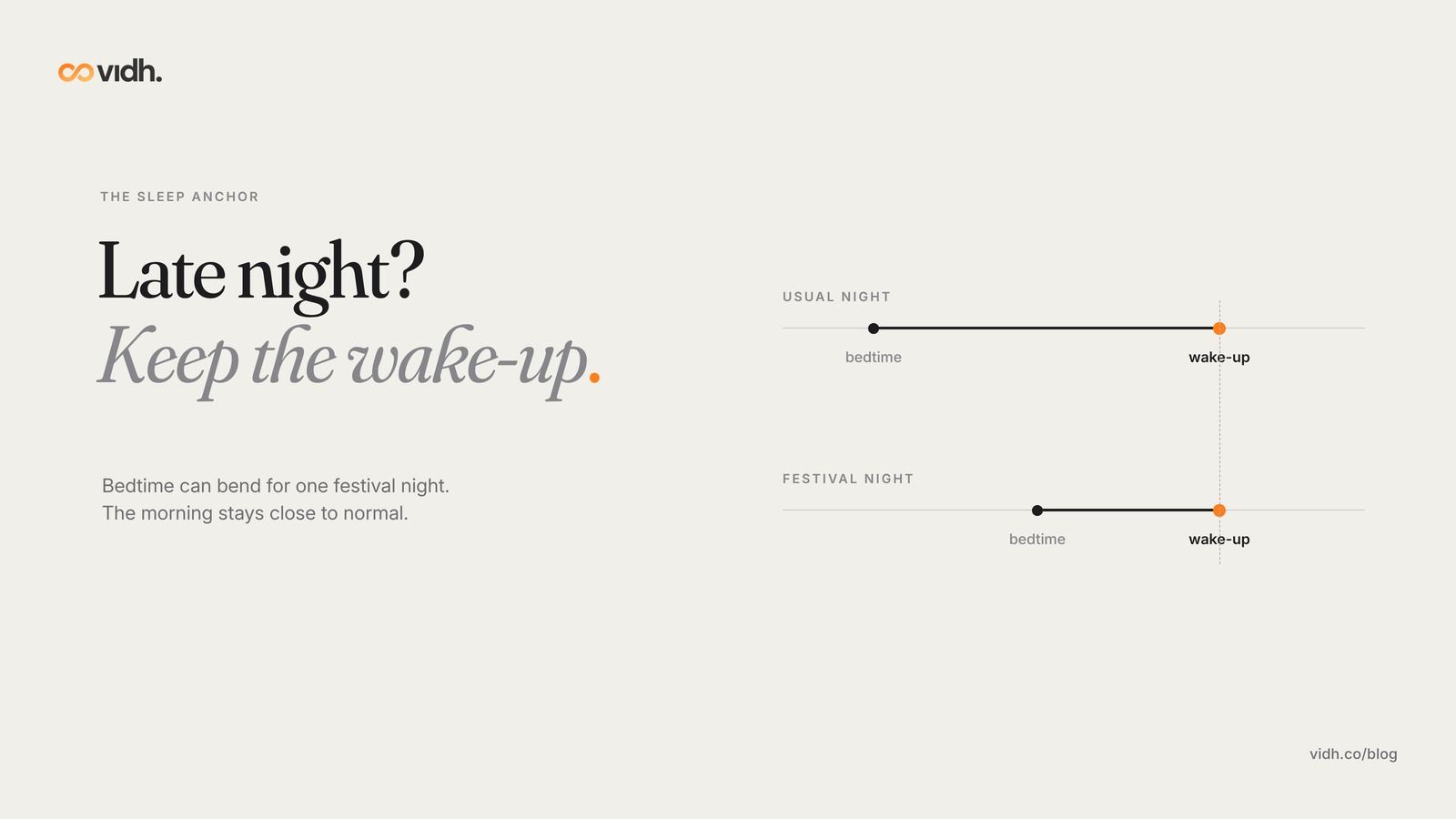
- Protect the wake-up after late nights. Bedtime can bend for a festival night. Keep the morning close to normal.
- Give real festival jobs. A child who owns the rangoli or the shopping list has less time to drift back to a screen.
- Know when it's bigger than screens. Lasting worry, low mood, or big changes in sleep or eating are worth a word with your child's doctor or school counsellor.
What does a good Diwali holidays routine for kids look like?
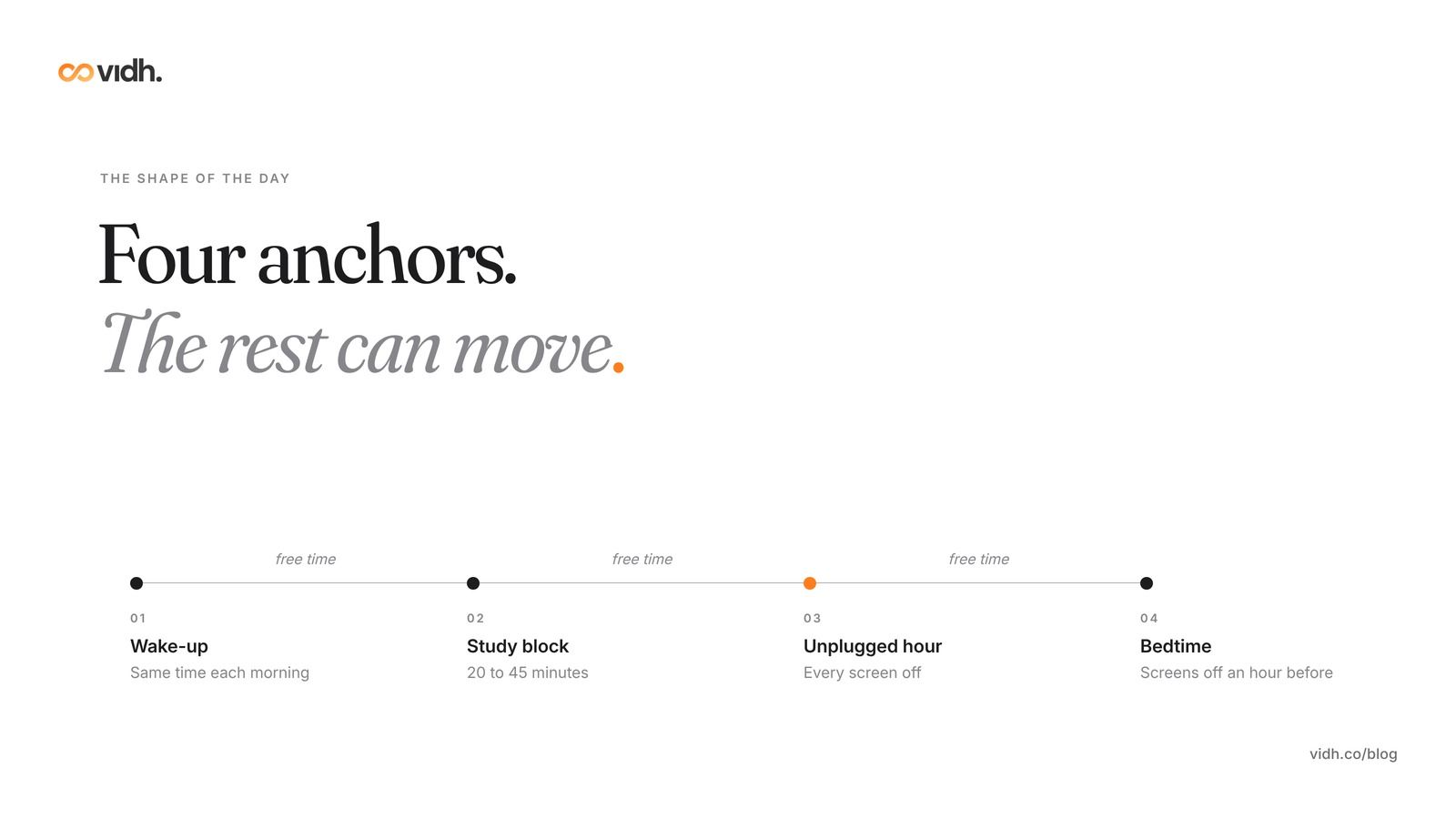
Think of the day as four fixed points with free time in between. Children cope with a lot of flexibility when they know a few things won't change.
- A wake-up anchor. Roughly the same time each morning, even if it's later than a school day. This one matters most, because it holds the rest of the day in place.
- One study block. Twenty to forty-five minutes of holiday homework, reading or revision, at the same time each day. Mornings usually work best, before the day fills up.
- One unplugged hour. An hour when every screen in the house is off, adults' phones included. It can be the active hour, a board game or helping in the kitchen.
- A sleep anchor. A bedtime you hold on most nights, with screens off for a while before it.
The four anchors aren't rules about how much screen time is allowed. They're the shape of the day. Screen time fits into the gaps, on terms you have already agreed.
Make the screen plan together, before day 1
The worst time to set a screen rule is when a child is mid-game. The best time is the evening before the break starts, when nobody is holding a device.
The American Academy of Pediatrics' Family Media Plan is a free online tool built for exactly this. Families pick the parts that matter to them, and the AAP says the plan "can be customized to meet your family's needs. Make a full plan, or just choose a few parts that matter the most to your family." You can print or share the finished plan and come back to change it (AAP HealthyChildren.org).
Involve your child in writing it. UNICEF's positive parenting guidance suggests you "let your child help create simple family rules and consequences", because it "builds responsibility and respect" (UNICEF). A rule a child helped write is far easier to hold than one announced from the doorway.
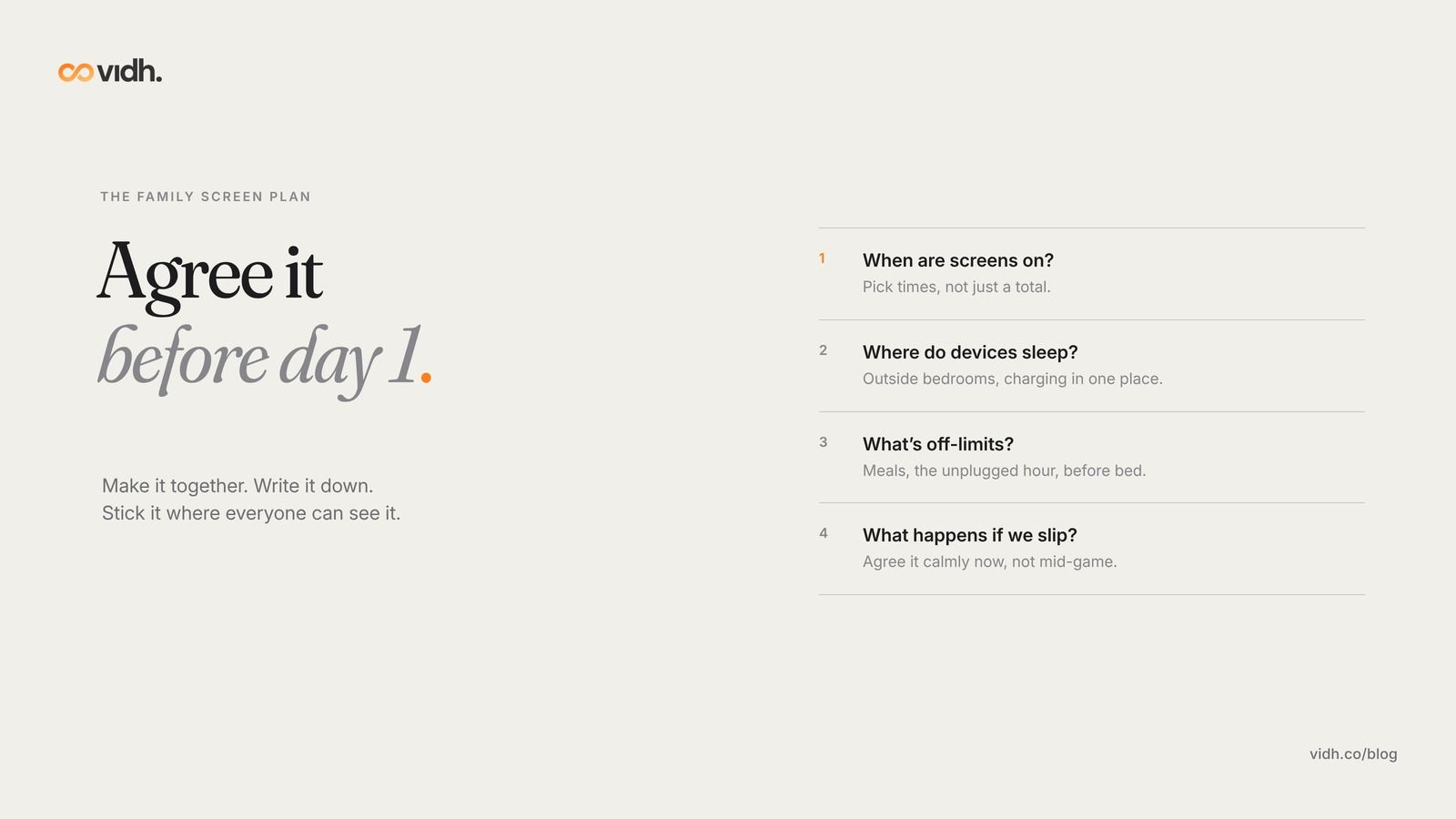
Four questions cover most of it:
- When are screens on? For example, after the study block, or after lunch. Pick times, not just a total.
- Where do devices sleep? Outside bedrooms, charging in one place, is the simplest rule to check.
- What's off-limits? Meals, the unplugged hour, and the time before bed.
- What happens if we slip? Agree it calmly now. UNICEF suggests you "explain what will happen if a rule is broken and follow through calmly."
Write the answers on one sheet and stick it on the fridge. When "ten more minutes" starts, you can point at the sheet instead of starting a debate. You are holding to a plan you both made, not inventing a punishment.
Ask what your child wants from the break, too. UNICEF gives the example of a parent saying, "Let's create a routine that helps you stay on track but also gives you time to rest and do things you enjoy. What do you think would work?" A long break should have real rest in it.
If you're wondering how much screen time is too much in the first place, our guide to screen time limits around the world sets out what different countries and health bodies recommend.
Screen time during holidays: move every day
The easiest way to cut screen time is to fill the day with something better, and moving is the best filler there is.
The World Health Organization recommends that children and adolescents aged 5 to 17 "should do at least 60 minutes of moderate to vigorous-intensity physical activity daily". It also stresses that "any amount of physical activity is better than none" and that "all physical activity counts" (WHO). It doesn't have to be a sport. WHO lists walking, cycling, active recreation and play.
Over a festival break, that could be:
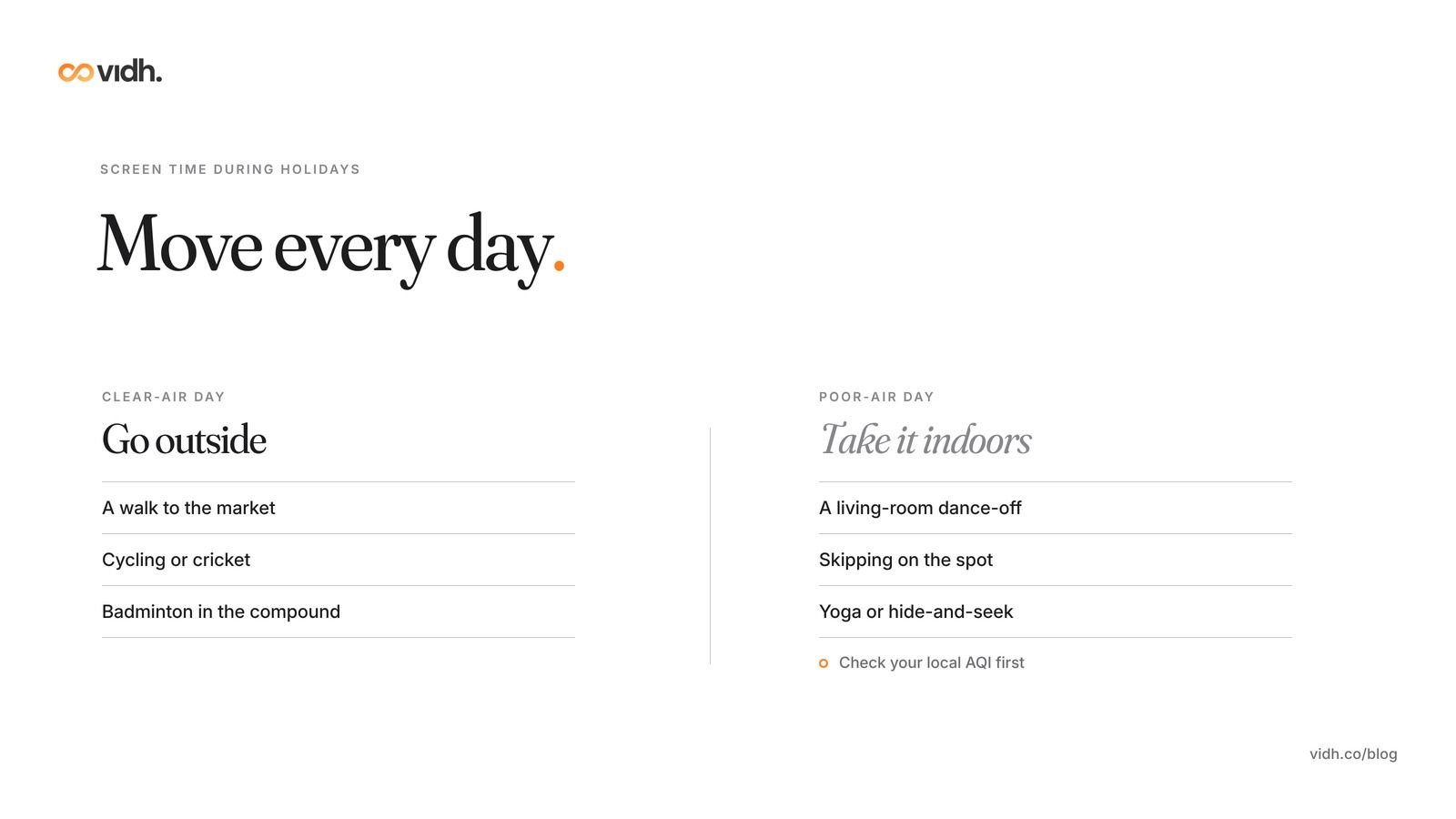
- a walk to the market for diya oil, flowers or sweets, with your child carrying the bag;
- cycling, cricket or badminton in the building compound or a nearby park;
- carrying chairs and setting up the house before guests arrive;
- a dance-off to festival songs in the living room.
On poor-air days, take it indoors. If the air in your city is bad on some days of the break, check your local air quality index (AQI) before planning outdoor play, and move the active hour inside on those days: dancing, skipping on the spot, yoga, or a hide-and-seek round. WHO's fact sheet on outdoor air quality explains why air quality matters (WHO); for your own child, follow your doctor's advice.
Keep the sleep anchor through late festival nights
Diwali means late nights: visiting relatives, fireworks, card games, staying up for one more round of sweets. That's part of the fun. The trick is to let bedtime bend for a night without losing the whole week.
The NHS's sleep advice is simple: "going to bed and getting up at similar times each day helps your body know when it's time to sleep", and you should "try to keep your routine the same when you can". It also suggests trying "not to use phones, tablets or computers for an hour before bed" (NHS Every Mind Matters). That guidance is written for everyone, not just children, but it maps neatly onto a festival break.
In practice:
- After a late night, keep the wake-up close to normal and make the morning quiet, rather than letting everyone sleep until noon. One long lie-in quickly turns into three.
- Pick the late nights in advance. Diwali night, maybe one family visit. The other nights keep the usual bedtime.
- Screens off before bed on every night, late or not. On a big night, that might be the drive home.
- Plan a slow day after the biggest night: no study block, an early night, and a walk.
Festival jobs kids can own
Children fight hardest for screens when there's nothing else that feels like theirs. A festival is full of real jobs, and handing one over completely (not just "help me with") gives a child something to be proud of.
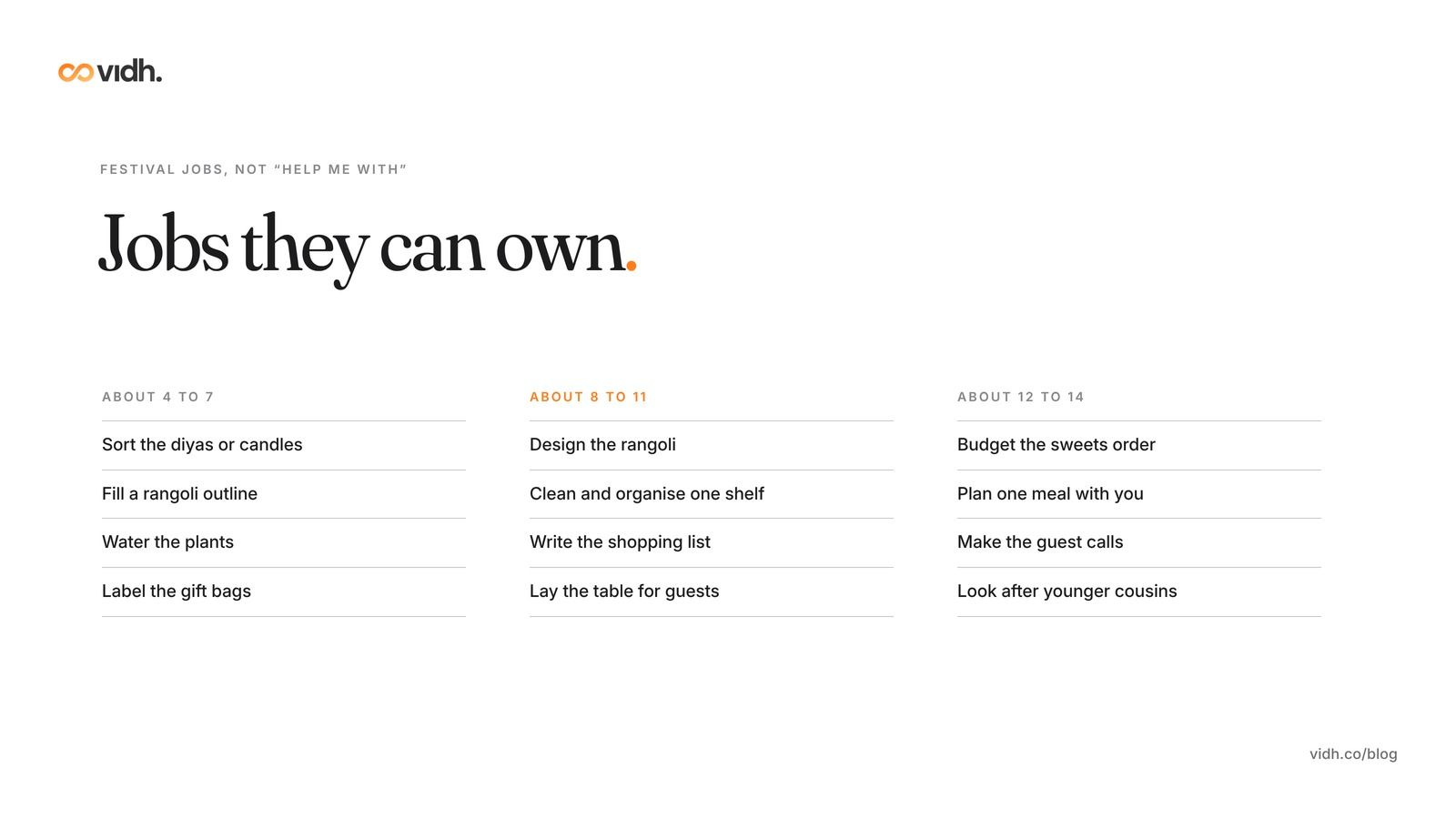
Match the job to the child:
- Younger children (about 4 to 7): sorting diyas or candles, filling a rangoli outline with colour, watering plants, folding napkins, sticking labels on gift bags.
- Middle years (about 8 to 11): designing the rangoli, cleaning and organising one shelf or cupboard, writing the shopping list, wrapping gifts, laying the table for guests.
- Older children (about 12 to 14): budgeting the sweets order, planning one meal with you, making the guest list and phone calls, running the playlist, looking after younger cousins for an hour.
Let them own the result, even if the rangoli is a little wobbly. UNICEF's advice is to "notice and praise your child's positive actions, even small ones". A specific line lands better than "good job": "You chose those colours yourself and it looks great at the door."
Festival jobs also make a natural unplugged hour. Nobody needs a tablet while they're sorting a hundred diyas.
A printable break planner
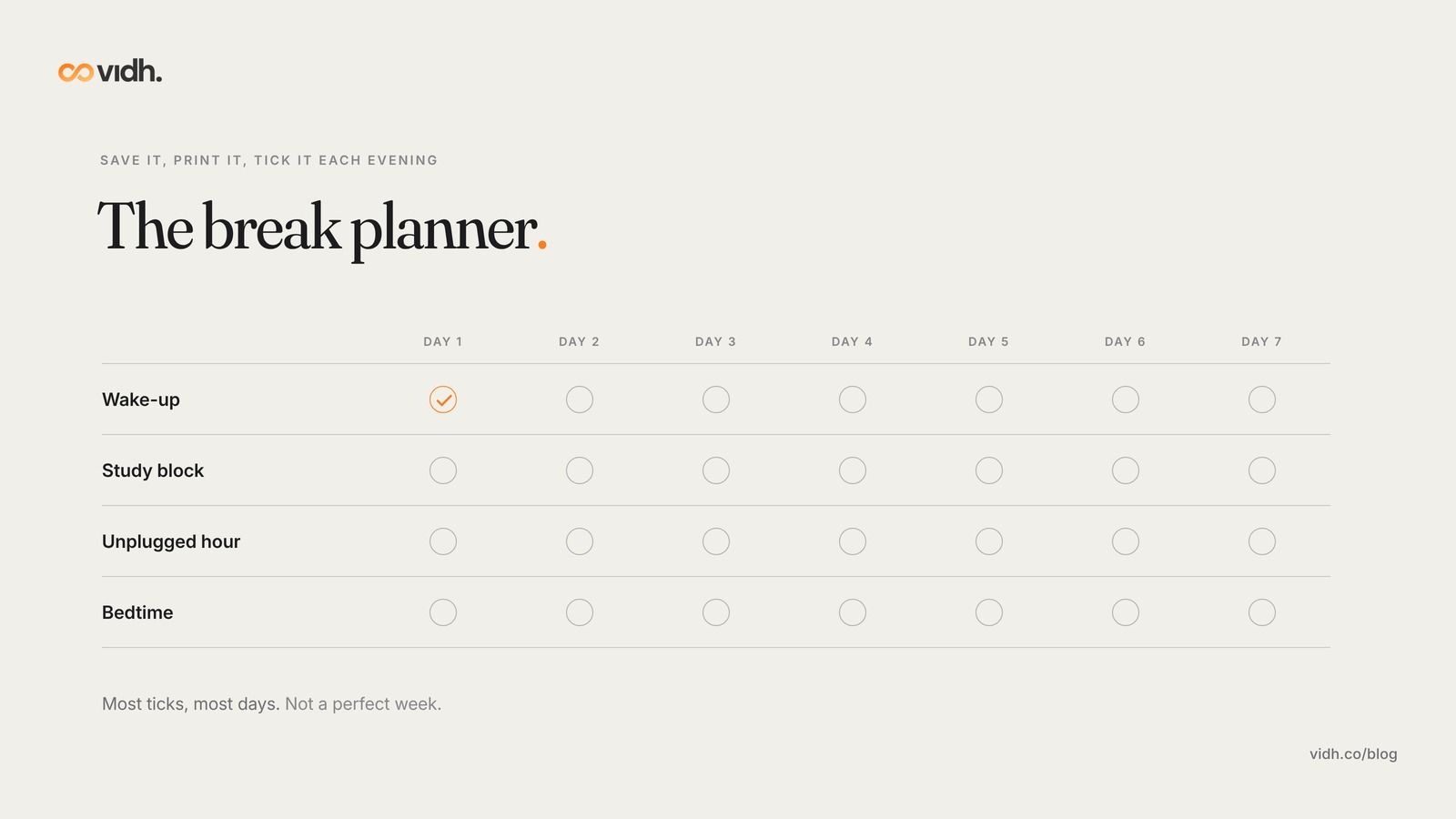
To keep it simple, we've put the four anchors on one page. Save the planner image below and print it, or just copy the grid onto paper. Each evening, tick the anchors you held that day. Don't aim for a perfect week. Aim for most ticks on most days, and talk about the gaps without blame.
Fill it in together on the evening before the break starts, at the same time as the screen plan. Let your child write the times in their own handwriting.
When it's about more than screens
Sometimes the screen fights are a sign of something else. If they come with lasting worry, low mood, or big changes in your child's sleep or eating, talk to your child's doctor or school counsellor. This post is general information for families, not medical advice.
FAQ
How do I make a routine for kids during the Diwali holidays?
Fix four anchors and leave the rest loose: a wake-up time, one study block, one unplugged hour and a bedtime. Agree them with your child before the break starts, write them down, and tick them off each evening on a simple planner.
How much screen time is OK during the holidays?
There isn't one number that suits every family. Instead of arguing over minutes, agree when screens are on, where devices sleep and what's off-limits, using a tool such as the AAP Family Media Plan. Our screen time guide covers what health bodies recommend.
How do I stop screen fights with my child?
Set the rules before the break, not during a game. Make them together, write them on one sheet and agree what happens if someone slips. When the argument starts, point to the plan you both made instead of debating.
Should kids study during the Diwali break?
A short study block most days keeps holiday homework and reading ticking over without taking over the break. Twenty to forty-five minutes at the same time each day is usually enough. Skip it on the biggest festival day.
What can kids do on poor-air days during Diwali?
Check your local AQI before planning outdoor play. On poor-air days, move the active hour indoors: dancing, skipping on the spot, yoga, hide-and-seek or helping set up the house. Follow your doctor's advice for your own child.
How do I get my child's sleep back on track after Diwali?
Keep the wake-up time close to normal even after late nights, keep screens off before bed, and bring bedtime back to the usual time a few nights before school restarts. Plan a slow, quiet day after the biggest night.
Save this, or send it to a parent
Save the four anchors for the first morning of the break, or send this to a parent in your child's class group who's already dreading the "ten more minutes" argument. For more short, practical guides for parents, follow Vidh on Instagram.
About Vidh: Vidh (vidh.co) is an AI platform for schools, built by Vidh Labs in Bengaluru, that keeps one shared record for every child across the school office, the classroom and home.
Sources
- American Academy of Pediatrics, HealthyChildren.org, "Family Media Plan": https://www.healthychildren.org/English/fmp/Pages/MediaPlan.aspxWorld Health Organization, "Physical activity" fact sheet: https://www.who.int/news-room/fact-sheets/detail/physical-activity
- World Health Organization, "Physical activity" fact sheet: https://www.who.int/news-room/fact-sheets/detail/physical-activity
- UNICEF Asia Pacific, "Positive parenting vs. Strict parenting" (20 April 2026): https://www.unicef.org/asia-pacific/place-for-parents/positive-parenting
- NHS Every Mind Matters, "How to fall asleep faster and sleep better": https://www.nhs.uk/every-mind-matters/mental-wellbeing-tips/how-to-fall-asleep-faster-and-sleep-better/
- World Health Organization, "Ambient (outdoor) air quality and health" fact sheet: https://www.who.int/news-room/fact-sheets/detail/ambient-(outdoor)-air-quality-and-health
- Education Times, "November School Holidays 2026" (updated 26 Oct 2026): https://www.educationtimes.com/news/november-school-holidays-2026-check-diwali-guru-nanak-jayanti-and-state-wise-holiday-list/articleshow/135205124.cms
- Business Standard, "Diwali 2026: Are schools closed on November 9?" (27 Oct 2026): https://www.business-standard.com/education/news/diwali-2026-are-schools-closed-on-november-9-check-state-wise-calendar-nc-126102700470_1.html
All seven sources were opened on 30 Oct 2026 (IST) with curl or a page fetch (HTTP 200) and the quoted wording was checked on the page.