Back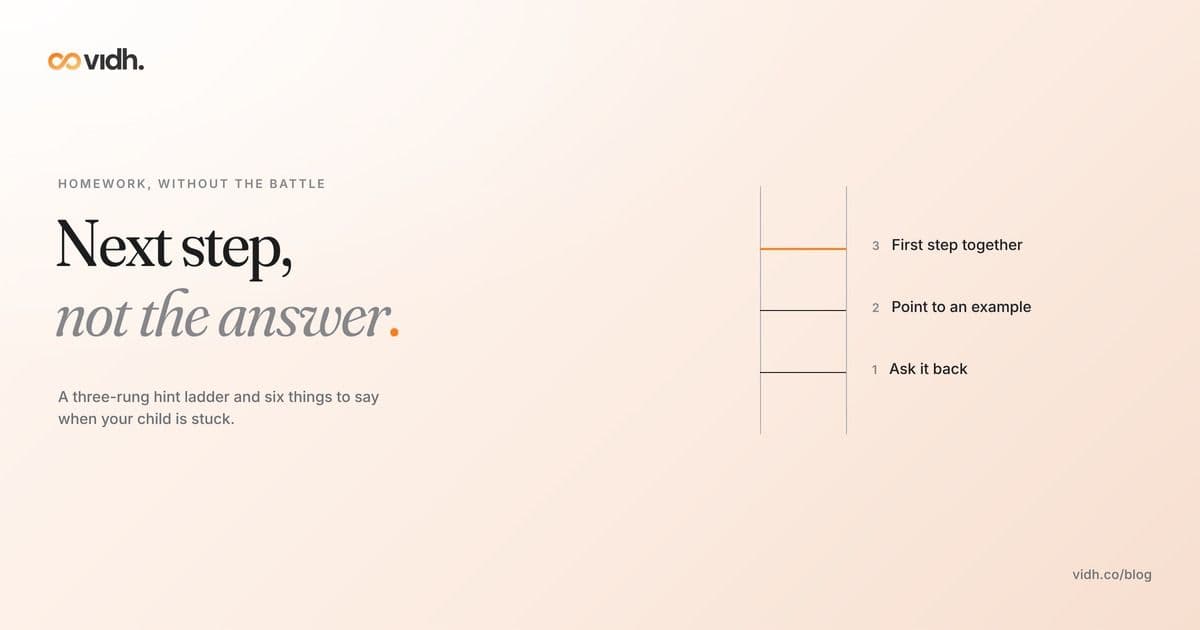

Homework Battles: Give the Next Step, Not the Answer
5 min read
Homework help for kids without the fights: a 3-rung hint ladder, 6 things to say when they're stuck, and how to set up homework time so it starts calmly.
By Bhagya · Last updated: 29 October 2026
Short answer: When your child is stuck, don't give the answer and don't do the sum for them. Give the next step. Ask what the question wants, point them to an example, or do just the first line together, then hand the pencil back. Nemours KidsHealth, a children's health system, puts it plainly: "resist the urge to provide the right answers or complete assignments."
It's 8:15 pm. One maths question has taken twenty minutes. Your child is slumped over the notebook, you are tired, and you know the answer is 42. Saying it would end this in ten seconds.
It would also start tomorrow's battle. The next time the work gets hard, the quickest way out for your child is to wait until you crack. And the teacher sees a right answer in the book, not the gap behind it.
This guide gives you a different move: the next step, not the answer. It has a three-rung hint ladder you can stick on the fridge, six short scripts for the moments that turn into fights, a set-up that stops many fights before they start, and a note on when to talk to the teacher.
Key takeaways
- Give the next step, not the answer. Support, guide and check, but let your child do the thinking.
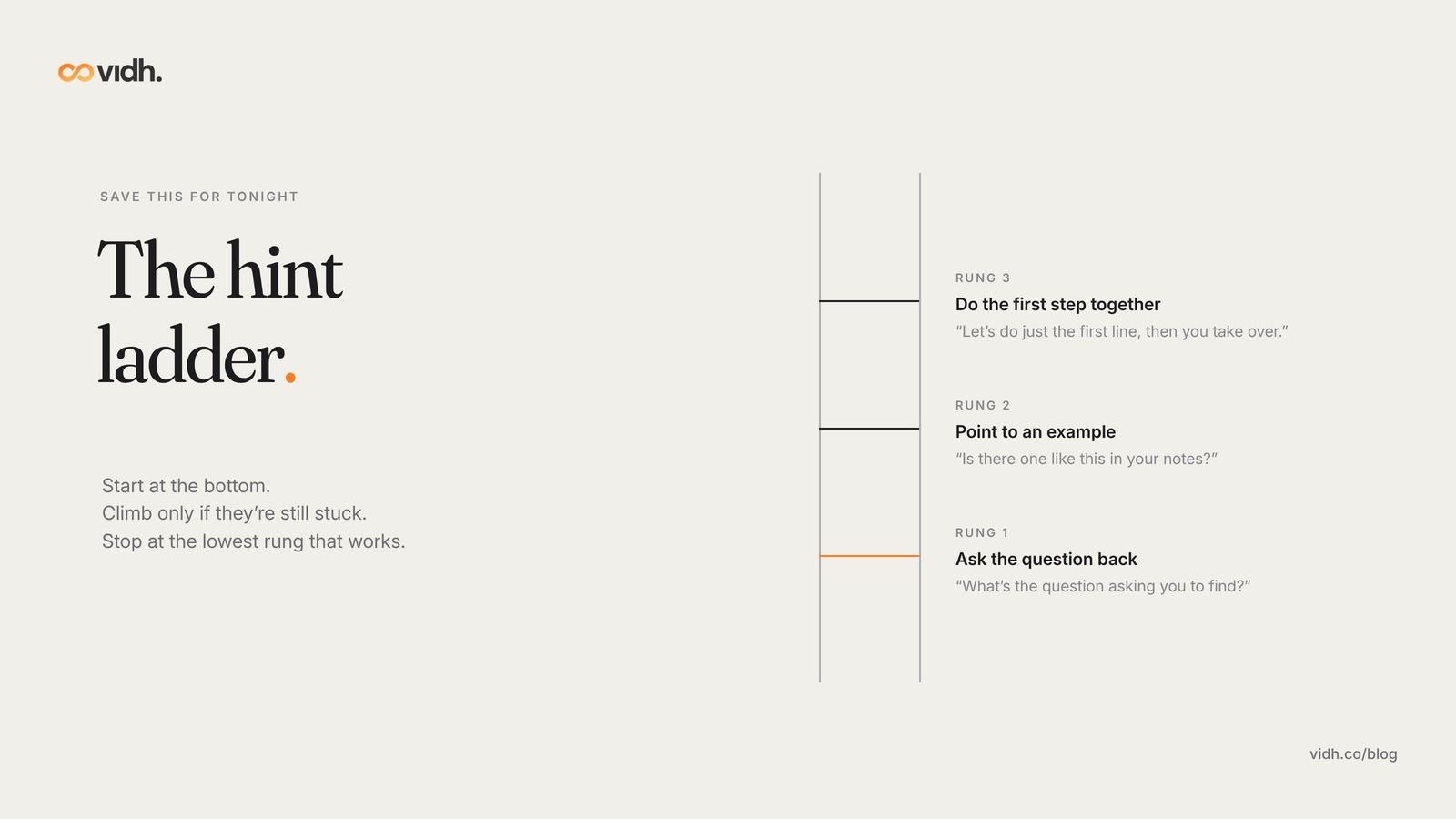
- Use a three-rung hint ladder. Ask the question back, point to an example, then do just the first step together. Stop at the lowest rung that works.
- Have the words ready. Six short scripts cover being stuck, "I'm stupid at this", rushing, tears, finishing and starting.
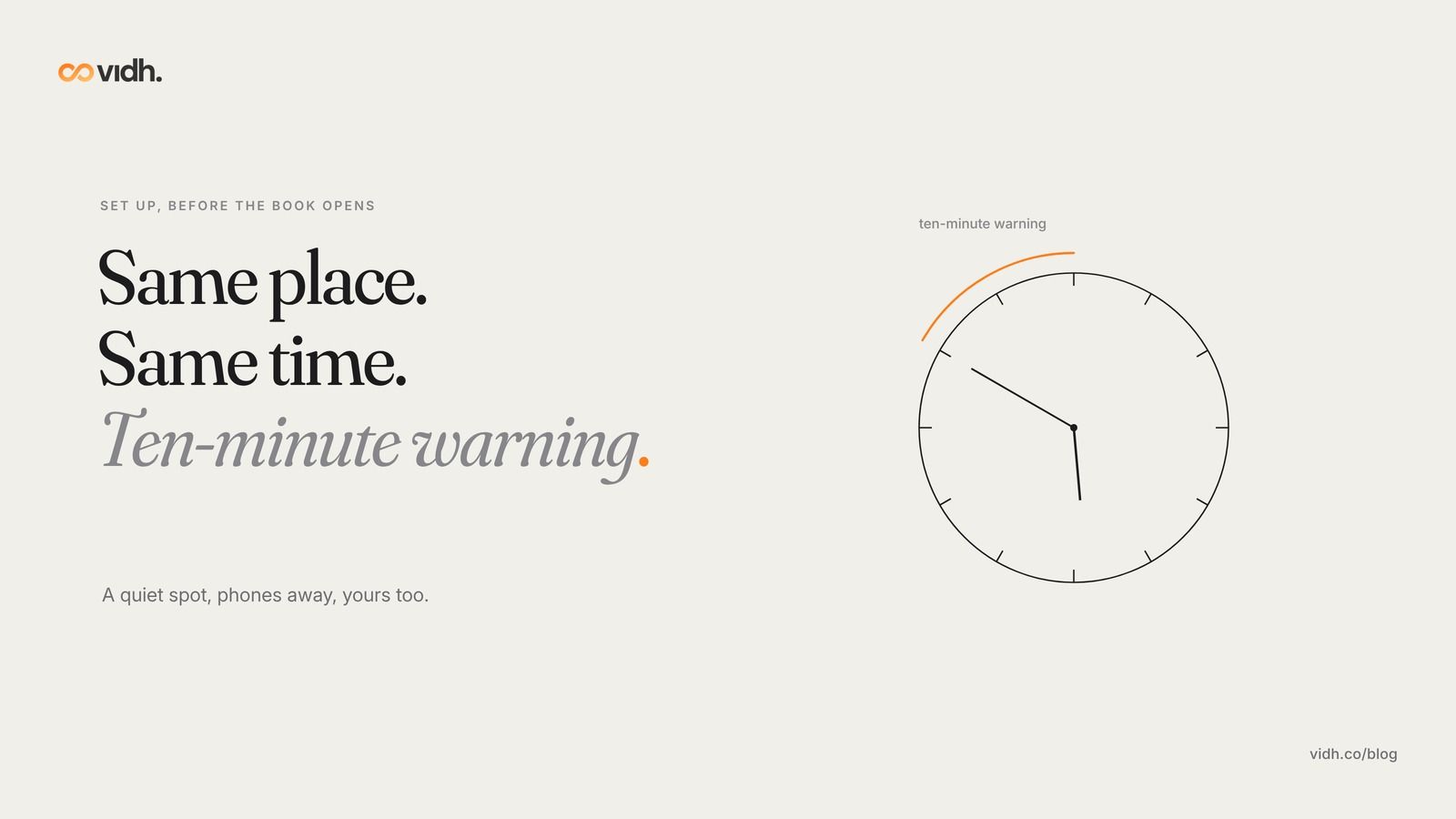
- Fix the set-up, not just the moment. Same place, same time, a ten-minute warning and a quiet spot prevent many fights.
- Praise the effort, not the speed. "I saw you stick with that one" builds more than "You're so smart."
- Talk to the teacher early if the same struggle keeps coming back. Don't wait for the report card.
Why does giving the answer backfire?
Homework is worth getting right. The Education Endowment Foundation's Teaching and Learning Toolkit finds that homework has a positive impact on average, about +5 months' additional progress, particularly in secondary school (EEF). That progress comes from the child doing the thinking.
KidsHealth describes a parent's role as being there "to offer support and guidance, answer questions, help interpret assignment instructions, and review the completed work", but to "resist the urge to provide the right answers or complete assignments", and to focus instead on "helping kids develop the problem-solving skills they'll need" (KidsHealth).
The American Psychological Association makes the same point about stress more broadly: "when parents swoop in to solve every little glitch, their children don't have a chance to learn healthy coping skills"; letting children solve low-stakes problems themselves builds confidence (APA). A homework sum is about as low-stakes as problems get.
So the aim isn't to step back completely. It's to give the smallest bit of help that gets your child moving again.
The three-rung hint ladder
Start on the bottom rung. Only climb if your child is still stuck after a real try. Most nights, rung one or two is enough.
Rung 1: Ask the question back
Say: "What's the question asking you to find?"
Skip: "It's 42."
Many "I'm stuck" moments are really "I haven't read the question properly". Asking them to say it in their own words often clears it up. Follow up with "What do you know already?" or "What will you try first?" Planning out loud is a skill in itself: the EEF describes metacognition as pupils "planning, monitoring and evaluating their learning" (EEF).
Rung 2: Point to an example
Say: "Is there one like this in your notes, or in the worked example?"
Skip: Doing the question for them.
Most homework practises something done in class that day. Help your child find the matching example in the textbook or notebook, then let them follow it on their own question.
Rung 3: Do just the first step together
Say: "Let's do just the first line together, then you take over."
Skip: Finishing it.
Write the first line with them, or talk through how to start the first sentence. Then hand the pencil back and move away a little. If they get stuck again, go back to rung 1 for the next part.
If you reach the top rung and your child still can't do it, stop. Help them write a short note for the teacher saying where they got stuck. That note is more useful to the teacher than a correct answer you supplied.
Six things to say when homework turns into a battle
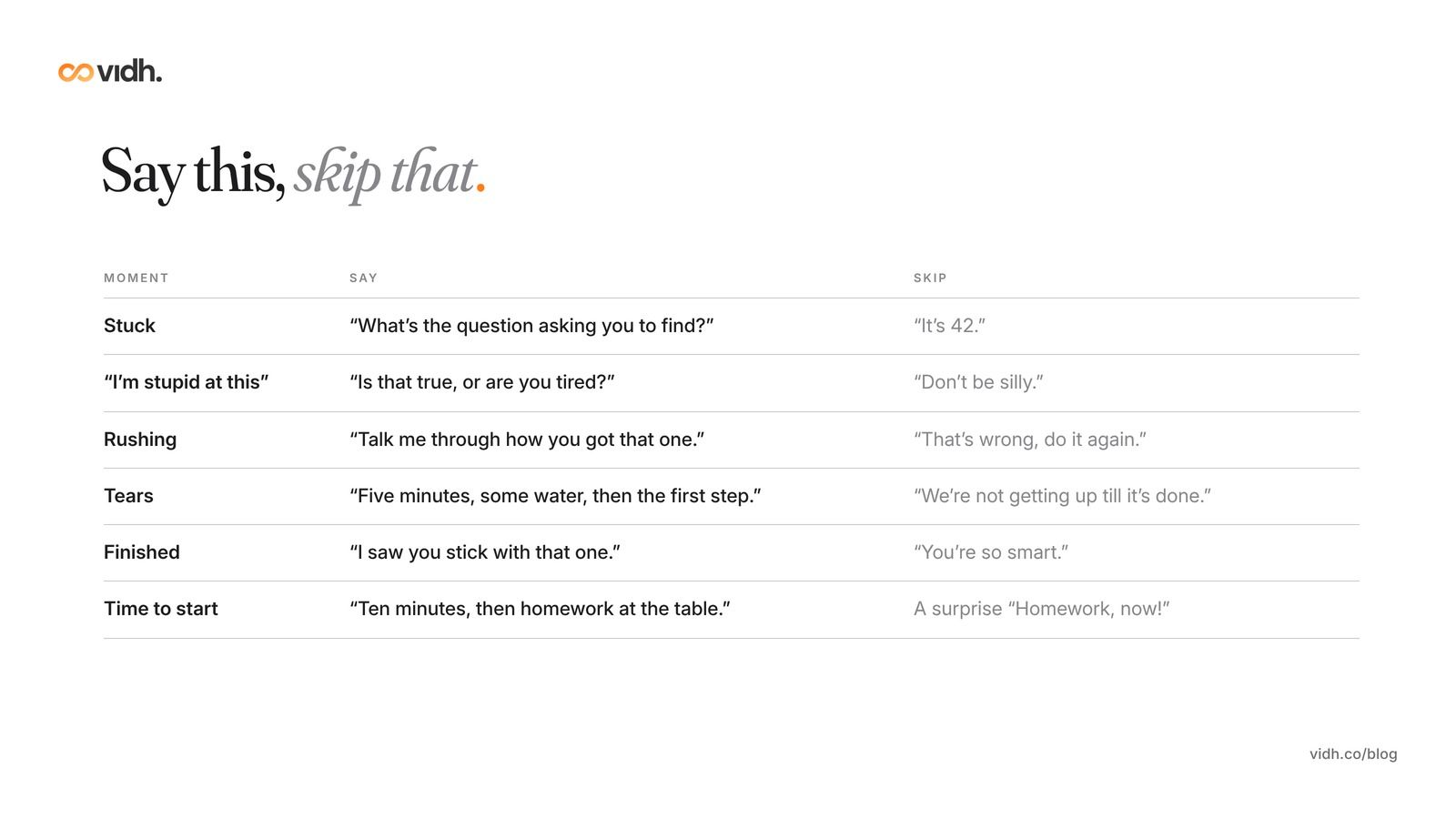
These are the moments that most often tip into a fight. Each has a line to try and one to skip.
- When they're stuck. Say: "What's the question asking you to find?" Skip: "It's 42." (KidsHealth: guide, don't answer.)
- When they say "I'm stupid at this." Say: "Is that true, or are you tired? Remember the one you cracked last week?" Skip: "Don't be silly." The APA suggests that when children talk themselves down, you don't just disagree: ask whether it's really true, or remind them of times they worked hard and improved.
- When they rush to finish. Say: "Talk me through how you got that one." Skip: "That's wrong, do it again." Explaining their own working often lets them catch the mistake themselves.
- When there are tears. Say: "Let's stop for five minutes, get some water, then try just the first step." Skip: "We're not getting up until this is done."
- When they finish. Say: "I saw you stick with that one." Skip: "You're so smart." (UNICEF: praise the effort, not talent.)
- When it's time to start. Say: "Ten minutes, then homework at the table." Skip: a surprise "Homework, now!" in the middle of play.
How do you set up homework time so it doesn't start a fight?
Many battles are lost before the book opens. A predictable set-up takes a lot of the heat out.
- Same place, same time. A regular spot and a regular start time mean less arguing about when. KidsHealth suggests a workspace that is well lit, comfortable, stocked with supplies and "quiet and free from distractions".
- A ten-minute warning. Give notice before homework starts, so your child can finish what they're doing.
- A quiet space, even a small one. The EEF notes that "some pupils may not have a quiet space for home learning". In a busy home, that might be one end of the dining table with the TV off for half an hour.
- Phones away, including yours. A child who sees you scrolling will want to scroll too.
- Start with what they can do. Begin with an easier task to build momentum, then move to the hard one.
- A homework notebook. KidsHealth suggests a daily homework notebook so both you and your child know what is due and when.
Praise the effort, not the speed
How you finish the session matters as much as how you start it. UNICEF's parenting guidance says praise "should celebrate effort, not talent": saying "I see how much care you put into this" will build more motivation than "Wow, you're really smart", and praise "that communicates encouragement, not pressure" helps (UNICEF). That advice is written for teenagers, but it works for younger children too.
A few lines to keep handy:
- "I saw you stick with that one."
- "You tried a different way when the first one didn't work."
- "You found the example yourself."
- "That took real concentration."
KidsHealth gives the same advice: "praise your kids for their hard work and effort", and encourage "effort and determination — not just the grades they get".
When should you talk to the teacher?
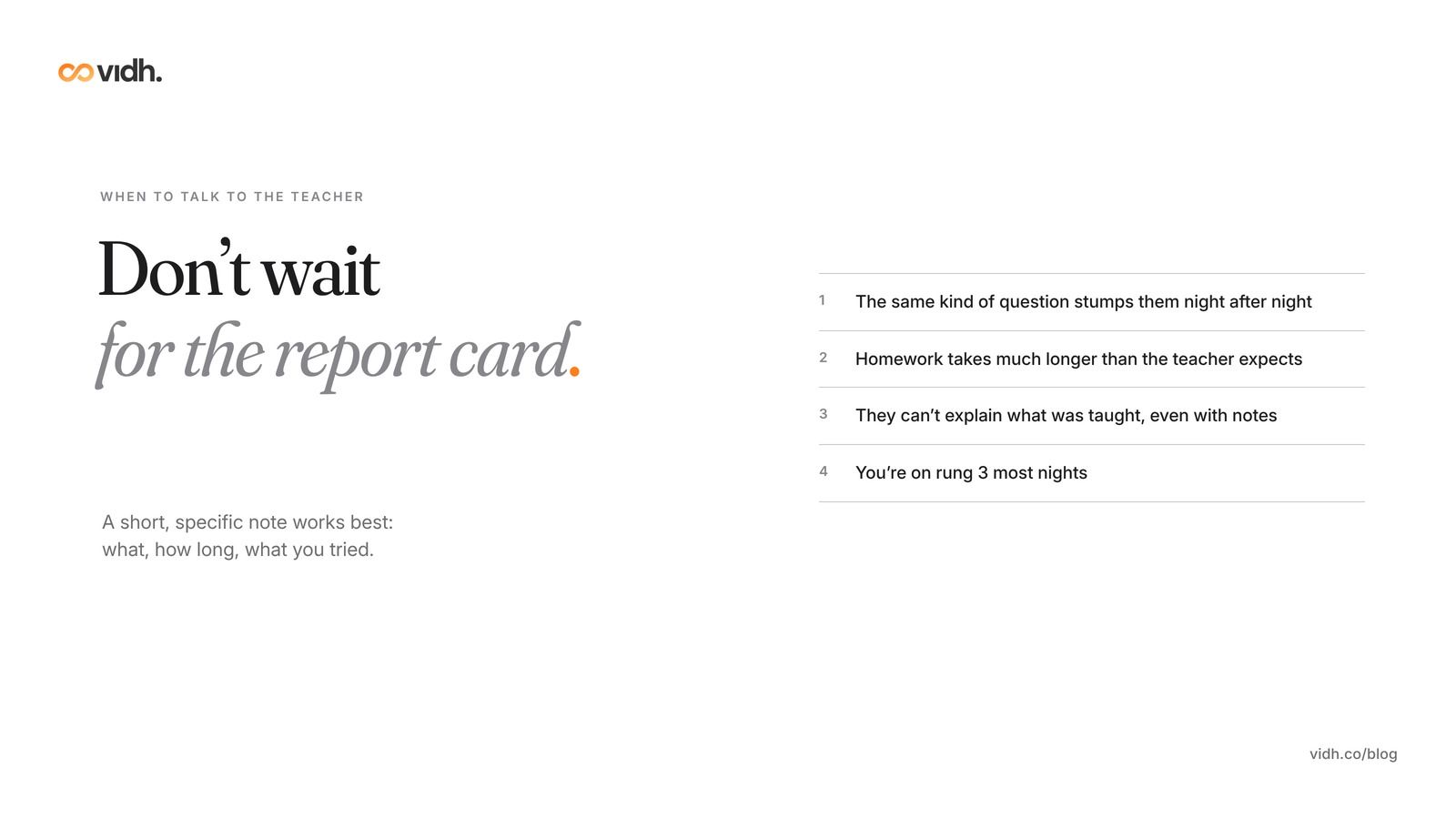
KidsHealth notes that "consistent complaints about homework or ongoing struggles with assignments could indicate a problem", and advises: "Don't wait for report cards to find out that there are problems at school."
Talk to the teacher if:
- the same kind of question stumps your child night after night;
- homework regularly takes much longer than the teacher expects;
- your child can't explain what was taught in class that day, even with the notes;
- you find yourself on rung 3 most nights.
A short, specific message works best: what your child was stuck on, how long it took, and what you tried. Encourage your child to ask the teacher too. Teachers would rather see an honest gap than a perfect page.
If homework stress comes with worry, low mood, or sleep or eating changes that last for weeks, talk to your child's teacher, school counsellor or doctor.
This guide is general information, not medical advice.
What about AI?
Homework apps and AI chatbots can produce an answer in seconds, which makes the "next step" rule even more important. The same ladder works: use the tool to explain a step, not to finish the question. Our guide to AI homework without cheating covers how schools are setting rules.
FAQ
Should I give my child the answer to their homework?
No. Give the next step instead: ask what the question wants, point to a similar example, or do just the first line together. KidsHealth advises parents to "resist the urge to provide the right answers or complete assignments" and to build problem-solving skills instead.
How do I help with homework without fighting?
Keep the same place and time each day, give a ten-minute warning, and use a quiet spot with phones away. When your child is stuck, use the hint ladder rather than taking over, and praise effort when they finish.
How much should I help with homework?
Help them start and keep going, not finish. Offer support, help them read the instructions and check the finished work. If you are doing the first step for them most nights, talk to the teacher.
What should I say when my child says "I'm stupid"?
Don't just disagree. Ask whether it's really true or whether they're tired, and remind them of a time they worked hard and improved. The APA suggests this approach when children talk themselves down.
When should I talk to the teacher about homework?
When the same struggle keeps coming back, homework takes much longer than expected, or your child can't explain what was taught. Don't wait for the report card. A short, specific note works best.
Is it OK for my child to use AI for homework help?
Use it like a hint, not an answer machine: ask it to explain a step, then let your child do the work. Our guide to AI homework without cheating covers school rules in more detail.
Save this, or send it to a parent
Save the hint ladder for tonight's homework, or send it to a parent in your child's class group who's in the middle of the same battle. For more short, practical guides for parents, follow Vidh on Instagram.
About Vidh: Vidh (vidh.co) is an AI platform for schools, built by Vidh Labs in Bengaluru, that keeps one shared record for every child across the school office, the classroom and home.
Sources
- Nemours KidsHealth, "Helping Your Gradeschooler With Homework": https://kidshealth.org/en/parents/help-gradeschooler-homework.html
- UNICEF Parenting, "3 ways to help motivate your teen": https://www.unicef.org/parenting/mental-health/3-ways-help-motivate-teens
- American Psychological Association, "How to help children and teens manage their stress" (updated 22 Oct 2024): https://www.apa.org/topics/children/stress
- Education Endowment Foundation, Teaching and Learning Toolkit, "Homework": https://educationendowmentfoundation.org.uk/education-evidence/teaching-learning-toolkit/homework
- Education Endowment Foundation, Teaching and Learning Toolkit, "Metacognition and self-regulation": https://educationendowmentfoundation.org.uk/education-evidence/teaching-learning-toolkit/metacognition-and-self-regulation
Sources 1, 2, 4 and 5 were opened on 29 Oct 2026 (IST) with curl (HTTP 200) and quotes checked on the page; source 3 returned 200 and its text was read via a page fetch on 29 Oct 2026 (IST).