Back
England EdTech Safety Certification: The DfE Consultation
6 min read
DfE is consulting on EdTech and AI safety certification for schools in England. It closes 4 February 2027. What is proposed, and how leaders can prepare.
By Bhagya, Vidh · Last updated: 19 November 2026
On 10 November 2026, the Department for Education (DfE) opened a consultation on a product certification scheme to assure the safety of education technology and artificial intelligence used in schools and other education settings in England. The consultation closes at 11:59pm on 4 February 2027. This guide is a factual readout for school and college leaders, DSLs, business managers and IT leads who want to know what is proposed, and how to respond.
Short answer: DfE is seeking views on certifying EdTech and AI for safety in England. Four proposed categories: filtering products, high-risk processing of children's data, student-facing generative AI, and student-facing personalised learning tools. If it goes ahead, DfE says at least 18 months is needed before products could be certified, then a transition period. Closes 11:59pm on 4 February 2027.
What is DfE consulting on?
The GOV.UK consultation page, published on 10 November 2026 and marked "Applies to England", says: "We are seeking views on plans to introduce a certification scheme to assure the safety of education technology and artificial intelligence products in England."
It also says the scheme should "give suppliers a clear and proportionate route to show their products meet defined safety standards".
The full proposals sit in a DfE consultation document on Citizen Space, linked from that GOV.UK page. The document describes "DfE's proposal to establish a product certification scheme to assure the safety of EdTech used in schools and other education settings in England."
Nothing in this guide is a view on whether the scheme should go ahead, and nothing here is a claim about any supplier.
Which products would be in scope?
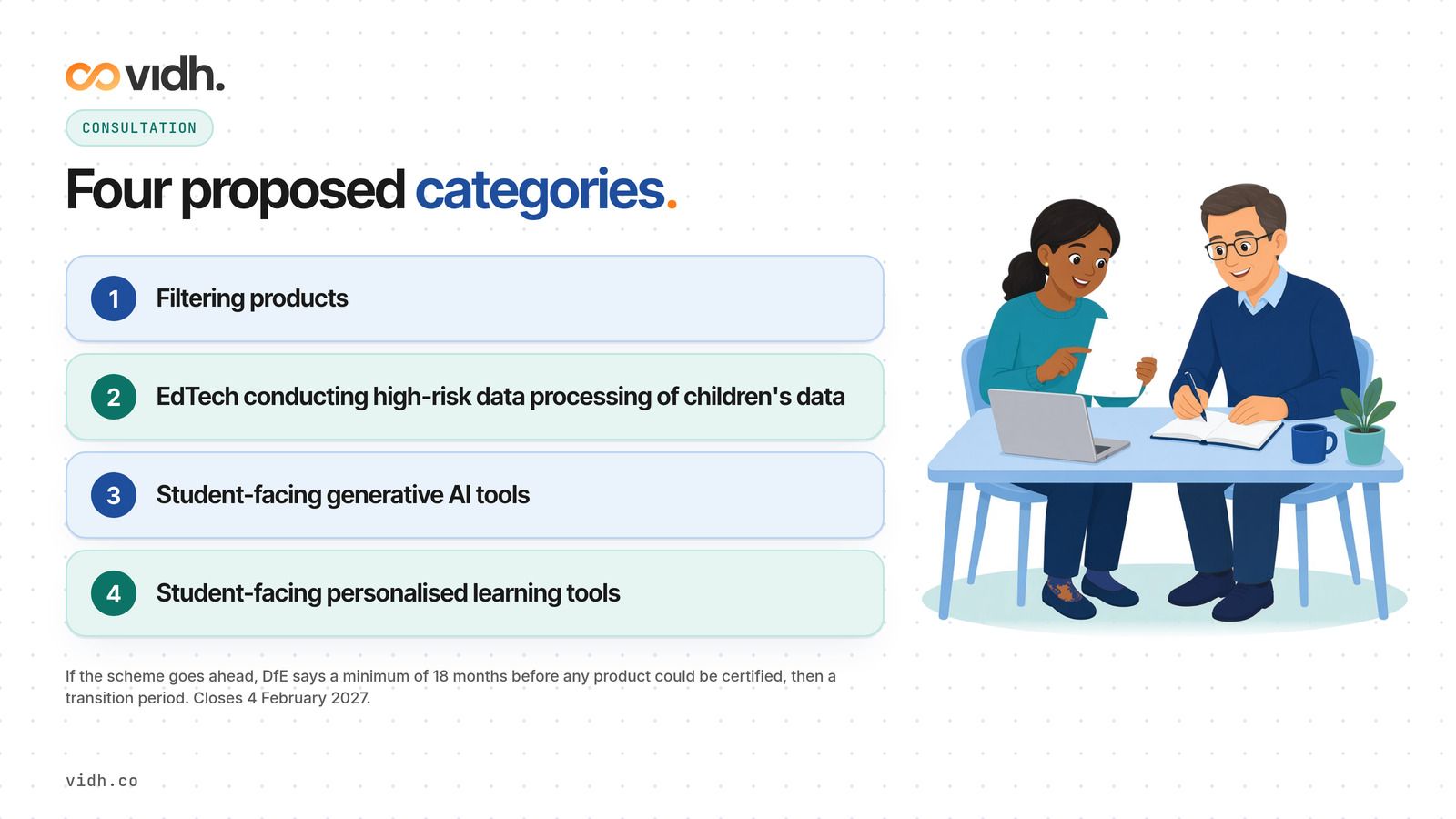
The consultation document groups the products in scope into four categories:
- Filtering products
- EdTech conducting high-risk data processing of children's data
- Student-facing generative AI tools
- Student-facing personalised learning tools
It adds: "Products in scope may fall into more than one category."
These are proposed categories, not a final list. The consultation asks for views on them.
What would not be covered, as proposed?
The document says: "Products have been excluded from this proposal where the risks are considered lower." The examples include:
- general office and communication tools, such as email and word-processing software, which do not conduct high-risk processing of children's personal data
- products that provide static content without personalisation, such as PDF textbooks and content repositories
- hardware and infrastructure, including computers, tablets, interactive whiteboards and projectors
- staff-facing products, including generative AI tools and administrative systems that do not conduct high-risk processing of children's personal data
If a tool sits on the boundary, that is a useful question to raise in your response.
How long would it take, if the scheme goes ahead?
The consultation document is explicit that this depends on the outcome: "Subject to the outcome of this consultation, a minimum of 18 months would be needed to establish the product certification scheme, before products could be certified, followed by a transition period to allow adoption by suppliers and education settings."
DfE also says the results of the consultation and its response "will be published on GOV.UK in Spring 2027."
This post does not describe the finished scheme as voluntary or as mandatory. That question is part of the consultation, and the final position is not set.
Who should respond, and how?
"The consultation is open to everyone, and all individuals and organisations with an interest in the proposals are welcome to respond."
The non-exhaustive list in the document includes school and college leaders, teachers and support staff, including procurement leads and IT leads; academy trusts, local authorities and college governing bodies; governors and trustees; parents and carers; pupils; organisations that support education settings, including safeguarding experts; and EdTech developers and suppliers.
Most of the questions are optional, so "you only need to answer questions that are applicable to you, and where you would like to comment." The document has a question overview that "indicates which questions may be especially relevant to specific groups."
DfE asks people to "use the online system wherever possible." The GOV.UK consultation page links to the response form. The Citizen Space page shows the consultation opened on 10 November 2026 and closes on 4 February 2027, matching the GOV.UK close time of 11:59pm on 4 February 2027.
A practical way to handle this in school is a 30-minute session with a member of the leadership team, the designated safeguarding lead and the IT lead, to agree one school response.
School leaders who want a wider sense of how easy it is for families to raise a concern can also use our parent communication audit. For day-to-day contact with families, see our guide to parent and teacher communication.
What should a leadership team prepare?
These prep questions are ours, not DfE's. They can help you walk into that session with a clear view:
- Which of our current tools fall into the four proposed categories, or sit on the boundary?
- What safety checks do we already do when we buy or renew a product?
- What would make certification useful for us, rather than another form to work through?
- Who will submit the response, and by when?
Questions school leaders ask
Is the scheme voluntary or mandatory?
The consultation asks for views on how a scheme would work, including questions about adoption. The final position is not set, so this guide does not describe the scheme as voluntary or as mandatory.
Does this apply outside England?
The GOV.UK page is marked "Applies to England", and the proposal is for EdTech and AI used in schools and other education settings in England. If you work in Scotland, Wales or Northern Ireland, the scheme as described here is not aimed at your setting, though anyone may still respond.
Can parents and governors respond?
Yes. The consultation is open to everyone. The document lists parents and carers, and governors and trustees, among the groups who may be interested.
When will products start being certified?
Not immediately, and only if the scheme goes ahead. DfE says a minimum of 18 months would be needed to establish the scheme before products could be certified, followed by a transition period.
Where do I find the questions that matter for school leaders?
Start with the question overview in the consultation document, which shows which questions are aimed at which groups. You are welcome to answer every question, but you do not have to.
How do I respond?
Use the online form linked from the GOV.UK consultation page. The consultation closes at 11:59pm on 4 February 2027.
Sources
- GOV.UK, Introducing an EdTech and AI product safety certification scheme (Department for Education, published 10 November 2026): https://www.gov.uk/government/consultations/introducing-an-edtech-and-ai-product-safety-certification-scheme
- DfE consultation document, Introducing a certification scheme for assuring EdTech and AI product safety (Citizen Space): https://consult.education.gov.uk/edtech-regulation-policy-team/education-technology-safety-assurance-certificatio/supporting_documents/introducing-a-certification-scheme-for-assuring-edtech-and-ai-product-safetypdf-1
- DfE consultation response page (Citizen Space; opened 10 November 2026, closes 4 February 2027): https://consult.education.gov.uk/edtech-regulation-policy-team/education-technology-safety-assurance-certificatio/consult_view/
All sources were opened on 14 November 2026.
About Vidh
Vidh (vidh.co) is an AI-powered platform for schools, built by Vidh Labs, that connects management, teachers, parents and students around each child.
Questions: hi@vidh.co