Back
England School Phone Rules: What Is Changing
5 min read
Schools in England should already follow statutory phone guidance. On 10 November, DfE said it will go further. What is changing, and what parents can ask.
By Bhagya, Vidh · Last updated: 18 November 2026
On 10 November 2026, the Department for Education (DfE) announced that it will strengthen its mobile phone guidance for schools in England. If your child is at secondary school, this guide sets out the rules that already apply, what DfE says should change, and what you can usefully ask your school now.
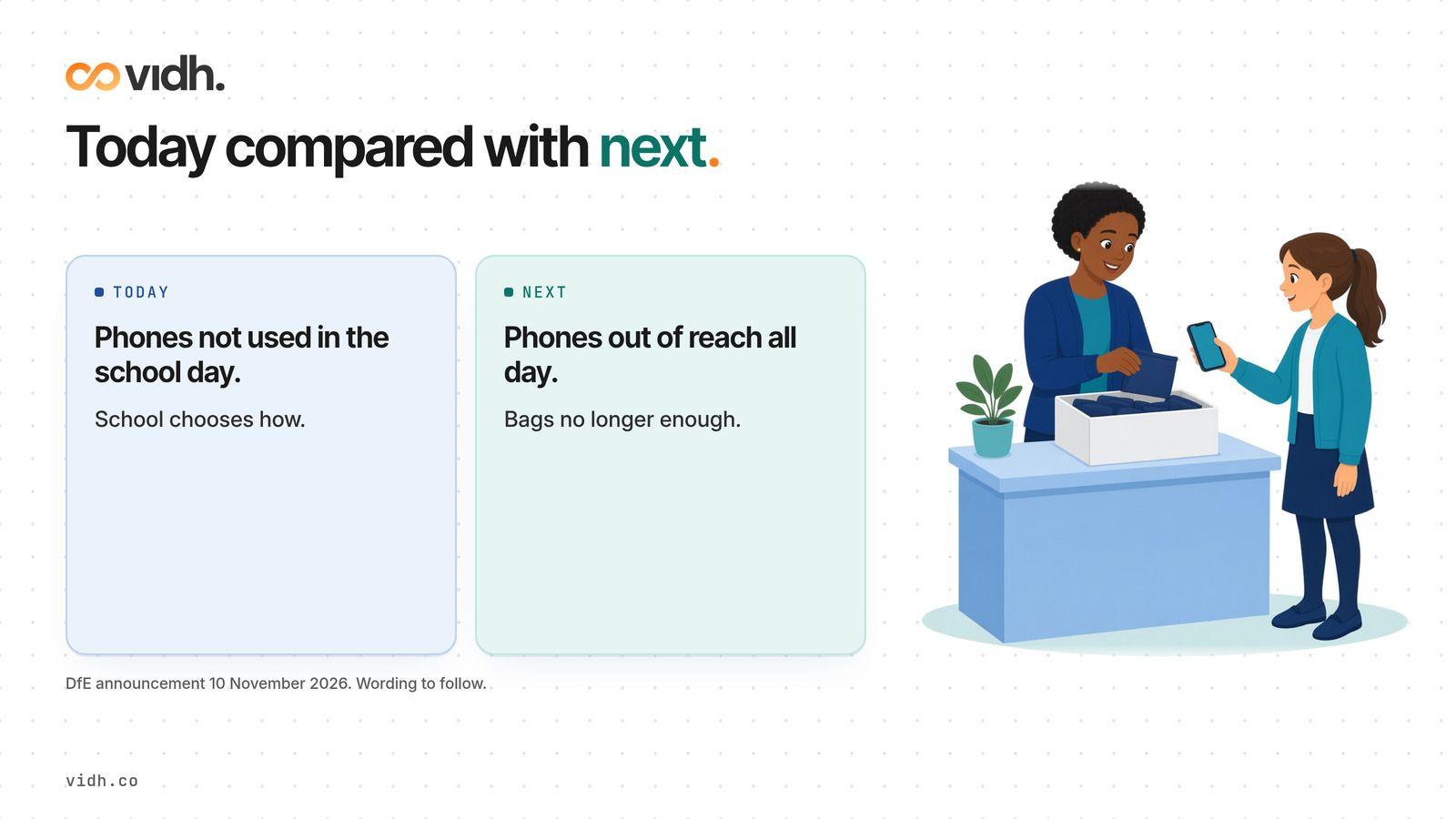
Short answer: From 1 September 2026, schools in England should follow statutory guidance that pupils do not have access to their phones throughout the school day, including breaktimes and lunchtime. The method is the headteacher's call. On 10 November, DfE said schools should go beyond "not seen, not heard", where a phone may stay in a bag. Wording is not yet published.
What do schools in England have to do today?
The current rules are in DfE's statutory guidance, "Mobile phones in schools", which was updated on 29 June 2026. The page is marked "Applies to England".
GOV.UK is clear on the start date that is already in force: "This guidance became statutory on 29 June 2026." It then says: "Schools should begin following it from 1 September 2026".
The guidance is about the whole school day, not only lessons. It "provides statutory guidance to individual schools and trusts on how to implement a policy that prohibits the use of mobile phones throughout the school day, including during lessons, the time between lessons, breaktimes and lunchtime."
DfE "expects schools to implement a policy whereby pupils do not have access to their mobile phone throughout the school day including during lessons, the time between lessons, breaktimes and lunchtime."
That is not the same as a single method every school must use. GOV.UK says: "There are a number of ways in which schools can ensure that they are mobile phone-free, and it is for headteachers to decide how best to achieve this within their own unique contexts."
The guidance also says: "All schools should be mobile phone-free environments by default; anything other than this should be by exception only."
Schools should publish the details of their policy. If you have not seen yours, ask the school office or check the school website.
What did DfE announce on 10 November?
In a GOV.UK news story published on 10 November 2026, DfE said the guidance will be strengthened.
The key line is: "The strengthened guidance will make clear that schools should go beyond 'not seen, not heard' - where phones may remain in pupils' bags - and adopt whole-school strategies that keep phones out of use and inaccessible throughout the school day."
In other words, a phone that is switched off in a bag may no longer be enough.
Education Secretary Lucy Powell put it simply: "Children should not be using smartphones at any point during the school day, full stop."
This is an announcement about future wording. It is not itself the new guidance, and it does not change your school's policy overnight.
What might "inaccessible" look like in practice?
DfE points to approaches some schools already use: "Some schools are already putting stronger whole-school approaches into practice through lockable pouches, collection at the start of the day, secure storage or prohibiting phones onsite altogether."
Those are examples, not a menu every school must pick from. The current statutory guidance still leaves the method to the headteacher. When the new wording is published, your school will confirm what it will do.
Why is the guidance being strengthened?
DfE says only 16% of secondary pupils say phone rules are followed all of the time. That figure comes from the 10 November GOV.UK announcement. The page does not name the underlying survey, so we have not added a sample size or year.
The same announcement says: "The strengthened guidance will build on this leadership, giving every school clearer backing to keep phones inaccessible and helping parents and pupils understand what a truly phone-free school day means."
When will the new wording start?
DfE has not published the new wording yet, and the 10 November announcement does not give a start date. A safe line to use at home is: your school will tell you what changes and when.
Until then, the statutory guidance that has applied from 1 September 2026 is the one your school should already be following.
What can parents do now?
Two practical questions are enough for most families:
- How will phones be stored during the school day?
- If I need to reach my child in an emergency, how do I do that through the school office?
On the second point, the current guidance already says: "Where parents need to contact their child during the school day, they should be directed to the school office, where staff should be aware of the school's policy on relaying messages and facilitating contact."
If the change is being discussed in a class parent chat, our Class WhatsApp group rules for UK parents can help keep that conversation calm. For day-to-day contact with school, see our guide to parent and teacher communication.
Vidh connects management, teachers, parents and students around each child. If you lead a school, our parent communication audit is a simple way to check how easy it is for families to raise a question.
Questions parents ask
Does this apply in Scotland, Wales or Northern Ireland?
The statutory guidance we quote here is marked "Applies to England". The 10 November announcement is about strengthening that guidance. If you live in Scotland, Wales or Northern Ireland, ask your child's school for its own phone policy.
Does the law require schools to ban phones?
No. What is in force today is statutory guidance, not a blanket legal ban. GOV.UK says the guidance "became statutory on 29 June 2026" and that "Schools should begin following it from 1 September 2026". How a school becomes phone-free is for the headteacher to decide.
What if my child needs a phone for a disability or medical condition?
Schools still have their other legal duties. The guidance says schools "must comply with their other legal duties such as the duty to make reasonable adjustments where necessary." It notes that, under the Equality Act 2010, "Allowing a disabled pupil access to their mobile phone during the school day, where it is necessary due to the nature of their disability, may be considered a reasonable adjustment". It also says that "in some circumstances, supporting a pupil with their medical condition can involve the use of a mobile phone." Raise this with the school, and ask for the arrangement to be written down.
How should I contact my child during the school day?
Go through the school office, rather than expecting your child to have their phone to hand. Ask the school how messages are passed on, including in an emergency.
Will every school use lockable pouches?
Not necessarily. Lockable pouches, collection at the start of the day, secure storage and a ban on phones on site are examples DfE has seen in schools already. Your school will choose the approach that fits its context, and should tell families what it is.
What about sixth form students?
The current guidance says schools "should consider whether students in the sixth form should be permitted access to their mobile phone at certain and limited times and locations, reflecting this period of education as one of increased independence and responsibility, without compromising the school's policy on the use of mobile phones for other pupils." It adds that this "should include prohibiting the use of mobile phones by sixth-form students in front of younger pupils, for example, limiting use to a sixth-form common room." Ask your school how its policy applies to post-16 students.
Sources
- GOV.UK, Strengthened guidance to take the next leap to phone-free schools (Department for Education, 10 November 2026): https://www.gov.uk/government/news/strengthened-guidance-to-take-the-next-leap-to-phone-free-schools
- GOV.UK, Mobile phones in schools (statutory guidance, updated 29 June 2026; applies to England): https://www.gov.uk/government/publications/mobile-phones-in-schools/mobile-phones-in-schools
All sources were opened on 14 November 2026.
About Vidh
Vidh (vidh.co) is an AI-powered platform for schools, built by Vidh Labs, that connects management, teachers, parents and students around each child.
Questions: hi@vidh.co