Back
UK Suspension Day 1: What Schoolwork Goes Home?
5 min read
What schoolwork should a suspended pupil get in England? DfE guidance effective 26 July 2026 on days 1 to 5, day six, and the call for evidence.
By Bhagya, Vidh · Last updated: 18 November 2026
When a pupil in England is suspended, the first school day at home sets the tone for everything after it. Statutory guidance from the Department for Education (DfE), effective from 26 July 2026, says what schools should do about schoolwork in those first days. DfE's call for evidence on school exclusion reform, which asks about exactly this, closes at 11:59pm on Thursday 19 November. This guide is for heads, pastoral leads and SENCOs in England, UK, who want a calm day-one routine in place before they need it. It is general information, not legal advice.
Short answer: At Vidh, we suggest schools in England settle their day-one work routine before they need it. DfE guidance effective from 26 July 2026 says heads should ensure work is set and marked during the first five school days of a suspension, the work should be achievable at home, and full-time education must be arranged from the sixth day.
What does the 2026 guidance say about the first five days?
The guidance is called "Suspension and permanent exclusion from maintained schools, academies and pupil referral units in England, including pupil movement". The version in force took effect on 26 July 2026, so check that your behaviour policy and letter templates cite it rather than an older edition.
Three paragraphs carry most of the weight for schoolwork:
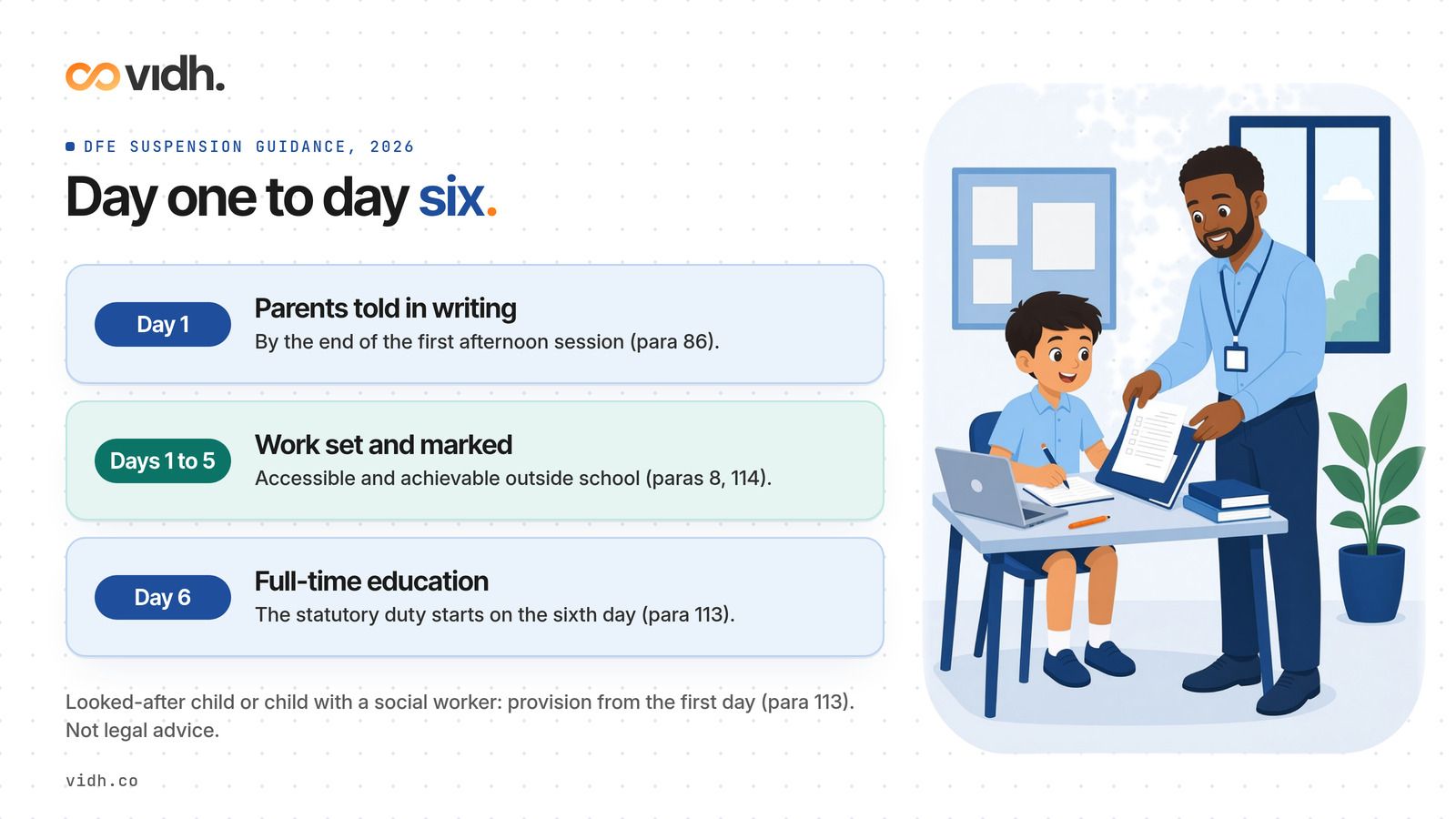
- Paragraph 8: "Headteachers should take steps to ensure that work is set and marked for pupils during the first five school days of a suspension."
- Paragraph 114: where alternative provision is not possible or not appropriate in the first five school days, "the school should take reasonable steps to set and mark work for the pupil." The work should be "accessible and achievable by the pupil outside school".
- Paragraph 113: the "statutory duty on governing boards or local authorities is to arrange full-time education from the sixth day" of a suspension or permanent exclusion.
The guidance names online platforms as one way to set work. It also includes a safeguard worth copying into your own policy: "Any time a pupil is sent home due to disciplinary reasons and asked to log on or utilise online pathways should always be recorded as a suspension."
What should reach home on day one?
The headteacher must tell parents which days their child must not be in a public place during school hours, without delay and at the latest by the end of the afternoon session on the first day (paragraphs 85 and 86). Sending the work plan with that notice means the family hears everything once, in writing.
A day-one pack that works for most pupils has five parts:
- Today's tasks. One or two pieces the pupil can start straight away, without logging in.
- The rest of the week. Tasks for the remaining days, in the order of the pupil's usual timetable.
- One named contact. A member of staff, how to reach them, and when they will reply.
- How work comes back. A photo of written work, an upload, or paper returned on a set day.
- When feedback arrives. For example, marked work back within two school days.
How do you make the work accessible at home?
Paragraph 114 asks schools to "ensure that the work set is accessible and achievable by the pupil outside school". In practice:
- Paper as well as screens. Online platforms suit a pupil with a device and a quiet place to work. If either is missing, post or hand over a printed pack.
- Work they can do alone. Practice, reading and revision on topics already taught travel better than new content that needs a teacher in the room.
- SEND adjustments. Paragraph 8 is plain: "The school's legal duties to pupils with disabilities or SEN remain in force". Ask the SENCO to check the pack before it goes out, for reading level, chunking or a visual timetable.
Who marks the work, and how does feedback get back?
Agree this before the first suspension of the year. Subject teachers usually mark their own subjects, and the form tutor or pastoral lead checks that work has come back at all. A few lines of feedback per task is enough. The point is that the pupil sees an adult read their work.
Keep a simple log of what was sent, what came back and what was marked. It gives the reintegration meeting something concrete to discuss, and it shows governors what happened during the suspension.
What happens from day six?
From the sixth school day, full-time education must be arranged (paragraph 113). The guidance adds that "there is an obvious benefit to the pupil in starting this provision as soon as possible." For a looked-after child or a child with a social worker, the school and the local authority should work together to arrange alternative provision "from the first day following the suspension or permanent exclusion."
If alternative provision is being arranged, paragraph 87 lists what the notice to parents must include where it can reasonably be found out in time: the start date, the start and finish times, the address, and who the pupil should report to on the first day.
How does day-one work help the return?
Schools should design a reintegration strategy and communicate it "at a reintegration meeting before or at the beginning of the pupil's return to school." Marked work from the suspension is useful at that meeting. It shows the pupil they are still part of the class, and it gives everyone a practical starting point.
"Where possible this meeting should include the pupil's parents." The guidance is just as clear that "a pupil should not be prevented from returning to a mainstream classroom if parents are unable or unwilling to attend a reintegration meeting."
A short private message to parents before the meeting helps. Our guide to choosing a parent-teacher communication app explains why one-to-one messages work better than group chats for sensitive topics. With one-to-one parent replies in Vidh, a pastoral lead can tell a family exactly what work is coming and when.
What is DfE's call for evidence asking?
DfE opened a call for evidence on school exclusion reform on 15 October 2026, linked to the schools white paper "Every child achieving and thriving". The reforms relate to "the use of internal suspension", "reintegration support partnerships following a suspension" and "provision of schoolwork during the first 5 days of suspension and permanent exclusion".
DfE says: "Responses should be supported by research, data and practical examples." It closes at 11:59pm on Thursday 19 November 2026. If your school has a day-one routine that works, or one that has not, that is the kind of practical example the call asks for. This guide takes no position on the proposed reforms.
For a wider look at how your school talks to families, try our parent communication audit.
Questions heads ask
Does sending a pupil home to work online count as a suspension?
Yes. Paragraph 8 says that any time a pupil is sent home for disciplinary reasons and asked to log on or use online pathways, it should always be recorded as a suspension.
Does this guidance apply in Scotland, Wales or Northern Ireland?
No. This statutory guidance applies to England. Schools elsewhere in the UK should follow their own government's guidance.
What about pupils with SEND?
The school's legal duties to pupils with disabilities or SEN stay in force during a suspension, including reasonable adjustments in how they are supported. Involve the SENCO in the work pack from day one.
Do parents have to attend the reintegration meeting?
The meeting should include parents where possible. A pupil should not be kept out of a mainstream classroom because parents cannot or will not attend.
Is a lunchtime suspension still a suspension?
Yes. Paragraph 9 says a suspension can be for parts of the school day, and the legal requirements, such as the headteacher's duty to notify parents, apply in all cases.
Sources
- GOV.UK, School exclusion reform, call for evidence (published 15 October 2026; closes 11:59pm on 19 November 2026): https://www.gov.uk/government/calls-for-evidence/school-exclusion-reform
- Department for Education, School Exclusion Reform, Call for Evidence (response site): https://consult.education.gov.uk/school-absence-and-exclusions-team/school-exclusion-reform-call-for-evidence/
- GOV.UK, School suspensions and permanent exclusions, statutory guidance page (last updated 26 July 2026): https://www.gov.uk/government/publications/school-exclusion
- Department for Education, Suspension and permanent exclusion guidance, effective from 26 July 2026 (PDF; paragraphs 8, 9, 30, 31, 85, 86, 87, 113 and 114): https://assets.publishing.service.gov.uk/media/6a63426d9a419980593b2b80/suspension-and-permanent-exclusion-from-maintained-schools-academies-and-pupil-referral-units-in-England-including-pupil-movement-effective-from-26-July-2026.pdf
All sources were opened on 16 November 2026.
About Vidh
Vidh (vidh.co) is an AI-powered platform for schools, built by Vidh Labs, that connects management, teachers, parents and students around each child.
To see how Vidh works for your school, book a 30-min demo.
Questions: hi@vidh.co