Back
CBSE Holistic Progress Card in India: Who Fills What
6 min read
Who fills in the CBSE holistic progress card? A guide for schools in India to each part, from the learner's insights to parent observations.
By Bhagya, Vidh · Last updated: 19 November 2026
Half-yearly reports are on the way in many CBSE schools in India, and for primary classes some schools now use a holistic progress card (HPC). The format looks long the first time a teacher opens it. Most of the confusion comes down to one question: who fills in which part? This guide walks CBSE coordinators, class teachers and principals in India through the card, section by section, using CBSE's own notification and manuals.
Short answer: Vidh's quick guide for CBSE schools in India: the holistic progress card has four voices. Teachers fill in student details with parents and record progress, the child reflects on themselves, a classmate gives peer feedback, and parents add observations. CBSE's notification 82/2023 says affiliated schools may adopt or adapt the prototypes.
What is the holistic progress card?
The idea comes from the National Education Policy 2020. CBSE's implementation guide for teachers explains that Para 4.35 of NEP 2020 recommends the HPC "to provide a 360 degree, multidimensional report of progress". It brings together self-assessment, peer assessment and teacher assessment, and it draws on evidence such as projects, group work and portfolios.
CBSE has published HPC material for three stages:
- Foundational Stage, age 3 to 6, and Grades 1 and 2, announced in CBSE notification 82/2023, dated 27 December 2023.
- Preparatory Stage, Classes 3 to 5, an exemplar card based on the National Curriculum Framework for School Education (NCF-SE 2023).
All of them are on the CBSE academic manuals page, along with the implementation guide for teachers.
Is the HPC compulsory for CBSE schools?
The documents use permissive language. Notification 82/2023 says: "The schools affiliated to the Board may adopt / adapt the HPC Prototypes for their institution." The Preparatory Stage card says "CBSE-affiliated schools may adapt/adopt the card as per their context."
So a school can use CBSE's card as it is, or change it to suit its own context. Check the latest CBSE circulars for your stage before you finalise your format.
Who fills in which part of the card?
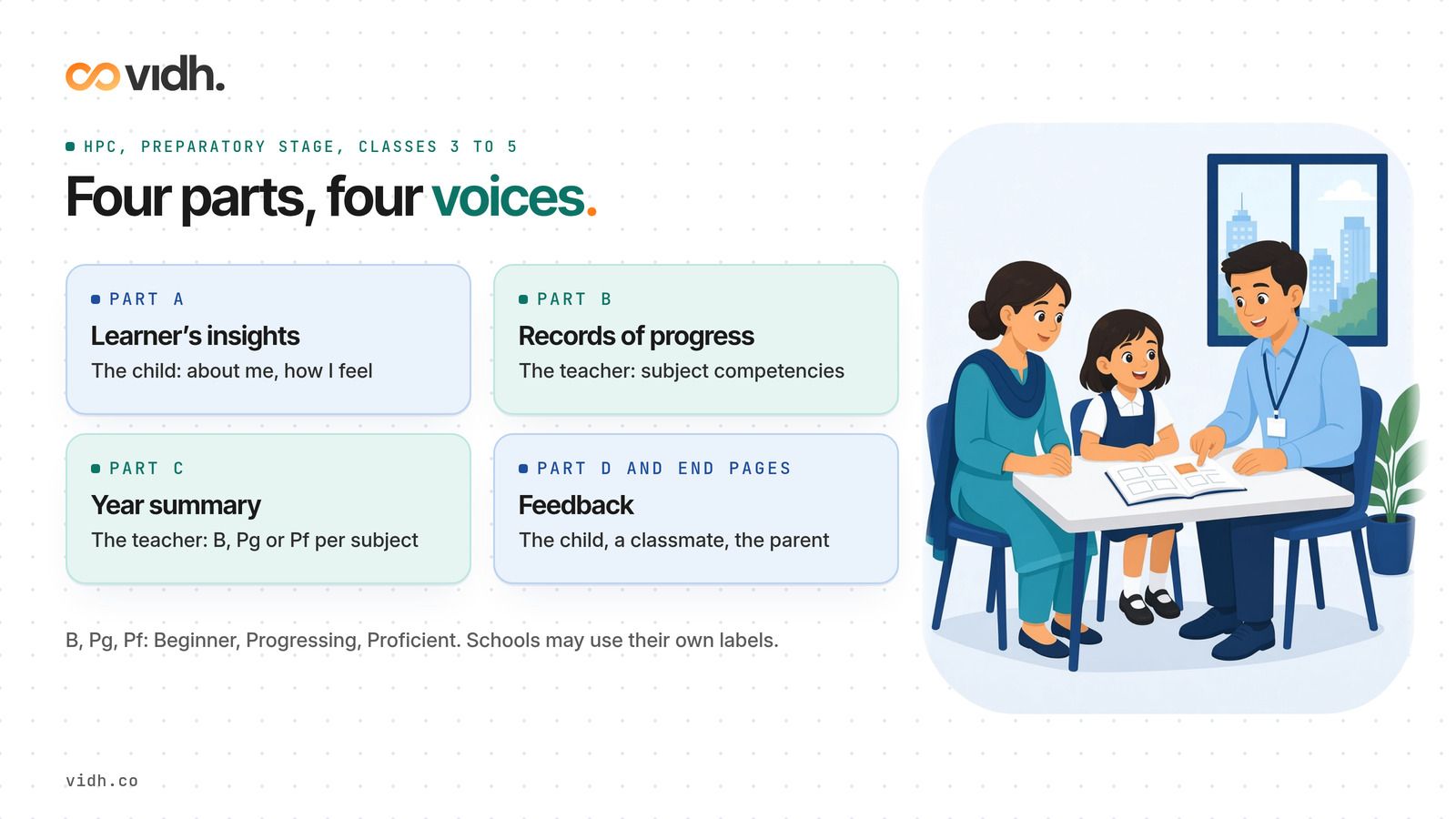
The Preparatory Stage card (Classes 3 to 5) is the clearest example. The card itself describes the mix: "The card is a combination of a child's own expression of self, teacher assessment, and peer assessment." Parents have their own section too.
Student information and attendance
The first page carries the child's details, class teacher and guardians. It is marked "(To be filled by the teacher in consultation with the parent/caregiver)". Attendance is recorded month by month, from April to March.
Part A: Learner's insights (the child)
The child draws or pastes a picture of themselves and their family, and shares things about themselves. A "How do I feel at school?" section asks the child to tick yes or no against simple statements each term, such as "I can talk about how I feel".
Part B: Records of progress (the teacher)
For each subject, the card lists curricular goals and competencies, term by term, with space for Teacher's Observations. This is the part that needs evidence gathered across the term.
Part C: Summary for the academic year (the teacher)
For each subject area, the teacher ticks a performance level based on the whole year, Beginner (B), Progressing (Pg) or Proficient (Pf), and adds observations and areas of improvement. The card adds that "Schools may use their own indicators to depict students' performance levels", as long as they do not carry negative connotations, and suggests "Budding, Sprouting and Blossoming" as one alternative set.
Part D: Learner's feedback (the child)
Each term the child answers four questions: what am I good at, what did I enjoy, what did I find challenging, and what is my action plan for next term.
Peer feedback (a classmate)
A classmate ticks Yes, No or Cannot Say against statements such as "My friend respects everyone's opinions." Keep it kind and low stakes, and prepare children for it first.
Parent's observation (the parent)
Parents answer Yes, No or Can not say to statements about their child, such as finding school a welcoming space and a safe space, and tick the areas where "MY CHILD NEEDS SUPPORT WITH" applies, from reading and mathematics to working independently at home.
How should teachers gather evidence?
Part B only works if teachers have notes to draw on. CBSE's implementation guide covers tools such as anecdotal records and portfolios. It also gives a useful reminder: "Remember the focus is to assess the task and not the learner."
A routine that keeps it manageable:
- Little and often. A few short anecdotal notes per child each week are easier than a rush before the report.
- One portfolio per child. Keep two or three pieces of work per term that show progress, dated.
- Same codes everywhere. Use the card's competency codes in your notes so they map straight onto Part B.
CBSE's own training material for the Preparatory Stage lists "lack of time and workload" among the challenges teachers raise about assessment. Planning the evidence routine at the start of term is the best answer to that.
How do you bring parents in?
The implementation guide says "The HPC will form an important link between home and school and will be accompanied by parent-teacher meetings". Teachers are asked to ensure that "Assessment incorporates the parents' feedback."
Before the half-yearly meeting, send parents a short note explaining the three levels and their own section of the card. Then use the meeting to agree one next step for home. Our post on student analytics for parent-teacher meetings has more on making that time count. If a report is disappointing, our guide on what to say after a low report card is a good one to share with families.
Schools using Vidh can run their holistic progress card workflow in one place, with teacher, parent and child inputs connected around each child.
Questions coordinators ask
Which classes does CBSE's HPC material cover?
CBSE has published cards for the Foundational Stage (age 3 to 6), Grades 1 and 2, and the Preparatory Stage (Classes 3 to 5), along with an implementation guide for teachers.
Can we use our own labels instead of B, Pg and Pf?
Yes. The Preparatory Stage card says schools may use their own indicators, as long as they are not negative or discriminatory. It suggests Budding, Sprouting and Blossoming as one option.
Who fills in the peer feedback?
A classmate, by ticking Yes, No or Cannot Say against simple statements about how the child gets on with others. The card does not say how classmates are chosen, so agree a fair approach across your school.
Do parents have to fill in a section?
The card has a parent's observation section, and CBSE's guide asks teachers to make sure assessment includes parents' feedback. How the school collects it, on paper, at a meeting or online, is up to the school.
Where can teachers ask CBSE questions about the HPC?
Notification 82/2023 gives a CBSE email address for HPC queries. You will find it at the end of the notification, linked in Sources below.
Sources
- CBSE, Notification 82/2023, Holistic Progress Card (HPC) for Foundational Stage, 27 December 2023 (PDF): https://cbseacademic.nic.in/web_material/Notifications/2023/82_Notification_2023.pdf
- CBSE, Holistic Progress Card, Preparatory Stage, Classes 3 to 5 (PDF): https://cbseacademic.nic.in/web_material/Manuals/HPC_PreparatoryReport25.pdf
- CBSE, HPC Implementation Guide for Teachers (PDF): https://cbseacademic.nic.in/web_material/Manuals/HPC_TeacherGuide.pdf
- CBSE, HPC Preparatory Stage Training Manual (PDF): https://cbseacademic.nic.in/web_material/Manuals/HPC_PreparatoryManual25.pdf
- CBSE Academic, manuals page: https://cbseacademic.nic.in/manual.html
All sources were opened on 16 November 2026.
About Vidh
Vidh (vidh.co) is an AI-powered platform for schools, built by Vidh Labs, that connects management, teachers, parents and students around each child.
To see how Vidh works for your school, book a 30-min demo.
Questions: hi@vidh.co