Back
India Hybrid School Days: A Calm Home Plan, Class 1 to 5
5 min read
GRAP Stage III means hybrid classes for Class 1 to 5 in Delhi-NCR, India. Who decides online or in person, and a calm home plan for hybrid school days.
By Bhagya, Vidh · Last updated: 16 November 2026
If your child is in Class 1 to 5 in Delhi-NCR, India, school may look different this month. With air quality under the Graded Response Action Plan (GRAP) at Stage III, schools offer these classes in hybrid mode. This guide explains what that means, who decides between online and in person, and how to run a calm school day at home.
Short answer: Under GRAP Stage III, Delhi-NCR schools offer Class 1 to 5 in hybrid mode where online classes are possible, and families choose online or in person. On hybrid days, keep a fixed school-time block, move indoors, close windows on bad-air hours, and avoid strenuous outdoor play. Check your school's latest message, because district rules differ.
What does hybrid mode mean for Class 1 to 5?
The GRAP is set by the Commission for Air Quality Management (CAQM). Its schedule says that under Stage III, governments in the NCR are "to mandatorily conduct classes in schools for children up to class V" in hybrid mode, meaning "both in physical and online mode (wherever online mode is feasible)".
This applies in Delhi and in the districts of Gurugram, Faridabad, Ghaziabad and Gautam Buddh Nagar (Noida). Other NCR areas may also choose hybrid classes. Hybrid is not a closure. Children can still attend in person, and online classes run alongside where the school can offer them.
The stage can change as air quality changes. At the time of writing, on 14 November 2026, news reports said Stage III was still in force.
Online or in person: who decides?
You do. The CAQM schedule says: "The option to exercise the online mode of education, wherever available, shall vest with the students and their guardians."
In practice, the details come from your state government, your district and your school: timings, which classes run online, and how attendance is marked. These can differ between Delhi, Noida and Gurugram, and between schools. Read your school's latest message, and ask your child's teacher if anything is unclear.
What does a calm hybrid day at home look like?
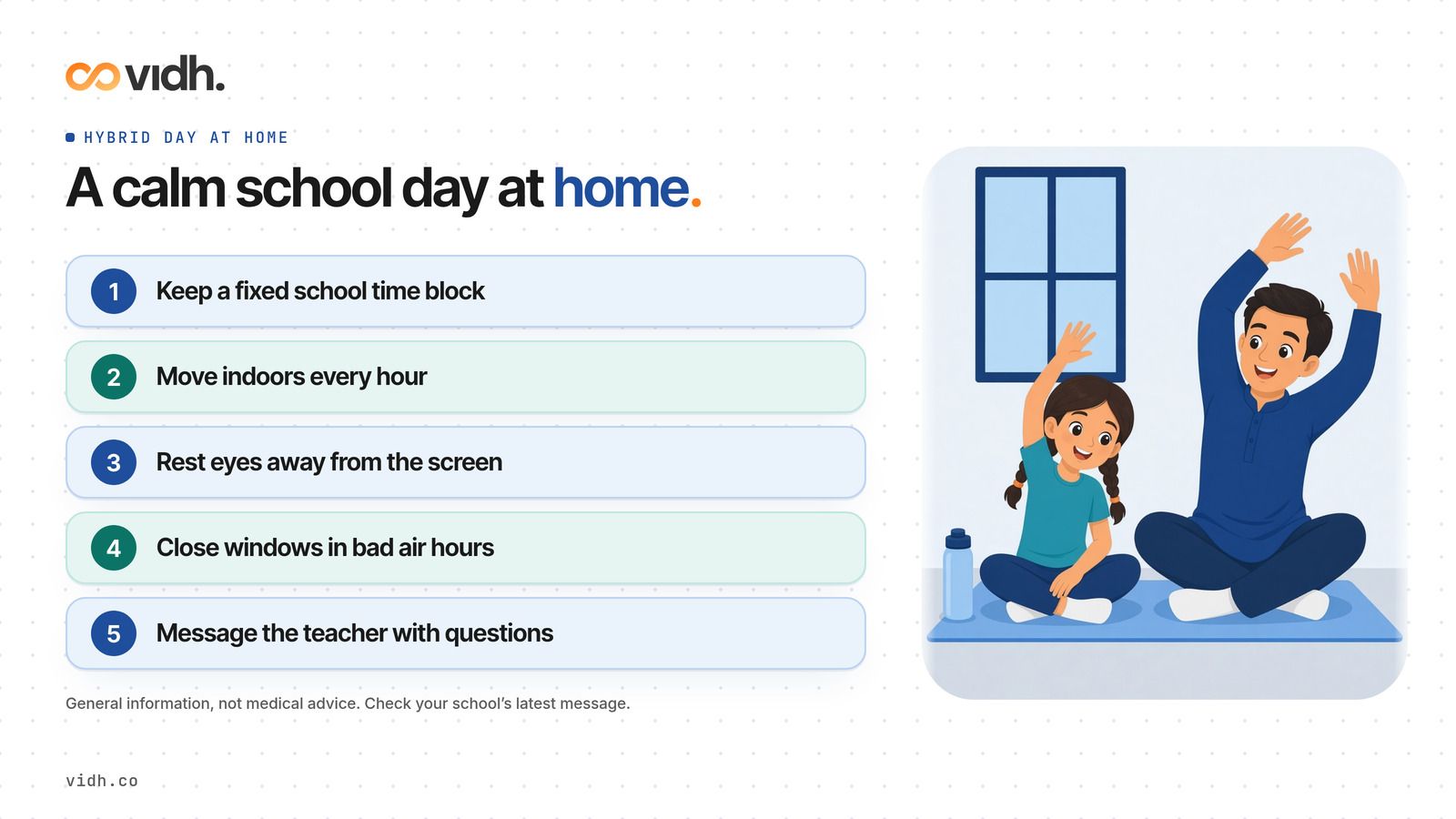
Young children cope best when an online day still feels like a school day:
- Keep the school-time block. Same wake-up time, uniform or school clothes if your child likes that, and breakfast before the first class.
- Set up one learning spot. A table near natural light, the device charged, books and a pencil ready the night before.
- Move indoors every hour. Stretches, a short dance, or animal walks across the room. Keep it gentle on bad-air days.
- Rest the eyes between classes. Look out of the window or across the room, away from the screen. Our guide to screen time in schools has more on balance.
- End the school day on time. A clear finish helps children switch off. The routine ideas in our Diwali break routine work for hybrid weeks too.
How do we keep indoor air cleaner?
Children are especially vulnerable to polluted air. UNICEF explains: "As children are growing, their developing lungs and brains makes them especially vulnerable to air pollution." UNICEF also notes that children breathe faster than adults and take in more air for their body weight.
UNICEF's advice for homes includes:
- Close windows and doors on high-pollution hours. UNICEF says: "Close windows and doors during high pollution".
- Ventilate while cooking. UNICEF says to "Ensure the cooking area is well-ventilated by opening windows and using exhaust fans to allow heat and fumes to escape."
- Avoid smoke indoors. UNICEF advises: "Don't burn candles or incense or use air fresheners that add toxic chemicals to the air." No smoking indoors or near children.
- Consider an air purifier if your budget allows. UNICEF says: "If possible, consider installing air purifiers with high efficiency particulate air (HEPA) filters which are effective against indoor air pollution."
This is general information, not medical advice. If your child has asthma or another breathing condition, ask your doctor what to do on bad-air days.
What should the school run look like on bad-air days?
If your child goes to school in person, a few small changes help:
- Check the air first. UNICEF suggests: "Check if air quality information is available on weather apps or local news for where you live."
- Choose quieter roads. UNICEF says: "Avoid roads with lots of traffic".
- Skip the sprint to the gate. UNICEF advises that when pollution is particularly bad, "it is best that children avoid strenuous activity."
The World Health Organization puts the stakes simply: "Air pollution is one of the greatest environmental risks to child health".
What should I ask my child's teacher?
A short message to the class teacher can save a lot of guessing. You could ask:
- Which days and times are online, and which are in school?
- How is attendance marked for online days?
- Where will homework and class notes be shared?
- Who should I contact if the link or device does not work?
- What should my child do if they miss part of a class?
Vidh connects management, teachers, parents and students around each child, including one-to-one replies between parents and teachers. For more, see our guide to parent and teacher communication.
Questions parents ask
Does hybrid mode apply to Class 6 and above?
Not at Stage III. The CAQM schedule extends hybrid mode to classes VI to IX and XI only at Stage IV, the highest stage. If the stage changes, your school will tell you.
Are the rules the same in Noida and Gurugram?
The CAQM schedule names Gurugram, Faridabad, Ghaziabad and Gautam Buddh Nagar alongside Delhi, but each state and district issues its own instructions. Follow your school's latest message.
Should my child wear a mask?
Ask your doctor. UNICEF says that the WHO does not have specific advice on masks for children in polluted air, and suggests checking with a health provider based on your child's age, health and local air quality.
Can my child play outside?
On bad-air days, keep play indoors and gentle. UNICEF says that when pollution is particularly bad, "it is best that children avoid strenuous activity." On clearer days, outdoor play can return.
What about homework on hybrid days?
Ask the teacher how much is expected on online days, and keep it inside the school-time block so evenings stay calm.
Sources
- CAQM, Graded Response Action Plan (GRAP) for the NCR, schedule (Revision 29.09.2026): https://caqm.nic.in/FileUploadDomain/WebsiteDocument/GRAP/GRAP%20Schedule/01fcdebf-83e1-4cfe-bc0c-d0b1470a4d4e.pdf
- UNICEF Parenting, What you need to know about air pollution: https://www.unicef.org/parenting/emergencies/air-pollution
- UNICEF East Asia and Pacific, How can I protect my child from air pollution?: https://www.unicef.org/asia-pacific/stories/how-can-i-protect-my-child-air-pollution
- WHO, Ambient (outdoor) air quality and health: https://www.who.int/news-room/fact-sheets/detail/ambient-(outdoor)-air-quality-and-health
All sources were opened on 15 November 2026. GRAP stages change with air quality; check CAQM and your school for the latest.
About Vidh
Vidh (vidh.co) is an AI-powered platform for schools, built by Vidh Labs, that connects management, teachers, parents and students around each child.
Questions: hi@vidh.co