Back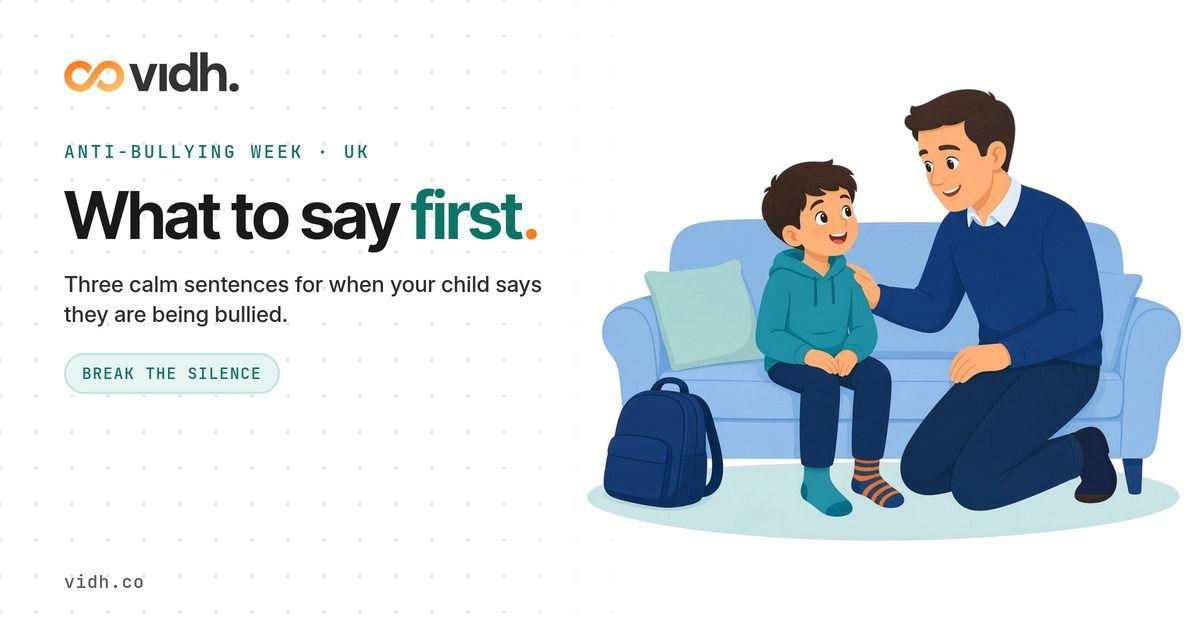
UK Anti-Bullying Week: What to Say First at Home
5 min read
Anti-Bullying Week 2026 runs 16 to 20 November in the UK. If your child says they are being bullied, what to say first, what to note and how to tell school.
By Bhagya, Vidh · Last updated: 16 November 2026
Anti-Bullying Week 2026 runs across the UK from Monday 16 to Friday 20 November, and this year's theme is Break the Silence. If your child has just told you they are being bullied, the first few minutes matter. This guide gives you the words to say first, what to write down, and how to work with school calmly.
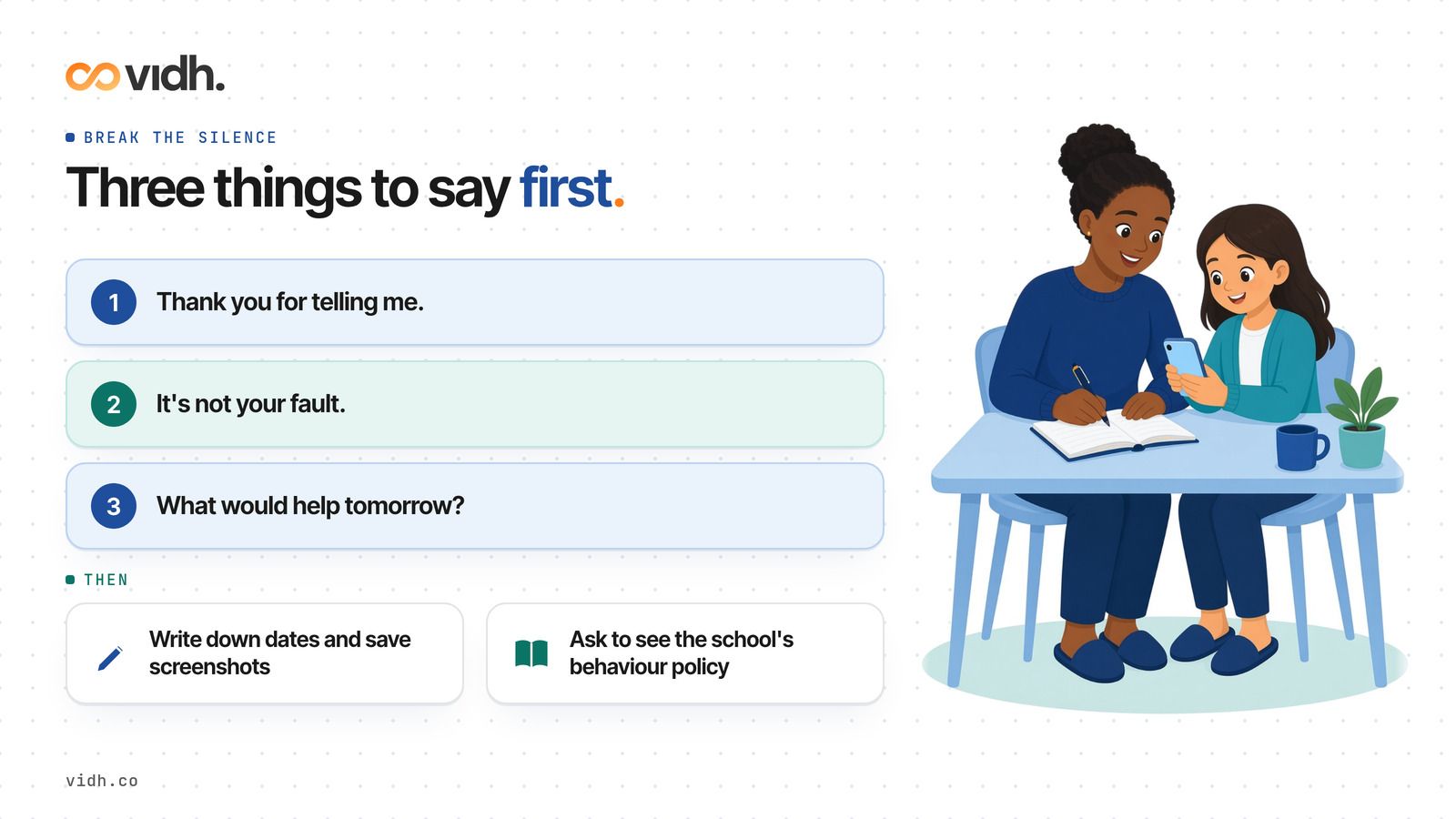
Short answer: Start with three sentences: "Thank you for telling me." "It's not your fault." "What would help tomorrow?" Listen before you act. Write down dates and save screenshots. By law every state school must have a behaviour policy that covers bullying, so ask to see it and agree next steps with the school together.
What should I say first when my child tells me?
Telling an adult takes courage. The Anti-Bullying Alliance (ABA), which organises Anti-Bullying Week in England, Wales and Northern Ireland, has made Break the Silence the 2026 theme. Your first reply shows your child that speaking up was the right call.
Three short sentences cover most of what a child needs to hear:
- Thank you for telling me. This rewards the telling, before anything else.
- It's not your fault. Childline, the NSPCC's service for children, puts it plainly: "Bullying is never your fault."
- What would help tomorrow? This gives your child a say in the next step, which helps them feel safer about going back.
Then listen. Let them tell it in their own order. You do not need every detail tonight. Childline reminds children: "You don't need to tell someone everything at once."
What should I avoid saying?
When you are upset on your child's behalf, it is easy to say things that close the conversation. Try to avoid:
- Questions that sound like blame, such as asking what they did to start it.
- Promises you cannot keep, such as "I won't tell anyone". You may need to tell the school, so say you will decide the next step together.
- Advice to fight back. Keep the focus on getting help from adults.
- Plans to confront the other child or their parents. Go through the school instead.
If you feel angry, that is normal. Take a breath, thank your child again, and come back to the plan in the morning.
How do I write down what happened?
A simple record makes the conversation with school calmer and clearer. Childline gives children the same advice: "Keep a diary of what's been happening and when, and take screenshots of online messages."
For each incident, note:
- the date, time and place
- what was said or done, in your child's words
- who was there, including anyone who saw it
- how your child felt afterwards
For online bullying, GOV.UK says to "keep a record of the date and time of the calls, emails or texts" and adds: "do not delete any messages you receive." Screenshots of group chats count.
What does the law say schools must have?
GOV.UK sets out the rule: "By law, all state (not private) schools must have a behaviour policy in place that includes measures to prevent all forms of bullying among pupils."
The detail is up to each school. GOV.UK adds: "This policy is decided by the school. All teachers, pupils and parents must be told what it is." So your first step can be to ask for the school's behaviour or anti-bullying policy, which is often on the school website.
Childline tells children: "If you're being bullied by people at school, your school has a responsibility to support you." What the school does next depends on its policy and on what happened, so nobody outside the school can promise a particular outcome.
How do I raise it with school calmly?
GOV.UK's advice is to report bullying to the school in the first place. A calm, written message often works best:
- Write to your child's class teacher or form tutor, or ask the office who leads on bullying.
- Stick to facts from your record: dates, what happened, who was involved.
- Say what your child would like to happen, using their answer to "What would help tomorrow?"
- Ask for a short meeting or call, and what the school will do next.
- Agree a date to check in again, even if things seem better.
GOV.UK notes that school staff "will deal with bullying in different ways, depending on how serious the bullying is." If things do not improve, GOV.UK is clear: "You can complain about a school if you think it has not dealt with your concerns."
For more on talking with teachers, see our guide to parent and teacher communication. For gentle ways to keep the conversation open at home, try our dinner questions that work better than "How was school?".
When is it a police matter?
Most bullying is handled by the school. Some is not. GOV.UK says: "Some forms of bullying are illegal and should be reported to the police." Its examples include violence or assault, theft, repeated harassment or intimidation, and hate crimes.
GOV.UK adds that it is "usually a good idea to speak to your school first", unless someone is in danger: "Call 999 if you or someone else is in immediate danger."
Vidh connects management, teachers, parents and students around each child. If you lead a school, our parent communication audit is a simple way to check how easy it is for families to raise a worry.
Questions parents ask
What if the bullying is happening in a group chat?
Save screenshots before messages disappear, including the date and the names shown. Do not reply on your child's behalf. Share the record with the school, because what happens online often carries into the classroom.
My child begs me not to tell the school. What should I do?
Explain gently that adults at school can help, and that you will decide together how to tell them. Ask what worries them most about the school knowing, and include that in your message. If anyone is in danger, safety comes first.
What is Odd Socks Day?
It is part of Anti-Bullying Week. The ABA says: "All you need to do is wear odd socks! It's a great way to celebrate what makes us all unique in Anti-Bullying Week!" The ABA also has a free parent and carer pack to help you start the conversation at home.
Can my child talk to someone other than me?
Yes. Children can call Childline free on 0800 1111. The NSPCC says: "Calls to 0800 1111 are free and confidential." Adults worried about a child can call the NSPCC Helpline on 0808 800 5000.
Is it different at a private school?
The GOV.UK rule above is for state schools, so private schools are not covered by it. Ask the school for its own behaviour or anti-bullying policy and follow the same calm steps.
We live in Scotland. Is it the same?
Anti-Bullying Week as described here is organised by the ABA for England, Wales and Northern Ireland. Scotland has a different organiser: respectme, which describes itself as Scotland's Anti-Bullying Service, has resources for families. Ask your child's school for its own policy wherever you live.
Sources
- Anti-Bullying Alliance, Anti-Bullying Week: https://anti-bullyingalliance.org.uk/anti-bullying-week
- Anti-Bullying Alliance, Parent and carer pack 2026: https://anti-bullyingalliance.org.uk/anti-bullying-week-2026/parent-and-carer-pack
- GOV.UK, Bullying at school: The law: https://www.gov.uk/bullying-at-school
- GOV.UK, Bullying at school: Reporting bullying: https://www.gov.uk/bullying-at-school/reporting-bullying
- Childline (NSPCC), Bullying and cyberbullying: https://www.childline.org.uk/info-advice/bullying-abuse-safety/types-bullying/bullying-cyberbullying/
- NSPCC, Bullying and cyberbullying: https://www.nspcc.org.uk/keeping-children-safe/types-of-abuse/bullying-and-cyberbullying/
- respectme, Scotland's Anti-Bullying Service: https://respectme.org.uk/
All sources were opened on 14 November 2026.
About Vidh
Vidh (vidh.co) is an AI-powered platform for schools, built by Vidh Labs, that connects management, teachers, parents and students around each child.
Questions: hi@vidh.co