Back
Outdoor Play Season: 60 Active Minutes a Day
7 min read
How much physical activity do kids need? The 60-minute daily guide, what counts as vigorous, muscle and bone play, 10 outdoor ideas and heat safety.
By Bhagya, Vidh · Last updated: 15 November 2026
As the weather cools, evenings and weekends outdoors become easier for many families in the Gulf. It is a good time to build an active habit that lasts all year. This guide explains how much activity children need, what counts, and simple ways to fit it in.
Short answer: Children and teens aged 6 to 17 need at least 60 minutes of moderate to vigorous activity every day, says US CDC guidance. Short bursts count. Include vigorous play like running games, plus climbing and jumping, at least three days a week. The cooler months are an easy time to build the habit outdoors.
How much activity does my child need each day?
The US Centers for Disease Control and Prevention (CDC) says: "Children and adolescents 6 to 17 need to be active for at least 60 minutes every day." It adds that this group needs "60 minutes or more of moderate-to-vigorous intensity physical activity each day".
For younger children, the CDC says: "Children 3 to 5 need to be active throughout the day."
Why it matters: the World Health Organization (WHO) says that "In children and adolescents, physical activity promotes bone health, encourages healthy growth and development of muscle, and improves motor and cognitive development."
Many children fall short. Globally, the WHO reports that one in four adolescents aged 11 to 17 "reported no active days" in the last week, meaning days with at least 60 minutes of moderate to vigorous activity. That is a global figure, not a figure for any one country.
Does it have to be 60 minutes in one go?
No. The WHO guidelines highlight "that any amount of physical activity is better than none; all physical activity counts". A walk to the shop, a game in the park and a dance in the living room all add up.
School helps too. The CDC says "school-based physical activity can help children meet the recommended 60 minutes or more of daily physical activity." And it reassures parents: "Sixty minutes of activity a day may sound like a lot, but don't worry! Your children may already be meeting the recommended physical activity levels."
What counts as vigorous, muscle and bone activity?
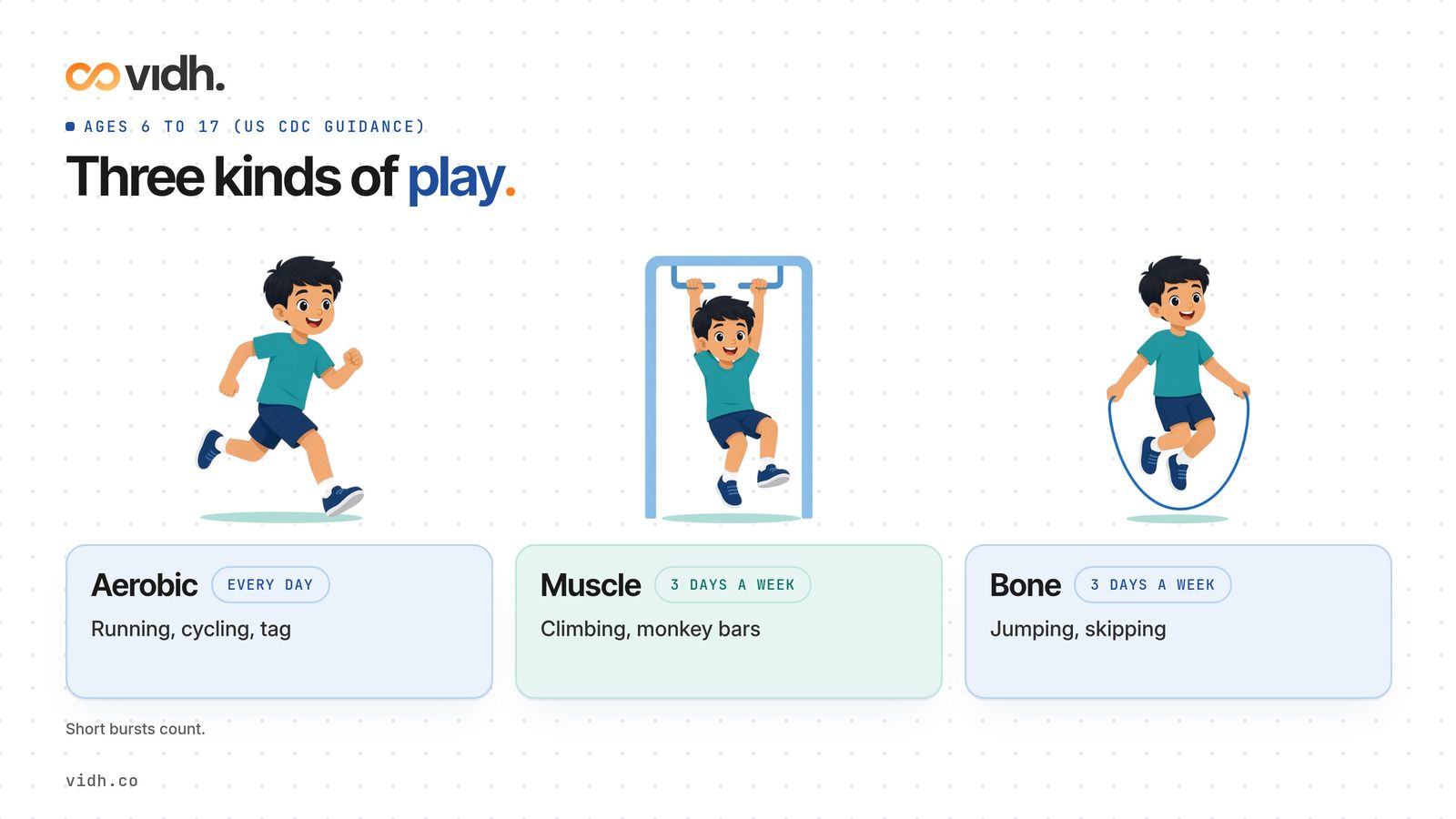
The CDC describes three kinds of activity for ages 6 to 17:
- Aerobic, every day. Walking, running or "anything that makes their hearts beat faster". The CDC adds: "At least 3 days a week should include vigorous-intensity activities."
- Muscle strengthening, 3 days a week. "Includes activities like climbing or doing push-ups, at least 3 days a week."
- Bone strengthening, 3 days a week. "Includes activities such as jumping or running, at least 3 days a week."
A simple way to judge effort is the CDC's 0 to 10 scale: "moderate-intensity activity is 5 or 6. Vigorous-intensity activity is 7 or 8." Walking to school with friends is usually moderate. Running or chasing during a game of tag is usually vigorous.
Younger children rarely need anything formal. The CDC notes they "usually strengthen their muscles when they do gymnastics, play on a jungle gym, or climb trees."
What are 10 easy outdoor ideas for evenings and weekends?
- Tag or chase games in the park.
- A family walk after dinner, with a "spot five things" challenge.
- Climbing frames and monkey bars at the playground.
- Skipping rope or hopscotch.
- Cycling or scooting on a safe path.
- Football, basketball or a frisbee with friends.
- Swimming, where it is supervised.
- A beach or park treasure hunt.
- Races with fun rules: hopping, crab walks, backwards.
- A weekly family "active hour" that children choose.
Let children pick. The CDC simply says: "Encourage children to do activities they enjoy." Pack a water bottle and the PE kit the night before with our night-before school bag checklist.
What does an active week look like?
Here is one simple example for a school-age child. School PE and active breaks count on top, so adjust it to your family's timetable.
- Sunday: Family walk and playground climbing (aerobic, muscle)
- Monday: Skipping rope or hopscotch after homework (aerobic, bone)
- Tuesday: Tag or chase games with friends (vigorous)
- Wednesday: Cycling or scooting (aerobic)
- Thursday: Monkey bars and running races (muscle, bone, vigorous)
- Friday: Swimming or a beach game (aerobic, vigorous)
- Saturday: Child's choice "active hour" (whatever they love)
Keep it light. Missing a day is fine; the habit matters more than a perfect chart. For PE teachers, sharing one simple weekly idea with families helps home and school pull the same way.
How do we stay safe on warm days?
Early and late in the season, some days can still be hot. The WHO's heat and health guidance says:
- "Avoid going outside and doing strenuous activity during the hottest time of day."
- Seek shade, and dress children in light, loose clothing with hats and sun protection.
- "Never leave children or animals in parked vehicles for any amount of time, as temperatures can quickly become dangerously high."
Outdoor timings, park rules and school PE schedules are set locally, so follow your school's and your area's guidance. If your child has a health condition such as type 1 diabetes, follow their care plan for active play. Our guide to type 1 diabetes at school covers PE and sport.
How do we trade some screen time for play without a fight?
Swap rather than ban. Agree a simple rule together, such as "outdoors first, then screens", and keep it the same every day. Give a five-minute warning before screens end, and have the shoes and ball ready by the door.
Our Diwali break routine guide has screen-time tactics that work for any holiday. For what schools are doing, see our guide to screen time in schools. And at dinner, ask about play, not just lessons. Our better than "how was school?" questions can help.
Questions parents ask
What if it is too hot or we cannot get outside?
Indoor activity counts too. Try dancing, a hallway obstacle course, stretching games or an indoor play space. Any amount of activity is better than none.
How do we keep girls active?
Offer choice and company. Some children enjoy team sport; others prefer dance, swimming, cycling or walking with friends. Let your daughter choose, and be active alongside her.
My teenager dislikes sport. What then?
Activity does not have to be sport. Walking with friends, cycling, swimming, skating or helping with active tasks all count. Let them choose.
Does school PE count towards the 60 minutes?
Yes. The CDC says school-based activity can help children meet the 60 minutes or more. Ask your child's school how much PE and active break time they get.
Are family walks enough?
A brisk walk counts as moderate activity. Add some faster play, climbing or jumping on a few days each week to cover vigorous, muscle and bone activity.
Sources
- CDC, Child Activity: An Overview: https://www.cdc.gov/physical-activity-basics/guidelines/children.html
- WHO, Physical activity fact sheet: https://www.who.int/news-room/fact-sheets/detail/physical-activity
- WHO, Heat and health fact sheet: https://www.who.int/news-room/fact-sheets/detail/climate-change-heat-and-health
All sources were opened on 10 November 2026.
About Vidh
Vidh (vidh.co) is an AI-powered platform for schools, built by Vidh Labs, that connects management, teachers, parents and students around each child.
Questions: hi@vidh.co