Back
India School Bus Safety: What Parents Can Check
5 min read
A school bus safety checklist for parents in India: CBSE rules on speed governors, attendants, transport managers, GPS and CCTV, and raising concerns.
By Bhagya, Vidh · Last updated: 22 November 2026
For many families in India, the school bus is the longest part of a child's school day without a parent. CBSE has clear guidelines on what a school bus should have, and most of them are easy for parents to check in a few minutes. This guide is for parents of children at CBSE-affiliated schools, and for school transport coordinators. It explains what the guidelines say, gives you a short checklist, and shows how to raise a concern calmly.
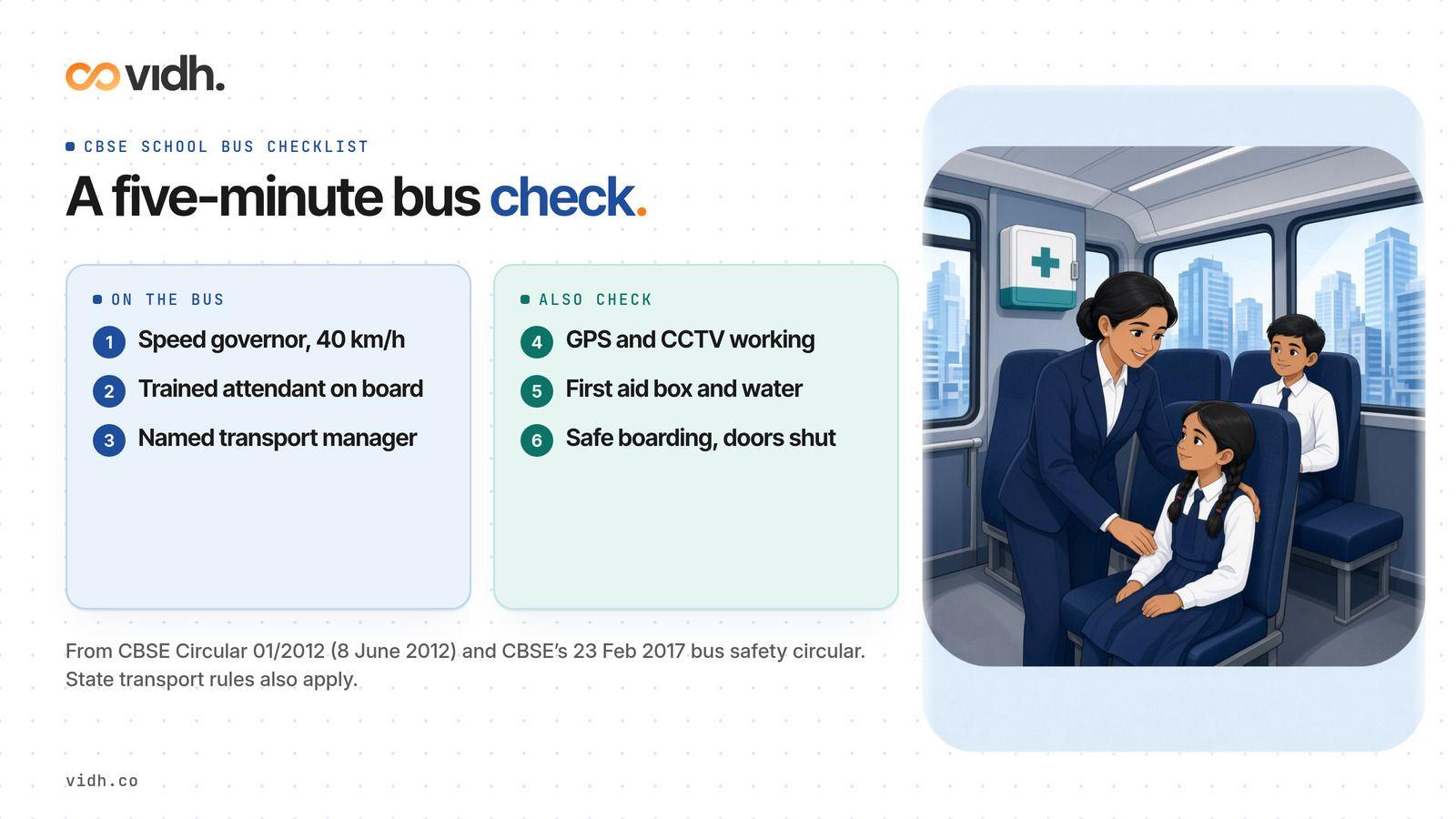
Short answer: Vidh's checklist starts with three CBSE basics: a speed governor capped at 40 km/h, a qualified attendant on board, and a named transport coordinator at school. CBSE also asks schools to arrange safe boarding and drop-off. If something looks missing, ask the coordinator in a one-to-one message. State transport rules apply too and vary, so check yours.
What do CBSE's school bus rules say?
CBSE first set out transport precautions in Circular No. 01/2012, dated 8 June 2012, which added them to its Affiliation Bye-laws as Annexure IX. Key lines include:
- "All school buses must be fitted with speed control devices so that they do not exceed the speed limit of 40 Kmph."
- "There must be a qualified attendant in the Bus to attend to Children."
- "Each school should designate one Transport Manager/ Coordinator who will ensure the safety of the school children."
- "Bus should have a First Aid Box."
- "The school authority shall ensure that the doors of the buses remain shut while in running condition."
CBSE consolidated its transport guidelines again in CBSE's 23 Feb 2017 bus safety circular (CBSE/AFF./Circular-8/2017). Its annexure says "Global Positioning System (GPS) and CCTV arrangement should be made compulsorily in each school bus" and that the GPS and CCTV must be kept in working condition at all times. It also says the transport manager's name and contact details "must be prominently displayed outside and inside the school bus", and asks for "at least one well-trained lady attendant, preferably a lady guard, in each school bus". It adds that the bus "must have a First Aid Box and drinking water."
These guidelines bind CBSE-affiliated schools. State board and ICSE schools follow their own rules, and the Motor Vehicles Act and state transport rules apply to every school bus.
What does the NCPCR manual add?
The National Commission for Protection of Child Rights (NCPCR) published a Manual on Safety and Security of Children in Schools in 2021. It is national child-rights guidance that brings together existing safety guidelines. On buses, it says "Police verification of the staff of the bus should be done before appointing them." and that "There must be a qualified attendant, preferably female in the Bus to attend to Children."
What should a parent check in five minutes?
You do not need to inspect the engine. On a normal school morning, or at the next parents' meeting, look for these:
- Speed governor. Ask the school to confirm the bus is fitted with a speed control device limited to 40 Kmph.
- Attendant on board. There should be a qualified attendant on every trip, not just the driver.
- Named transport manager. The name and contact details should be displayed inside and outside the bus.
- GPS and CCTV working. Ask whether they are installed and who checks they work.
- First aid box and water. Both should be on the bus.
- Safe boarding. Children should board and get down only at designated stops, with doors shut while the bus is moving.
- An emergency phone. CBSE's 2012 guidelines ask schools to provide a mobile phone in each bus. A 2017 CBSE circular (Acad-32/2017, 18 August 2017) advises it "should be of basic model without internet facility and data storage."
What about the driver?
The 2012 guidelines say the driver should have a valid licence and at least five years of experience driving heavy vehicles. They also say "eye testing shall be made every year" as part of a yearly medical check of the driver's fitness, and that drivers should wear a distinctive uniform with their name on it. Parents cannot check every document, but you can ask the transport manager how these checks are done and recorded.
How do I raise a concern with the school?
Calmly, and one to one. A bus worry posted in a class WhatsApp group can spread fast and help no one. Our school WhatsApp group rules explain why individual concerns belong with the school, not the group.
- Note what you saw, with the date, time and bus number.
- Message the transport manager or class teacher directly.
- Ask what will be done and when you will hear back.
- If nothing changes, raise it with the principal in writing.
Schools can make this easier with a clear contact for transport and a reply time. Our parent communication audit and our guide to parent-teacher communication apps show what good looks like. With Vidh, live bus tracking lets parents see where the school bus is, and one-to-one parent replies keep transport questions private. Our school bus tracking guide for parents explains more.
Why does this matter so much?
The World Health Organization's Global status report on road safety 2023 says road traffic injuries remain "the leading killer of children and young people" worldwide. A safe bus, a careful driver and a watchful attendant make a real difference on every journey.
Questions parents ask
Does every CBSE school bus need GPS and CCTV?
CBSE's 23 Feb 2017 bus safety circular says GPS and CCTV should be made compulsory in each school bus and kept in working condition. Ask your school how it checks this.
Does the attendant have to be a woman?
CBSE's 23 Feb 2017 bus safety circular asks for at least one well-trained lady attendant in each school bus, and the NCPCR manual says a qualified attendant, preferably female.
Can I ask to see the driver's licence and checks?
You can ask the transport manager how licences, police verification and yearly eye tests are checked and recorded. Schools may not share personal documents, but they should explain the process.
My child goes to a state board school. Do these rules apply?
The CBSE circulars apply to CBSE-affiliated schools. Your state's transport rules and the Motor Vehicles Act apply to all school buses, so check your state's rules and ask the school what it follows.
What about vans and autos?
Many children travel in private vans or autos arranged by parents. These are covered by state transport rules rather than CBSE circulars, so the same checks are a good idea, especially the number of children, a safe driver and a working door.
What should I do if the bus is often late?
Note the dates and times and message the transport manager. Late buses can mean children waiting at stops for a long time, so ask for a clear plan and a way to see where the bus is.
Sources
- CBSE, Circular No. 01/2012, Transport precautions to be observed by schools (Annexure IX), 8 June 2012: https://www.cbse.gov.in/circulars/cir_school_trans_2012.pdf
- CBSE's 23 Feb 2017 bus safety circular, Safety of school children in the school bus, CBSE/AFF./Circular-8/2017 (scanned PDF): https://www.cbse.gov.in/cbsenew/Press_Notes/2017/07.%20Safety%20of%20School%20children%20in%20the%20school%20bus.pdf
- CBSE, Circular Acad-32/2017, 18 August 2017: https://www.cbse.gov.in/cbsenew/Examination_Circular/2017/19_CIRCULAR.pdf
- NCPCR, Manual on Safety and Security of Children in Schools, 2021: https://www.ncpcr.gov.in/public/uploads/165650391762bc3e6d27f93_manual-on-safety-and-security-of-children-in-schools-sep-2021.pdf
- World Health Organization, Global status report on road safety 2023: https://www.who.int/publications/i/item/9789240086517
All sources were opened on 16 November 2026.
About Vidh
Vidh (vidh.co) is an AI-powered platform for schools, built by Vidh Labs, that connects management, teachers, parents and students around each child.
To see how Vidh works for your school, book a 30-min demo.
Questions: hi@vidh.co