Back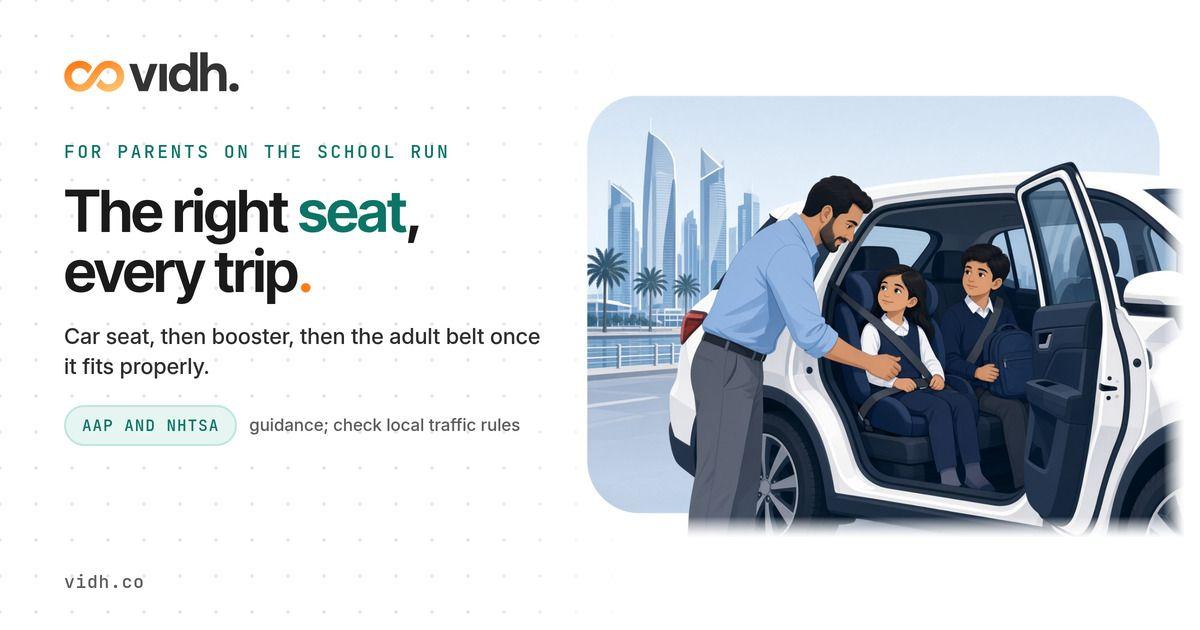
Gulf School Run: Seat Belts and Car Seats by Age
5 min read
Seat belts and car seats by age for the Gulf school run, using US AAP and NHTSA guidance: a booster until the belt fits, under 13 in the back.
By Bhagya, Vidh · Last updated: 20 November 2026
The school run is the car trip Gulf families make most often, which is exactly why it is easy to get relaxed about seats and belts. A short drive to school still needs the right seat for your child's size. This guide is for parents doing the school run across the Gulf, and for school transport leads. Child seat and front seat laws are set by each country and differ across the Gulf, so we do not quote any country's law here: check your own country's traffic rules. The age bands below are US guidance, from the American Academy of Pediatrics (AAP) and the US National Highway Traffic Safety Administration (NHTSA), because they set the stages out clearly by age.
Short answer: Vidh's school-run rule: every child, every trip, in the right seat for their size. Use a car seat, then a booster until the adult belt fits, usually around 8 to 12 years in US guidance. WHO says seat-belts cut the risk of death by up to half. Keep children under 13 in the back, and check your country's own traffic rules.
Why do seats and belts matter so much?
The World Health Organization's road safety fact sheet says road traffic injuries are the leading cause of death for children and young adults aged 5 to 29. It also says "Wearing a seat-belt can reduce the risk of death among vehicle occupants by up to 50%." and "The use of child restraints can lead to a 71% reduction in deaths among infants."
Which seat does my child need at each age?
These stages are US guidance from NHTSA and the AAP. Your car seat's own height and weight limits always come first.
- From birth: rear-facing car seat. NHTSA's advice for ages 1 to 3 is "Keep your child rear-facing as long as possible." Move on only when your child reaches the seat maker's top height or weight limit.
- Next: forward-facing seat with a harness. NHTSA lists this stage for ages 4 to 7. Use it until your child reaches the seat's top limit.
- Then: booster seat. The AAP says children should use a belt-positioning booster "until the vehicle seat belt fits properly, typically when they have reached 4 feet 9 inches in height and are 8 to 12 years of age." That height is about 145 cm.
- Finally: the adult lap and shoulder belt, once it fits. Height and fit matter more than a birthday.
When can my child sit in the front?
US guidance is consistent. The AAP says "The safest place to ride for all children younger than 13 years is the back seat." NHTSA puts it simply: "Keep your child in the back seat at least through age 12." The AAP also warns: "Never place a rear-facing seat in the front seat of a vehicle that has an active front passenger airbag." Front seat rules differ by country across the Gulf, so check your local traffic rules as well.
How do I know the seat belt fits?
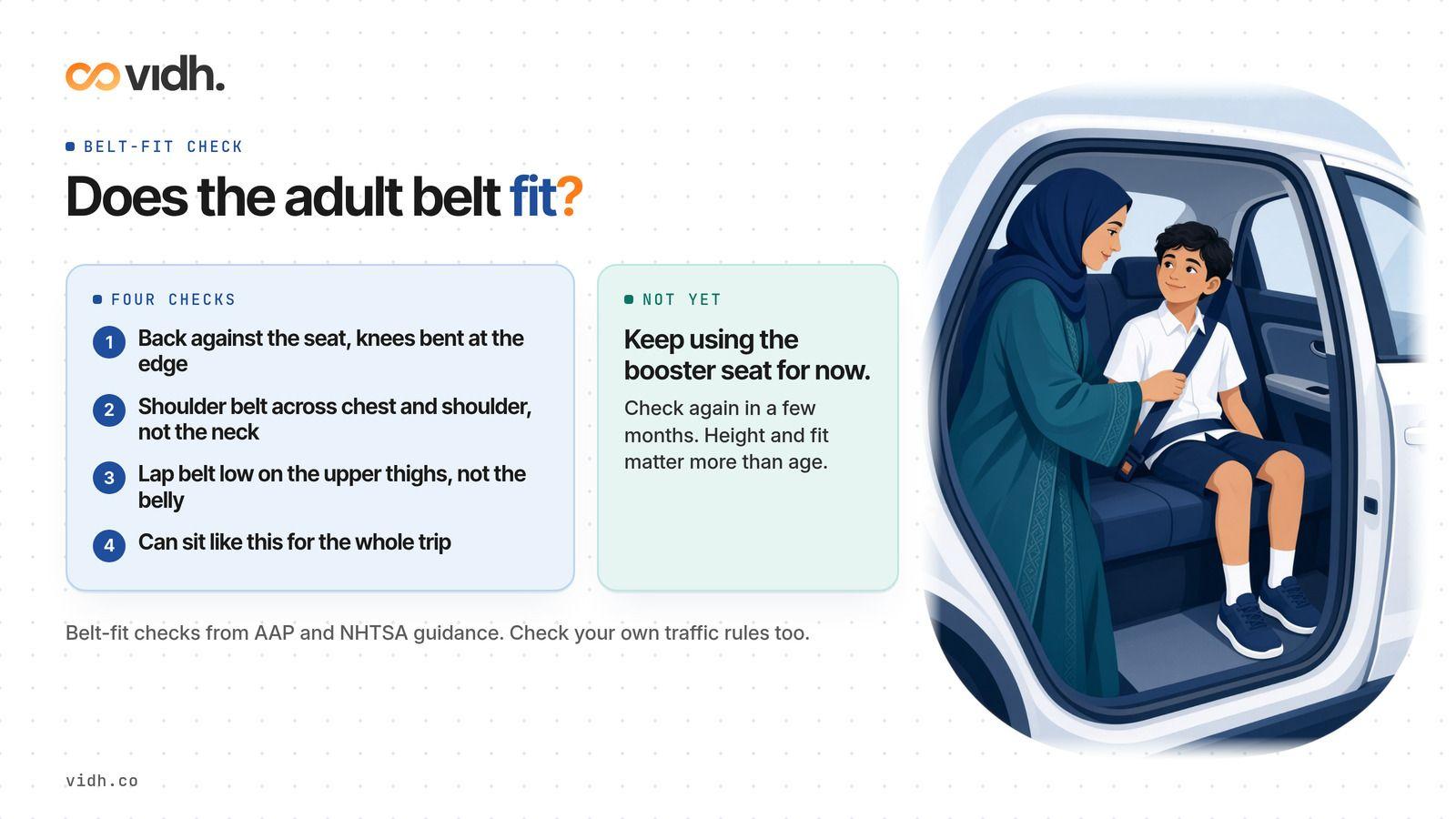
The AAP's checklist for an adult belt is short. Try it with your child sitting in the car:
- They sit with their back against the seat and their knees bent over the edge, without slouching.
- The shoulder belt lies across the middle of the chest and shoulder, not the neck or throat.
- The lap belt is low and snug across the upper thighs, not the belly.
- They can stay sitting like that for the whole trip.
If any answer is no, keep using the booster. NHTSA adds that "the lap belt must lie snugly across the upper thighs, not the stomach."
What about short trips to school?
Every trip counts, including the five-minute drive and the carpool. If you share the school run, agree with the other families that every child rides in the right seat for their size, and that boosters travel with the child. Our school WhatsApp group rules have tips for keeping carpool plans clear in the class group.
Never leave a child alone in a parked car, even for a minute. The AAP warns that in a parked car, "temperatures can reach deadly levels in minutes." In the Gulf heat, that matters all year. When the weather cools, our guide to the outdoor play season for Gulf kids has ideas for active time outside.
What can schools ask at the drop-off zone?
Drop-off rules are each school's own policy. Schools can help by asking families to let children out on the pavement side, keeping the drop-off lane moving, and sending one clear message at the start of term that every child should travel in a seat or belt that fits. Calmer mornings help too: our night-before school bag checklist saves time at the door.
What about school buses?
School transport rules are set by each school and local authority. If your child takes the bus, ask the school how seating and supervision work. Live bus tracking in Vidh lets parents see where the school bus is, so children are not waiting outside for longer than needed. Our school bus tracking guide for parents explains what to look for.
Questions parents ask
Can my child sit in the front for a short trip?
US guidance says children under 13 are safest in the back seat on every trip, however short. Your country's traffic rules may also set an age or height for the front seat.
What about taxis and ride-hailing?
The same safety advice applies. Bring a portable booster for an older child if you can, ask what child seats the service offers, and always use the seat belt.
Can an older sibling sit in the front instead?
Under the US guidance above, only once they are 13 or older, and only if your country's rules allow it.
Is a second-hand car seat safe?
It can be. NHTSA publishes a used car seat safety checklist and says that if you can tick off each statement, "then it may be okay to use one." If you do not know a seat's history, buy new.
My child hates the booster. What can I do?
Explain that the booster makes the adult belt fit their body. Let them help choose a high-back or backless booster, if your car allows either, and keep the rule the same for every trip.
How quickly can a parked car get too hot?
Very quickly. The AAP's advice is "Never leave your child alone in or around cars", and to lock your car when it is not in use so children cannot climb in.
Sources
- World Health Organization, Road traffic injuries (fact sheet): https://www.who.int/news-room/fact-sheets/detail/road-traffic-injuries
- American Academy of Pediatrics, HealthyChildren.org, Car Seats: Information for Families (US guidance): https://www.healthychildren.org/English/safety-prevention/on-the-go/Pages/Car-Safety-Seats-Information-for-Families.aspx
- US National Highway Traffic Safety Administration, Car Seats and Booster Seats (US guidance): https://www.nhtsa.gov/vehicle-safety/car-seats-and-booster-seats
All sources were opened on 16 November 2026.
About Vidh
Vidh (vidh.co) is an AI-powered platform for schools, built by Vidh Labs, that connects management, teachers, parents and students around each child.
To see how Vidh works for your school, book a 30-min demo.
Questions: hi@vidh.co