Back
Australia: AI in Schools, What Parents Should Know
5 min read
What Australian parents should know about AI in schools: the national Framework's 6 principles, Victoria and NSW rules, and 3 questions to ask.
By Bhagya, Vidh · Last updated: 21 November 2026
AI tools are already turning up in Australian classrooms and homework. Some schools use them in lessons, some are still deciding, and many parents are unsure what the rules are. This guide is for parents and carers in Australia, and for school leaders who want to explain their approach clearly. It covers what the national framework says, how two states have applied it, and three questions worth asking your child's school.
Short answer: Vidh's short version: Australia has a national Framework for generative AI in schools, built on six principles, but it is guidance, not law. States add their own rules. Victoria, for example, needs parents' opt-in consent before some AI tools use student data, and says AI must not directly write reports. Ask your school which tools it uses and why.
What is the Australian Framework for Generative AI in Schools?
The Australian Framework for Generative Artificial Intelligence in Schools was approved by Education Ministers in 2023. Its purpose is "to provide guidance on understanding, using and responding to generative AI in Australian school-based education." It also states that "The Framework is aspirational in nature", so it describes what good use looks like rather than setting legal rules.
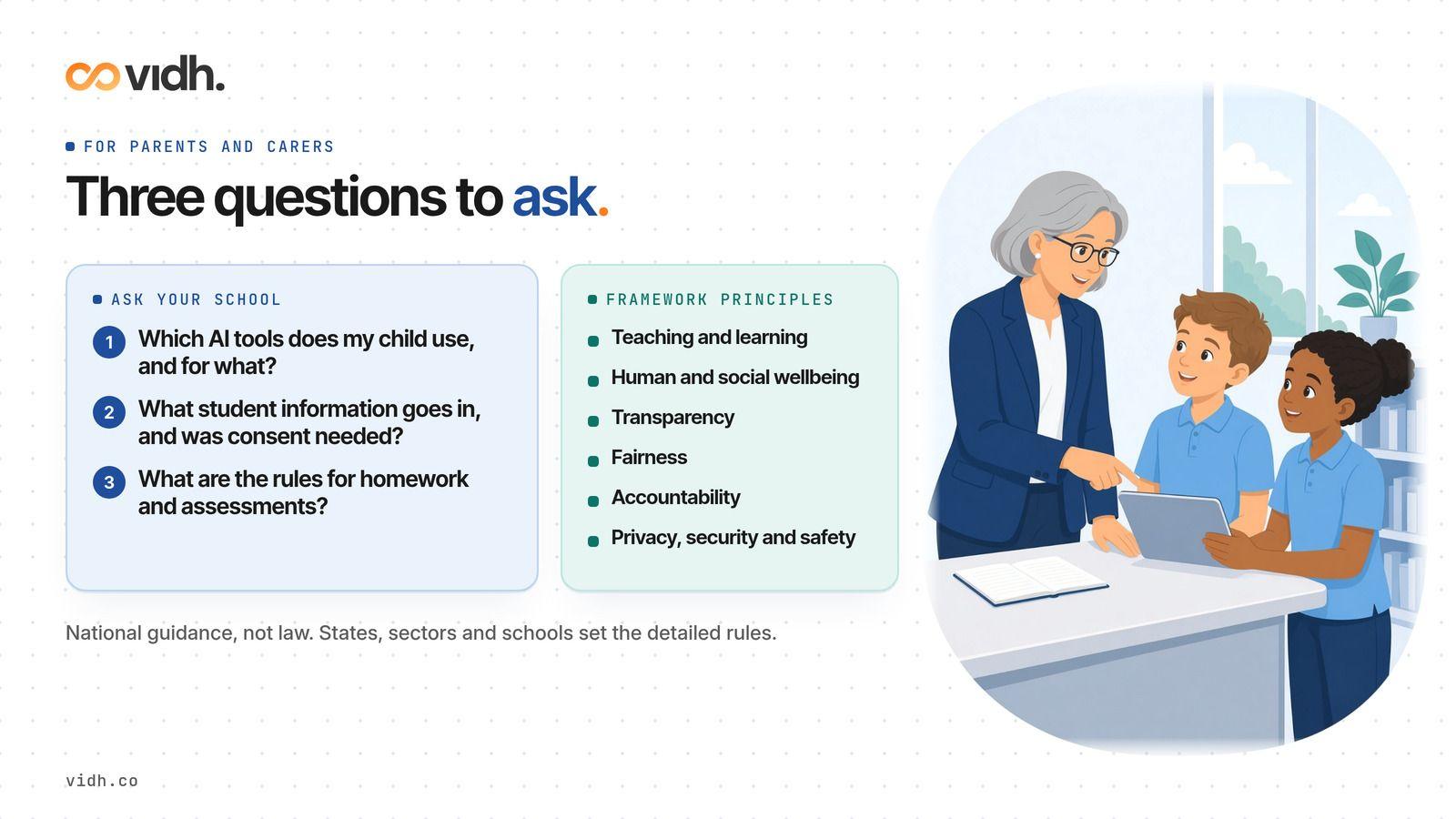
The Framework is built on "6 Principles and 25 Guiding Statements." The Department of Education adds that "In June 2025, Education Ministers endorsed the 2024 Framework Review". The 6 principles are:
- Teaching and learning
- Human and social wellbeing
- Transparency
- Fairness
- Accountability
- Privacy, security and safety
Which guiding statements matter most to parents?
A few of the 25 guiding statements speak directly to families:
- 3.1 Information and support: "teachers, students, staff, parents and carers have access to clear and appropriate information and guidance about generative AI."
- 6.2 Privacy disclosure: "school communities are proactively informed about how and what data will be collected, used, and shared while using generative AI tools, and consent is sought where needed."
- 6.3 Protection of student inputs: students, teachers and staff "take appropriate care when entering information into generative AI tools".
- 1.3 Teacher expertise: teachers "are recognised and respected as the subject matter experts within the classroom."
- 5.1 Human responsibility: "teachers and school leaders retain control of decision making and remain accountable for decisions that are supported by the use of generative AI tools."
In short, the Framework expects schools to tell families what is going on, protect children's data, and keep teachers in charge.
How do states apply it?
The Framework is national guidance. Each state and territory, and each school sector, sets its own policies. Two examples from government schools:
Victoria
The Victorian Department of Education's policy "sets out requirements for schools that choose to explore the use of generative artificial intelligence (AI) tools." Schools must "obtain opt-in consent from parents and carers before using any generative AI tool that requires personal information beyond provision of a student's school email address and creation of a password for registration". Staff must also be directed not to use generative AI tools to directly "write student reports for parents or carers."
New South Wales
The NSW Department of Education runs its own tool, NSWEduChat. It says: "NSW public school students in Years 5 to 12 now have access to NSWEduChat student mode." The department also says "User input is not used to train NSWEduChat."
Catholic and independent schools follow their own sector and school policies, so if your child is not at a government school, ask the school directly.
How should AI be used for homework?
The Framework's learning design statement says assessments should clearly outline "how generative AI tools should or should not be used". On academic integrity, it says "students are supported to use generative AI tools ethically in their schoolwork, including by ensuring appropriate attribution."
NSW gives a practical example: if schools allow NSWEduChat for homework or assessments, "students should notify their teachers if they have used NSWEduChat in completing tasks." A good family rule is simple: if AI helped, say so, and be able to explain the work in your own words.
Our guides to using AI for homework without cheating and what research says about AI, study and exam scores go further.
What three questions should I ask my child's school?
- Which AI tools does my child use at school, and for what? For example, writing feedback, research or practice questions.
- What student information goes into those tools, and was consent needed? The Framework expects schools to tell families about data and to seek consent where needed.
- What are the rules for homework and assessments? Ask how your child should show where AI helped.
A calm, private message to the teacher usually gets a better answer than a busy class group thread. Our guide to parent-teacher communication apps explains why one-to-one channels help. If the bigger worry is social media, see our guide to Australia's social media minimum age for parents.
Questions parents ask
Is AI banned or allowed in Australian schools?
Neither, nationally. The Framework guides schools but is not law. Each state, sector and school decides which tools are allowed, so the answer can differ between two schools in the same street.
Do schools use AI detection tools?
Some may, but the Framework does not require them. Its focus is on clear rules for each task and on students showing where AI helped. Ask your school how it checks work and what happens if it has a concern.
Is it different in primary and secondary school?
Often, yes. Tools, age limits and rules usually differ by year level. In NSW public schools, for example, student mode of NSWEduChat is for Years 5 to 12.
What about my child's privacy?
The Framework expects schools to tell families how data is collected, used and shared, and to seek consent where needed. In Victorian government schools, opt-in consent is needed before using tools that require personal information beyond a school email and password.
Can my child use AI tools over the holidays?
That is a family decision. Check each tool's age rules, agree what it is for, and remind your child not to enter personal details. If holiday homework is set, check the teacher's rules on AI first.
Who should I contact at school?
Start with your child's class teacher. For whole-school policy, ask the principal or the staff member who leads digital learning.
Sources
- Australian Government Department of Education, Australian Framework for Generative Artificial Intelligence (AI) in Schools (page and official PDF): https://www.education.gov.au/schooling/resources/australian-framework-generative-artificial-intelligence-ai-schools
- Victorian Department of Education, Generative Artificial Intelligence: Policy: https://www2.education.vic.gov.au/pal/generative-artificial-intelligence/policy
- NSW Department of Education, Student use of NSWEduChat: https://education.nsw.gov.au/schooling/parents-and-carers/artificial-intelligence/student-use-of-nsweduchat
All sources were opened on 16 November 2026.
About Vidh
Vidh (vidh.co) is an AI-powered platform for schools, built by Vidh Labs, that connects management, teachers, parents and students around each child.
To see how Vidh works for your school, book a 30-min demo.
Questions: hi@vidh.co