Back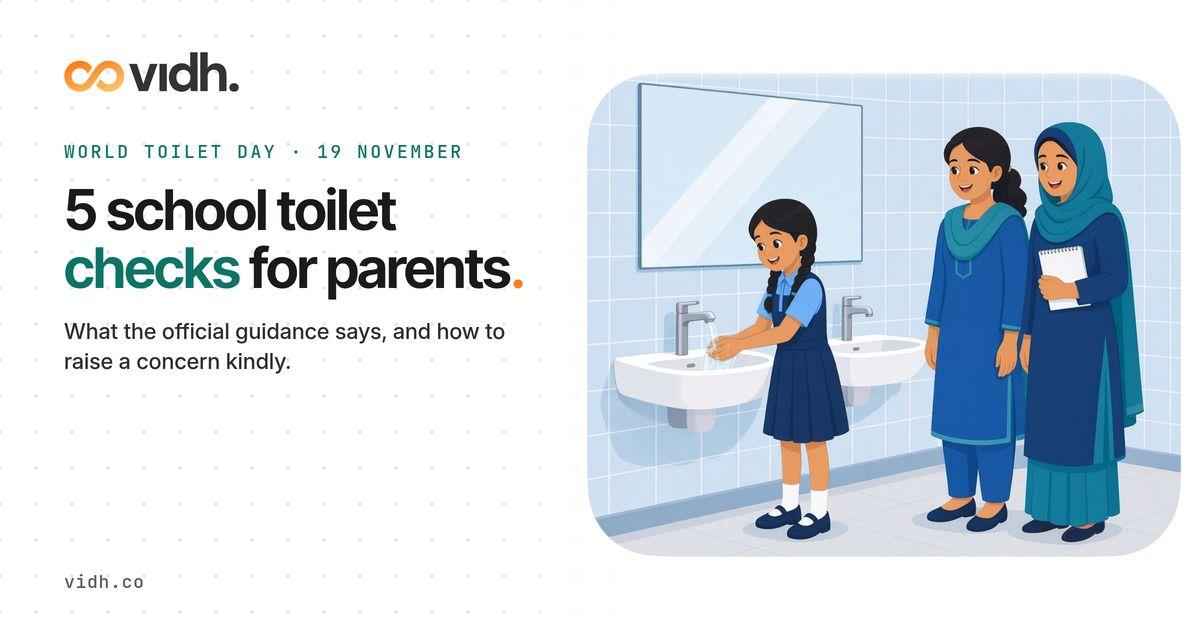
India School Toilets: 5 Things Parents Can Check
5 min read
What the Government of India says about school toilets and drinking water, five simple checks for parents, and how to raise a concern calmly.
By Bhagya, Vidh · Last updated: 19 November 2026
World Toilet Day falls on 19 November. In India, it is a good moment to think about something children rarely talk about at home: the school toilet. Clean, safe toilets and drinking water help children stay comfortable and focused through the school day. This guide explains what the Government of India says schools should provide, five simple things parents can check, and how to raise a concern kindly. It is general information, not legal advice.
Short answer: Vidh's answer for parents in India: the Government of India says the RTE Act expects every school building to have safe drinking water for all children and separate toilets for boys and girls. A good toilet also has soap, a door that locks and is open all day. If something is missing, calmly ask the school what is planned.
What does the Government of India say a school should have?
The Government of India has explained this in a Press Information Bureau (PIB) release from 2017. It says the Right of Children to Free and Compulsory Education (RTE) Act, 2009 provides norms and standards for schools, and that the Act states, among other things, that "every school building should have safe and adequate drinking water facilities to all children; and separate toilets for boys and girls."
The same release says: "The appropriate Governments have the responsibility and mandate to provide school infrastructure including drinking water facility and toilets in schools", in line with the norms of the RTE Act "and respective State RTE Rules."
In practice, that means two things for parents:
- States add detail. Each state has its own RTE Rules, so the details can differ from one state to another.
- Some things are school practice. Day-to-day matters such as cleaning schedules, soap supply and sanitary pad arrangements are usually decided by the school or the state, so ask your school how it handles them.
What should a good school toilet have?
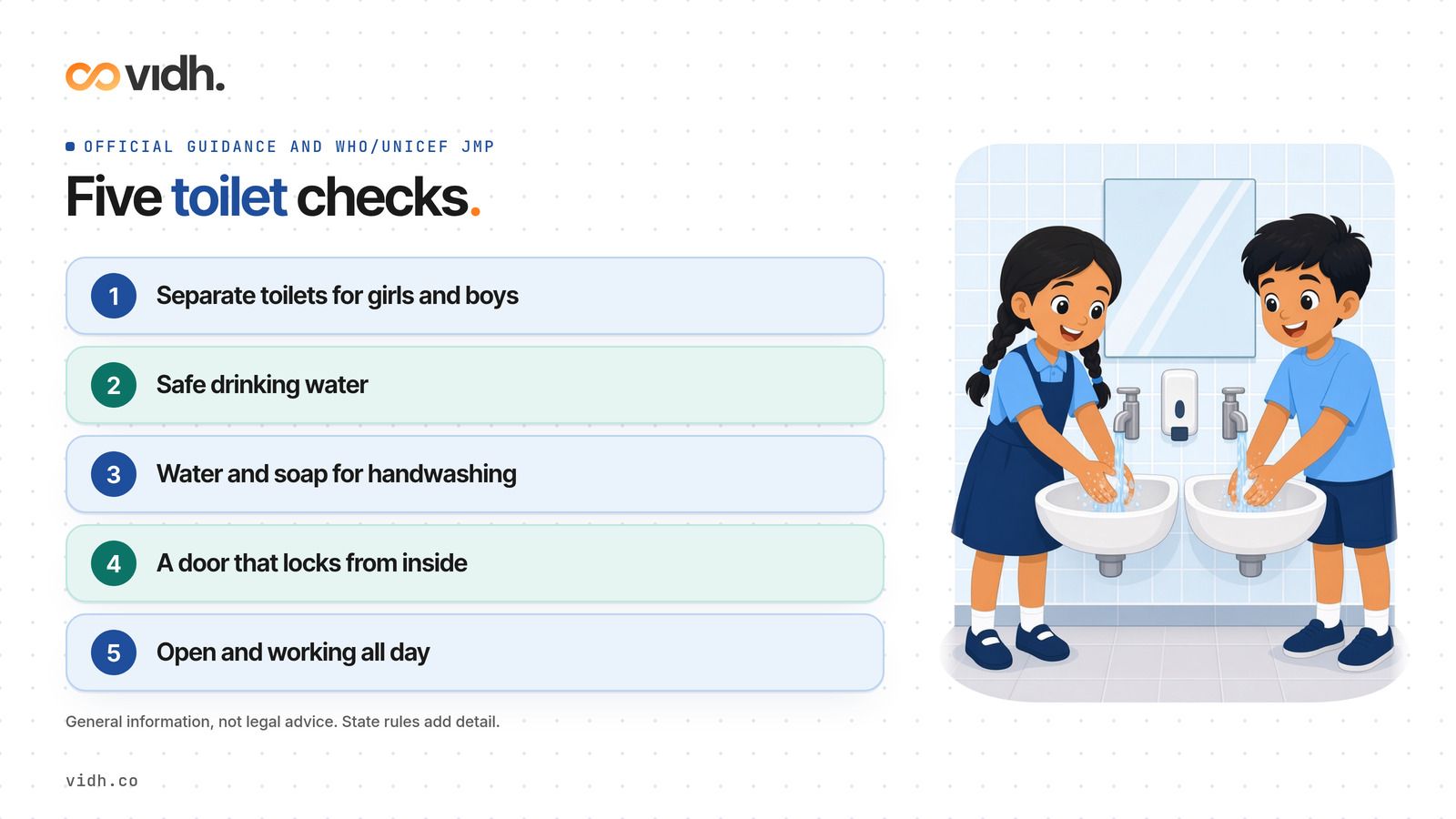
The WHO and UNICEF Joint Monitoring Programme (JMP) tracks water, sanitation and hygiene in schools worldwide. Its definitions make a simple checklist for parents:
- Separate toilets for girls and boys. The Government of India's summary lists this, and the JMP counts toilets as basic only when they are "single-sex and usable".
- Safe drinking water. Also in the Government's summary. Ask where children fill their bottles.
- Water and soap for handwashing. The JMP counts handwashing as basic when schools have "handwashing facilities with water and soap available".
- A door that locks from inside. For privacy, the JMP looks for "closable doors that lock from the inside and no large gaps in the structure".
- Open and working all day. The JMP calls a toilet usable when "doors are unlocked or a key is available at all times", and functional when "the toilet is not broken, the toilet hole is not blocked, and water is available for flush/pour-flush toilets".
For older girls, ask about menstrual waste bins too. Globally, the UN notes: "Fewer than 1 in 3 of schools globally have menstrual waste bins in girls' toilets." That is a world figure, not a figure for India.
Why do toilets matter for learning, especially for girls?
The UN's World Toilet Day 2026 theme makes the link: "World Toilet Day 2026 is about sanitation and gender equality." It adds: "With access to safe and secure toilets, alongside soap, water and menstrual hygiene facilities, girls can learn and women can earn."
There is still work to do worldwide. The JMP's 2026 report finds that "the world is not on track to achieve universal access (>99%) to basic WASH services in schools by 2030."
At home, small signs can tell you something. If your child comes home very thirsty, or always rushes to the toilet the moment they get home, it is worth a gentle question.
How can I check without making it awkward?
Start with your child, in a relaxed moment, not as a test of the school:
- "Is there soap by the taps?"
- "Can you lock the door when you go?"
- "Do you get time to go between lessons?"
- "Where do you fill your water bottle?"
Listen more than you ask. Our Children's Day guide to letting your child plan the day has more on listening to children.
You can also ask at a parent-teacher meeting, or look around on an open day or admission visit. Keep it private and respectful. Please do not post photos or complaints about school toilets in the class group. Our school WhatsApp group rules explain why private messages work better.
How do I raise a concern with the school?
- Start with the class teacher. Describe what your child noticed, for example "there is no soap in the girls' toilet on the first floor".
- Put it in writing. A short, polite message keeps a record. Our guide to choosing a parent-teacher communication app explains why a private written message works well. Vidh's one-to-one parent replies are built for this kind of private conversation with a teacher.
- Ask what is planned. Ask when it will be fixed and who to follow up with.
- Go to the principal if needed. If nothing changes after a reasonable time, write to the principal.
If you still need help, ask the school whether it has a parents' committee you can raise it with, or contact your local education office. The right route differs by state and type of school, so ask which one applies to yours.
For principals, a short note to parents on how toilets are cleaned and stocked builds trust quickly. Our parent communication audit can help you plan what to share.
Questions parents ask
Do these rules apply to every school and every class?
The Government of India's summary describes the RTE norms for school buildings, and each state adds its own RTE Rules. What applies can depend on your state, the type of school and the class, so ask your school or your state's education department.
My child avoids the school toilet all day. What should I do?
Talk gently to find out why: it might be a broken lock, no water, no time, or feeling shy. Tell the class teacher privately. If your child has pain, or toilet problems that keep happening, speak to your doctor.
What about menstrual hygiene for older girls?
Ask the school whether girls' toilets have water, soap and a bin, and whether pads are available in an emergency. Arrangements vary by school and state, so ask rather than assume.
Who can I contact beyond the school?
Start with the principal. After that, ask whether the school has a parents' committee, or contact your local education office. Your state's education department can tell you which route applies.
Sources
- United Nations, World Toilet Day: https://www.un.org/en/observances/toilet-day
- WHO/UNICEF Joint Monitoring Programme, WASH in schools: https://washdata.org/topics/schools
- Press Information Bureau, Government of India, Drinking water and toilet facilities in Government schools (21 December 2017): https://www.pib.gov.in/PressReleaseIframePage.aspx?PRID=1513698
All sources were opened on 16 November 2026.
About Vidh
Vidh (vidh.co) is an AI-powered platform for schools, built by Vidh Labs, that connects management, teachers, parents and students around each child.
To see how Vidh works for your school, book a 30-min demo.
Questions: hi@vidh.co