Back
IEP Meeting Questions: What to Ask, What to Expect
5 min read
What federal law guarantees parents at an IEP meeting, how to prepare, and the questions to ask about goals, progress, services and next steps.
By Bhagya, Vidh · Last updated: November 15, 2026
In the United States, an IEP meeting can feel like a room full of experts and one parent. It helps to know that federal law gives you a real place at that table, and that good questions are the best way to use it. This guide covers what the law guarantees, how to prepare, and the questions worth asking. It is general information, not legal advice.
Short answer: At an IEP meeting, federal law gives you the right to take part, at a mutually agreed time, and to receive a free copy of the IEP. The team must consider your child's strengths and your concerns, and review the IEP at least yearly. Ask how each goal is measured, how progress will be reported, and what changes in class.
What does federal law guarantee parents at an IEP meeting?
The Individuals with Disabilities Education Act (IDEA) regulations, in 34 CFR Part 300, set a floor that every public school must meet. Your district may do more.
- You are part of the meeting. "Each public agency must take steps to ensure that one or both of the parents of a child with a disability are present at each IEP Team meeting or are afforded the opportunity to participate". That includes notifying you "early enough to ensure that they will have an opportunity to attend" and "Scheduling the meeting at a mutually agreed on time and place."
- You can join another way. "If neither parent can attend an IEP Team meeting, the public agency must use other methods to ensure parent participation, including individual or conference telephone calls".
- Your view must be considered. In developing the IEP, the team must consider "The strengths of the child;" and "The concerns of the parents for enhancing the education of their child;".
- The IEP is reviewed at least yearly. The team "Reviews the child's IEP periodically, but not less than annually, to determine whether the annual goals for the child are being achieved".
- You get a free copy. "The public agency must give the parent a copy of the child's IEP at no cost to the parent."
Meeting length, the forms used, whether you see a draft beforehand, and parent portals are district or school practice. If you want a draft in advance, ask your district.
What should I prepare before the meeting?
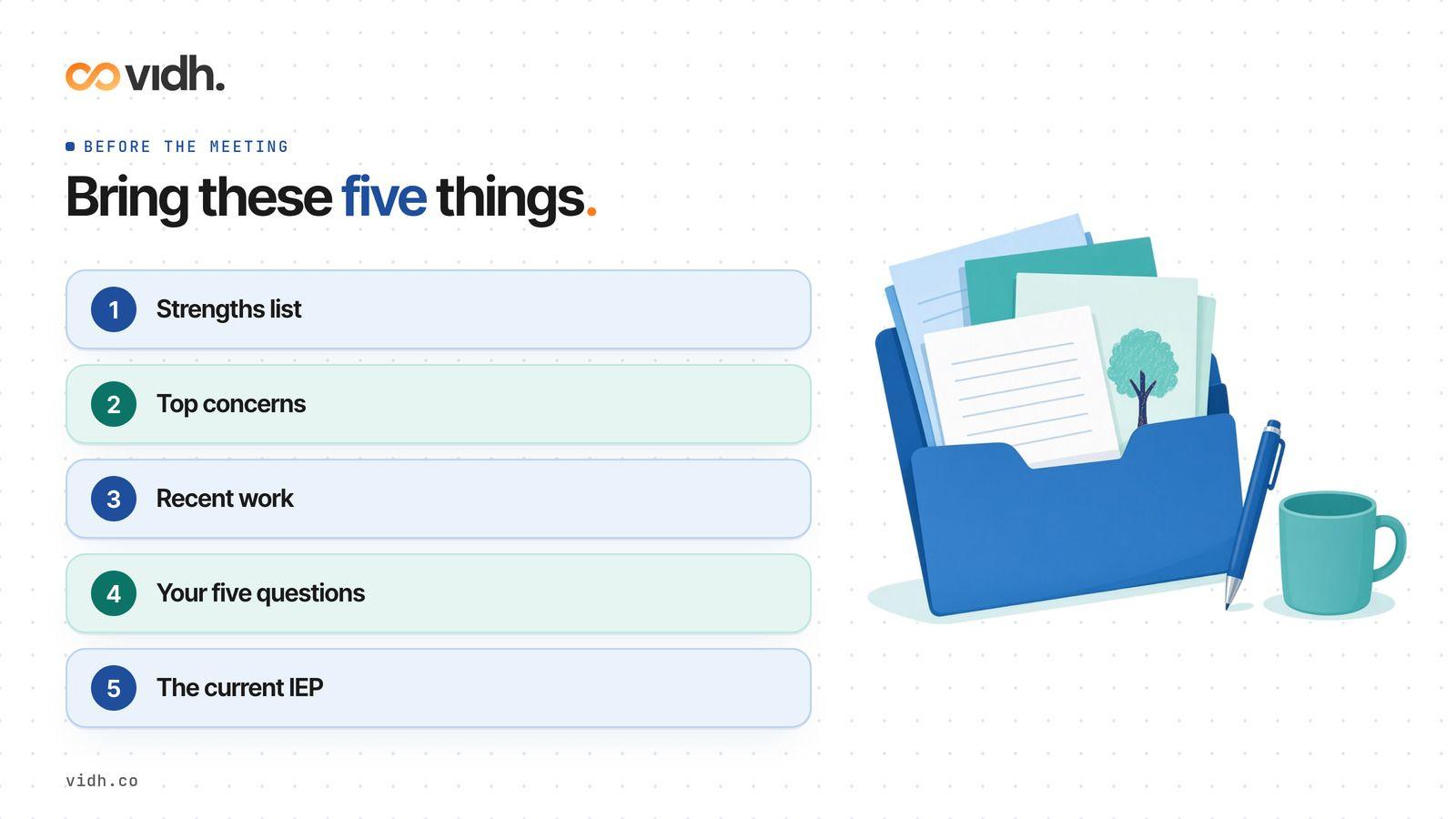
A little preparation makes the meeting calmer and more useful:
- A strengths list. Three or four things your child is good at or enjoys. The law asks the team to consider strengths, so bring yours.
- Your concerns. Write the top two or three, with examples from home.
- Recent work. A few pieces of homework, notes from the teacher, or the last progress report.
- Your questions. Pick the five that matter most from the lists below.
- The current IEP. If your child already has one, bring it and mark anything that is not working.
The Center for Parent Information and Resources (CPIR) notes that "IEP teams are made up of individuals who bring different perspectives and expertise to the table." You are one of those perspectives.
Which questions should I ask about goals and progress?
Goals are the heart of the IEP. CPIR explains that an IEP includes annual goals and "how school personnel will measure the child's progress toward the annual goals." Useful questions:
- What does this goal look like when my child has met it?
- How will you measure progress, and how often?
- How and when will I hear about progress?
- What is the starting point for this goal right now?
- What can we do at home to support it?
For the home side, our guide to homework help that gives the next step, not the answer is a good fit. And when progress is slow, our guide on what to say after a low report card helps you talk with your child kindly.
What should I ask about services, support and the classroom?
- Which services will my child receive, how often, where, and starting when?
- What will change in the classroom day to day?
- Will my child miss any class time, lunch or clubs for services?
- Who should I contact with questions, and how?
- How will the general education teacher know about the IEP?
If you need an interpreter, CPIR advises telling the school system ahead of time "so that arrangements can be made to have an interpreter present."
What if I disagree or need more time?
You do not have to decide everything in one meeting. You can say, "I need time to think about this. Can we schedule a follow-up?" CPIR says: "The parent can request an additional IEP Team meeting at any time and does not have to agree to excuse an IEP Team member."
Federal rules also require prior written notice. Written notice "must be given to the parents of a child with a disability a reasonable time before the public agency" proposes or refuses to start or change your child's identification, evaluation, placement or services. That notice must describe the action and explain why.
If you disagree, ask for the reasons in writing, and contact your state's Parent Training and Information Center. You can find yours through CPIR, the central hub for the network of Parent Centers serving families of children with disabilities. Its "Find Your Parent Center" page helps parents find Parent Centers in their state.
What happens after the meeting?
- Get your copy. Ask when you will receive the final IEP. It is free.
- Check the prior written notice. Read what the school proposed or refused, and why.
- Keep a record. Save emails and notes in one place. Our guide to choosing a parent-teacher communication app explains how written messages help.
- Follow up on progress. Put the first progress report date in your calendar.
- Ask for amendments if needed. CPIR notes: "Upon request, a parent must be provided with a revised copy of the IEP with the amendments incorporated."
If you want to see everything the school holds about your child, our guide to requesting your child's school records under FERPA explains how. For regular check-ins outside the IEP, see our three questions for a short parent-teacher meeting.
Vidh connects management, teachers, parents and students around each child.
Questions parents ask
Can I bring someone with me?
Yes. CPIR lists "other individuals (invited by parents or the school) who have knowledge or special expertise about the child" as possible team members, such as a relative close to your child. Let the school know who is coming.
Can I record the meeting?
It depends. State and district rules vary, so ask your district before the meeting.
Can I attend by video or phone?
Federal rules say that if neither parent can attend, the school must use other methods, including individual or conference telephone calls. Ask your district what options it offers.
Can I ask for an IEP meeting?
Yes. CPIR says a parent "can request an additional IEP Team meeting at any time". Put the request in writing.
What is the difference between an IEP and a 504 plan?
An IEP comes under IDEA, the law in this guide. A 504 plan works differently, so ask your school which applies to your child and why.
Sources
- 34 CFR 300.322, Parent participation (eCFR): https://www.ecfr.gov/current/title-34/section-300.322
- 34 CFR 300.324, Development, review, and revision of IEP (eCFR): https://www.ecfr.gov/current/title-34/section-300.324
- 34 CFR 300.503, Prior notice by the public agency (eCFR): https://www.ecfr.gov/current/title-34/section-300.503
- Center for Parent Information and Resources, IEP meetings: https://www.parentcenterhub.org/meetings/
- Center for Parent Information and Resources, home page: https://www.parentcenterhub.org/
All sources were opened on November 10, 2026, except the CPIR home page, opened on November 14, 2026.
About Vidh
Vidh (vidh.co) is an AI-powered platform for schools, built by Vidh Labs, that connects management, teachers, parents and students around each child.
Questions: hi@vidh.co