Back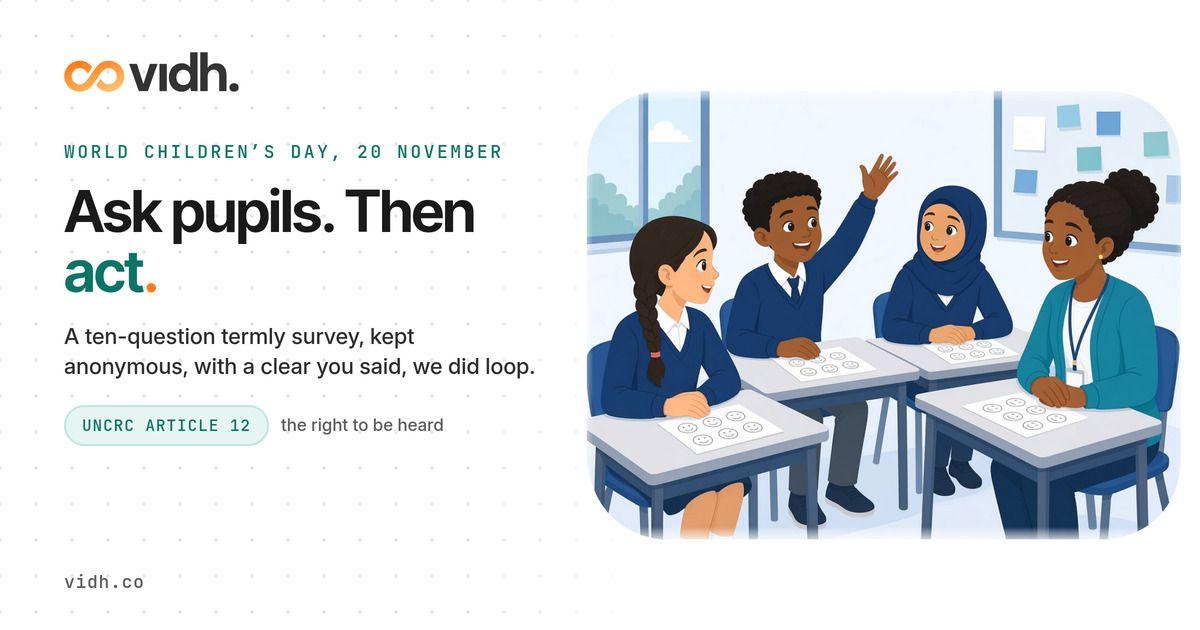
UK Pupil Voice: A 10-Question Survey Schools Can Run
5 min read
A 10-question termly pupil voice survey for UK schools this World Children's Day: anonymous, age-appropriate, with a clear you said, we did loop.
By Bhagya, Vidh · Last updated: 20 November 2026
Today, 20 November, is World Children's Day, and UNICEF's theme this year is "My day, my rights, my future." For schools in the UK, it is a good moment to ask pupils what school feels like and to act on what they say. This guide gives heads, pastoral leads and student council coordinators a short pupil voice survey to run this term, plus a simple way to show pupils what changed.
Short answer: Vidh's quick answer: run a short, anonymous survey once a term, ask about ten simple questions on safety, a trusted adult, fairness and feedback, then tell pupils what changed. UNCRC Article 12 gives children the right to be heard on matters that affect them. A termly survey is your school's own choice, not an Ofsted requirement, so keep it light.
What is pupil voice, and why does it matter on World Children's Day?
Pupil voice means asking children for their views on school life and taking those views seriously. UNICEF puts it plainly: "All children have a right to be heard and to be involved in the decisions that affect them." World Children's Day falls on 20 November because it marks the UN General Assembly's adoption of the Convention on the Rights of the Child in 1989.
A survey will not replace everyday conversations with pupils. What it does well is reach the quieter children who would never speak up in a council meeting.
What does the UN Convention on the Rights of the Child say?
Article 12 is the key line: "States Parties shall assure to the child who is capable of forming his or her own views the right to express those views freely in all matters affecting the child". It adds that those views should be given due weight, in line with the child's age and maturity.
The convention is an international treaty. It does not tell any school to run a survey. It sets the principle: children's views count, and adults should listen in ways that suit each child's age.
What does Ofsted already ask pupils?
Ofsted has its own pupil questionnaire, but it is only used during inspections. Ofsted's guidance says: "Schools give out online questionnaires when they're being inspected." Its items include "I feel safe when I am at school" and "There is an adult I could talk to if something was worrying me". Ofsted inspects schools in England; Scotland, Wales and Northern Ireland have their own inspectorates.
You do not need to copy Ofsted's wording, and a termly survey is not a legal duty. Covering the same themes, such as safety, behaviour, bullying, fairness and feedback, simply means nothing in an inspection survey should surprise you. Ofsted's October 2025 research on how inspectors hear from children, families and staff "heard from over 3,500 people across early years, schools and further education settings".
Which 10 questions should a termly survey ask?
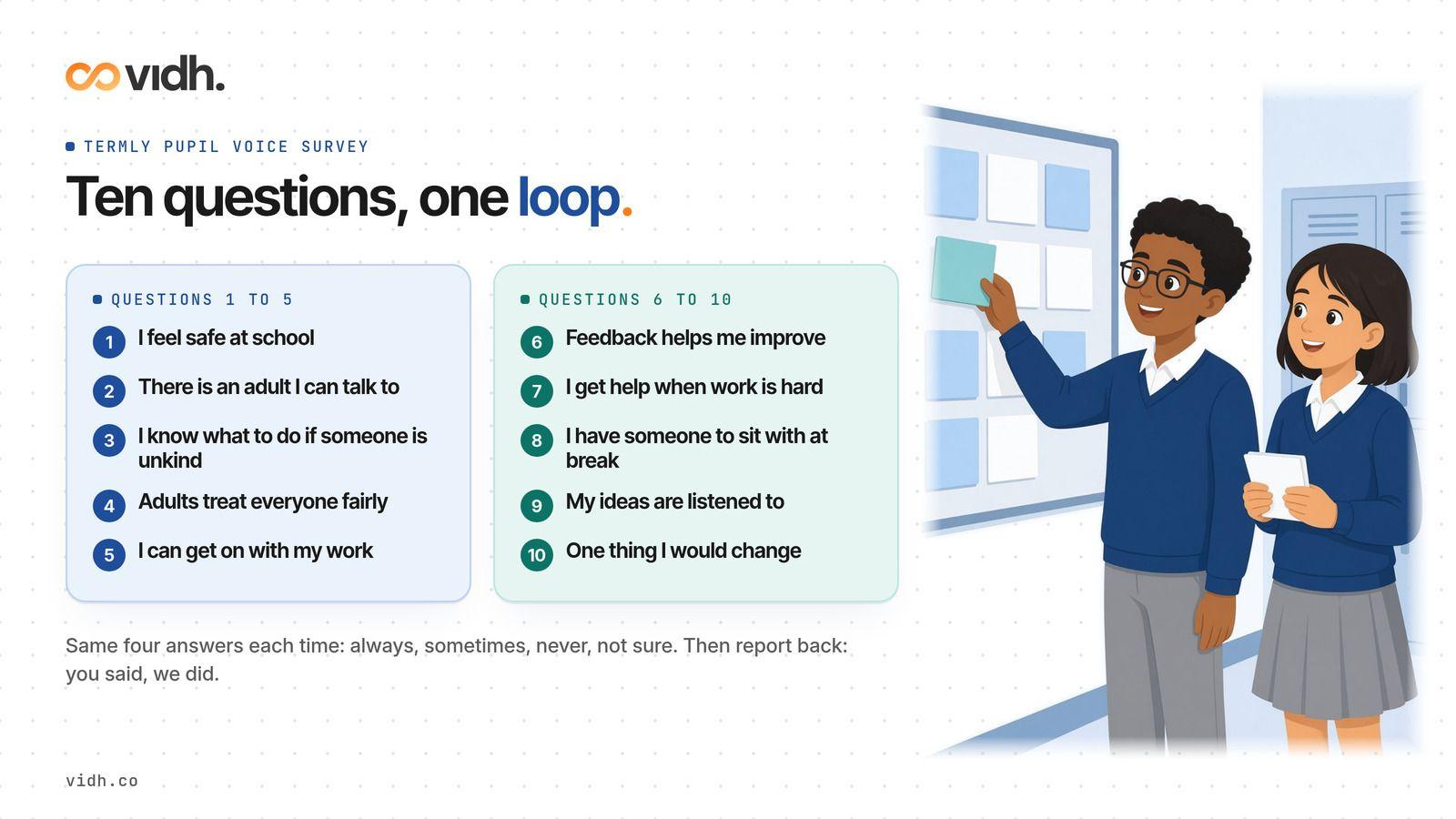
Keep each question short, use the same four answers every time (always, sometimes, never, not sure) and leave one open box at the end. Here is a starter set, written for your own school rather than copied from Ofsted:
- I feel safe at school.
- There is an adult at school I can talk to if I am worried.
- I know what to do if someone is unkind to me.
- Adults at school treat everyone fairly.
- I can get on with my work in lessons.
- The feedback I get helps me improve.
- I get help when I find work hard.
- I have someone to sit with at break time.
- My ideas are listened to at school.
- If you could change one thing at school, what would it be?
How do you keep it anonymous and age-appropriate?
- For Reception to Year 2, read each question aloud and use three faces (happy, OK, sad) instead of words. Small groups with a familiar adult work best.
- For Years 3 to 6, use the four-word scale and keep it to one sitting of about ten minutes.
- For secondary pupils, an online form works well. Switch off name collection, and avoid asking for tutor group if groups are small enough to identify someone.
- For pupils with SEND, offer symbols, a reader, extra time or a one-to-one chat with a trusted adult.
Tell pupils who will see the answers and what happens if someone writes that they do not feel safe. Any safeguarding concern goes to your designated safeguarding lead, as normal.
How do you show pupils what changed?
Pupils stop answering surveys when nothing happens. Within a few weeks of the survey:
- Share three findings. Pick the clearest themes, good and bad, and share them in an assembly or form time.
- Pick one change. Choose something you can really do this term, ideally from the open question.
- Report back. Use a simple you said, we did board, newsletter line or assembly slide, and ask the student council to present it.
Parents like to see this too. A short summary in your newsletter shows families that pupils are heard. Our parent communication audit has ideas for sharing updates without overload, and our guide to what schools should track weekly covers what leaders watch week to week.
If the bullying question raises worries, our guide to what to say first when a child is being bullied can help families at home. For younger children, letting your child plan the day is a lovely way to practise listening.
Vidh connects management, teachers, parents and students around each child.
Questions schools ask
How often should we run a pupil voice survey?
Once a term is plenty for most schools. More often and pupils tire of it; less often and changes are hard to track.
How do we avoid survey fatigue?
Keep it to about ten questions, keep the same core questions each time so you can compare, and always report back. Pupils answer more honestly when their last answers led somewhere.
How do we make the survey accessible for pupils with SEND?
Offer symbols or faces, read questions aloud, give extra time, or let a trusted adult help a pupil answer one to one. Keep the questions the same so their answers count alongside everyone else's.
Should we share results with parents?
Yes, in summary. Share themes and the changes you are making, never individual answers or anything that could identify a pupil.
What role should the student council play?
Council members can help write questions in pupil-friendly language, test the survey with younger classes and present the you said, we did update.
Does this work in a small school?
Yes, but take more care with anonymity. Avoid asking for class or year group if that would make answers easy to trace.
Sources
- UNICEF, World Children's Day, 20 November 2026: https://www.unicef.org/take-action/campaigns/world-childrens-day
- UNICEF, Convention on the Rights of the Child (text), Article 12: https://www.unicef.org/child-rights-convention/convention-text
- Ofsted, Pupil survey questions: schools (updated 27 November 2025): https://www.gov.uk/government/publications/school-inspections-staff-and-pupil-questionnaire-text/pupil-survey-questions-schools
- Ofsted, Education inspections: hearing from children, learners, parents, carers and staff (published 23 October 2025): https://www.gov.uk/government/publications/ofsted-education-inspections-hearing-from-children-learners-parents-carers-and-staff
All sources were opened on 16 November 2026.
About Vidh
Vidh (vidh.co) is an AI-powered platform for schools, built by Vidh Labs, that connects management, teachers, parents and students around each child.
To see how Vidh works for your school, book a 30-min demo.
Questions: hi@vidh.co