Back
Gulf Parents: Do Kids Need Antibiotics for a Cold?
7 min read
Do antibiotics help a child's cold or flu? What WHO advice says for Gulf parents, why leftovers are risky, what helps, and when to see a doctor.
By Bhagya, Vidh · Last updated: 17 November 2026
Cold season is here for many families in the Gulf, and with it come runny noses, coughs and tired children. When your child is unwell, it is natural to want something that works fast. This guide explains what antibiotics can and cannot do, why it matters, and what usually helps. It is general information, not medical advice: always ask your child's doctor or a pharmacist about your own child.
Short answer: No. Colds and flu are caused by viruses, and antibiotics do not work on viruses. Giving them anyway can help bacteria become resistant, which makes future infections harder to treat. WHO advice is simple: use antibiotics only when a health professional prescribes them, follow that advice, and never use leftover or shared antibiotics. Ask your child's doctor.
Will antibiotics help my child's cold or flu?
No. The UK's National Health Service (NHS) puts it plainly: "Antibiotics do not work for viral infections such as colds and flu, and most coughs." Its common cold guidance adds: "Antibiotics only work if you have a bacterial infection, but colds are caused by viruses."
The World Health Organization's office for the Eastern Mediterranean (WHO EMRO) gave the same advice to the public in its 2025 World AMR Awareness Week campaign: "Do not use antibiotics for viral infections like colds or flu".
Antibiotics also will not make a cold pass faster. The NHS says doctors "do not recommend antibiotics for colds because they will not relieve your symptoms or speed up your recovery."
What is antibiotic resistance, in plain words?
Germs can change so that medicines stop working on them. The WHO explains: "Antimicrobial resistance (AMR) occurs when bacteria, viruses, fungi and parasites do not respond to antimicrobial medicines." When that happens, "infections become difficult or impossible to treat".
Using antibiotics when they are not needed makes this more likely. The WHO says: "The misuse and overuse of antibiotics, for example taking them when they are not needed or taking the wrong type, remains one of the main drivers of AMR."
It matters close to home. The WHO "estimates that antibiotic resistance is highest in the WHO South-East Asia and Eastern Mediterranean Regions, where 1 in 3 reported infections were resistant." The Eastern Mediterranean Region spans many countries, so that figure is for the whole region, not for any one Gulf country.
That is why this week matters: "18 to 24 November is World AMR Awareness Week", and the 2026 theme is "One Health, One Action: Prevent AMR Now".
When might a doctor prescribe antibiotics?
Some infections are caused by bacteria, and for those, antibiotics can be the right medicine. Only a doctor can decide, sometimes after an examination or a test. WHO EMRO's 2026 campaign asks health workers to "Correctly diagnose before treating".
If your child is prescribed antibiotics, follow the instructions exactly. WHO EMRO's 2026 advice for the public is: "Take the prescribed dose for the recommended duration and seek advice if symptoms persist or worsen". If you have a concern, such as a side effect, speak to the doctor or pharmacist rather than changing the dose yourself.
Why not use leftover antibiotics from last time?
A medicine chosen for one illness, or for one person, may not suit another. That is why the advice is clear:
- WHO EMRO, 2026: "Do not demand or share antimicrobials, or use leftover medicines".
- WHO EMRO, 2025: "Refrain from using left-over antibiotics or sharing antibiotics".
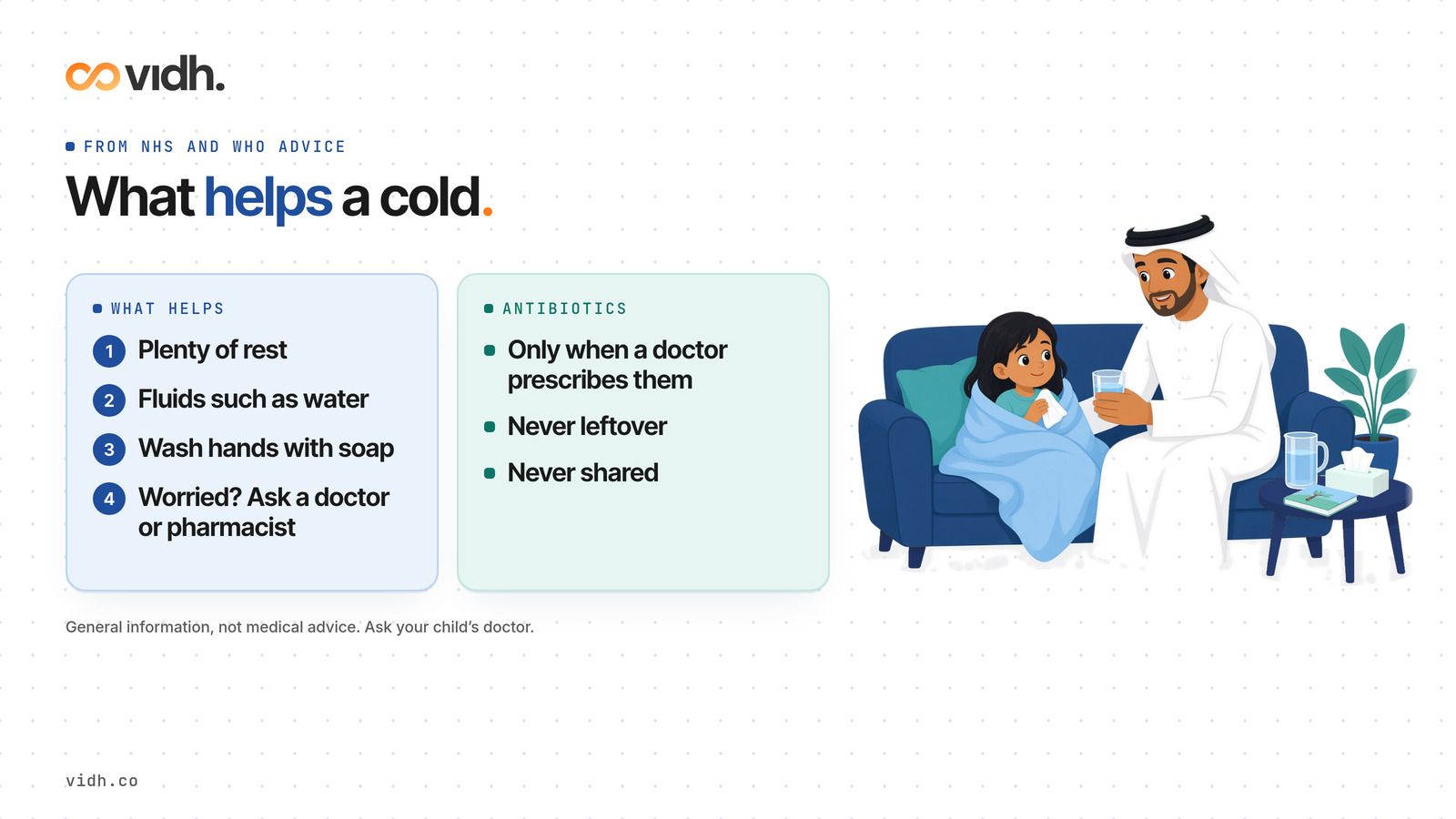
- NHS: "Only ever take antibiotics prescribed for you".
If you have unused medicine at home, WHO EMRO's 2026 advice is to "Dispose of unused medicines through appropriate channels." Ask your pharmacist how to do this where you live.
What actually helps a child with a cold?
Most colds get better on their own. The NHS says: "You should begin to feel better in about 1 to 2 weeks." It also notes that "Symptoms of a cold can last longer in young children."
The NHS suggests simple care at home:
- Plenty of rest.
- Fluids: "drink lots of fluid, such as water, to avoid dehydration".
- Healthy food, even if appetite is low for a few days.
Some important cautions from the same NHS page: "do not give aspirin to children under the age of 16", "Do not give honey to children under 12 months old." and "Some cough and cold medicines are also not suitable for babies, children and pregnant women." Before giving any medicine, ask a pharmacist or your child's doctor what is right for your child's age.
The NHS lists reasons to see a doctor, including "you're worried about your child's cold symptoms", "your cold symptoms get worse", "you feel short of breath or have chest pain" or "your cold symptoms do not get better after 10 days". In an emergency, call your local emergency number.
What can schools do during cold season?
Schools can help in simple ways that cut down the spread of colds. The NHS lists three easy habits:
- "wash your hands often with warm water and soap"
- "use tissues to trap germs when you cough or sneeze"
- "bin used tissues as quickly as possible"
A pack of tissues and a named water bottle in the school bag help too. Our night-before school bag checklist makes that part of the routine.
Sick-day rules, such as when a child should stay home, are each school's own policy, so check your school's guidance. If your child is off, tell the class teacher directly. Our guide to choosing a parent-teacher communication app explains why a short private message works better than a busy group chat. Vidh's one-to-one parent replies are built for exactly this kind of message.
For school nurses and teachers, World AMR Awareness Week is a good moment to share the message with families. WHO EMRO asks everyone to "Encourage your family, school, workplace and community to take practical action to prevent AMR now". And at dinner, a gentle question can tell you how your child is really feeling. Our better than "how was school?" questions can help.
Questions parents ask
Should my child finish the course of antibiotics?
Follow the instructions of the doctor or pharmacist who prescribed them. WHO EMRO's 2026 advice is to take the prescribed dose for the recommended duration. If you are unsure, ask them before you stop or change anything.
Can brothers and sisters share antibiotics?
No. WHO EMRO says individuals can help prevent resistance by not sharing antibiotics and only taking antibiotics that have been prescribed. Each child needs their own doctor's advice.
Can I buy antibiotics at a pharmacy without a prescription?
Pharmacy rules for antibiotics are set by each country and differ across the Gulf, so ask your pharmacist about local rules. Whatever the rule, WHO advice is to use antibiotics only when a health professional prescribes them.
When is a fever a reason to see a doctor?
The NHS suggests seeing a doctor if a high temperature lasts more than 3 days, if the temperature is very high, or if you are worried. If your child has a long-term health condition, such as diabetes or a heart, lung or kidney condition, the NHS suggests seeing a doctor when cold symptoms start. In an emergency, call your local emergency number.
How can we lower the chance of needing antibiotics?
WHO EMRO's 2026 advice is: "Stay up to date with recommended vaccinations, practice hand hygiene and prepare food safely". Ask your child's doctor which vaccinations are recommended for your child.
Should we pack antibiotics for a family trip?
Not leftover ones. Only take antibiotics a doctor has prescribed for that trip. If your child falls ill while away, see a local doctor or pharmacist.
Sources
- WHO, World AMR Awareness Week: https://www.who.int/campaigns/world-amr-awareness-week
- WHO, Antimicrobial resistance fact sheet (16 July 2026): https://www.who.int/news-room/fact-sheets/detail/antimicrobial-resistance
- WHO EMRO, World AMR Awareness Week 2026: https://www.emro.who.int/world-antimicrobial-awareness-week/2026/
- WHO EMRO, World AMR Awareness Week 2025, How you can help (2025 campaign page): https://www.emro.who.int/world-antimicrobial-awareness-week/2025/how-you-can-help.html
- NHS, Antibiotics: https://www.nhs.uk/medicines/antibiotics/
- NHS, Common cold: https://www.nhs.uk/conditions/common-cold/
All sources were opened on 14 November 2026.
About Vidh
Vidh (vidh.co) is an AI-powered platform for schools, built by Vidh Labs, that connects management, teachers, parents and students around each child.
Questions: hi@vidh.co