Back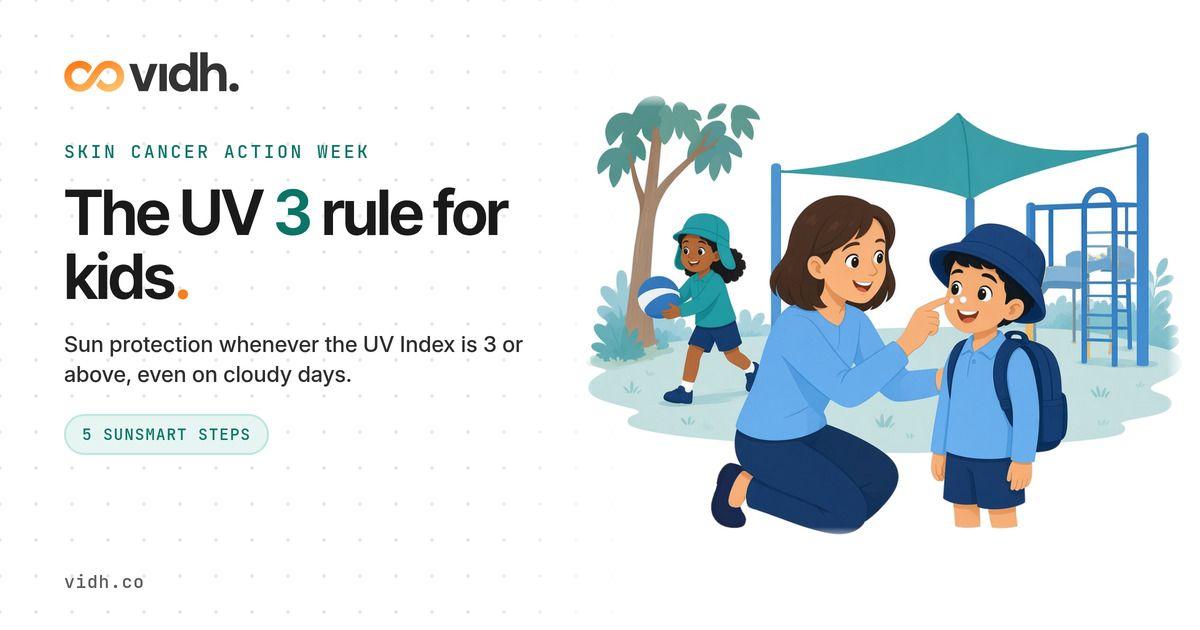
Australia Sun Safety: The UV 3 Rule for Kids
6 min read
When does your child need sun protection in Australia? The UV 3 rule, the five SunSmart steps, checking UV and school hat rules, in plain words.
By Bhagya, Vidh · Last updated: 17 November 2026
In Australia, the summer holidays are close and children are outdoors more than ever. National Skin Cancer Action Week runs from 15 to 22 November 2026, so it is a good moment to check your family's sun routine. Here is what Cancer Council Australia and the Australian Government's StartingBlocks website advise, in plain words. It is general information: if you have a question about your child's skin, ask your GP.
Short answer: In Australia, protect your child whenever the UV Index is 3 or above, even on cool or cloudy days. Use all five SunSmart steps: slip on clothing, slop on SPF50+ sunscreen, slap on a hat, seek shade and slide on sunglasses. Check the daily sun protection times, and wear sunscreen yourself: children copy what parents do.
When does my child need sun protection?
The rule is about UV, not temperature. Cancer Council says: "Sun protection is recommended whenever UV levels reach 3 or higher."
You cannot rely on how the day feels. Cancer Council explains: "Unlike the sun's heat and light, we can't see or feel UV radiation". StartingBlocks, the Australian Government's early childhood website run by ACECQA, adds: "UV can't be seen or felt, so don't just wait for hot and sunny days to use sun protection, UV can be just as high on cool and cloudy days as it is on hot sunny days."
Childhood matters most. Cancer Council's National Skin Cancer Action Week page says: "Half of all lifetime UV exposure happens before the age of 20." It adds: "Childhood sunburn can approximately double the risk of developing melanoma later in life."
What are the five SunSmart steps?
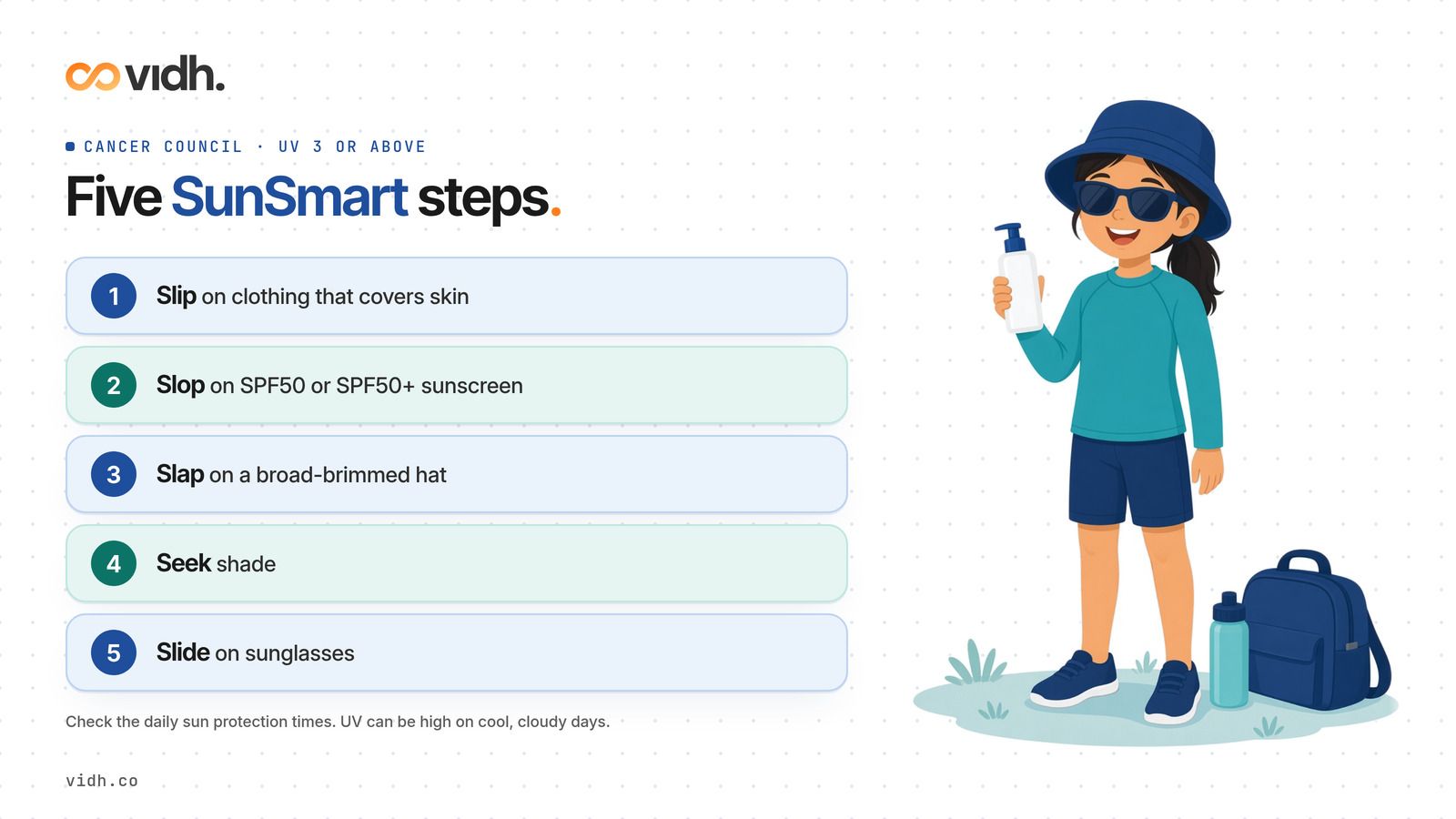
Cancer Council recommends all five, together, whenever the UV Index is 3 or above:
- Slip. "Slip on sun-protective clothing that covers as much skin as possible"
- Slop. "Slop on broad-spectrum, water-resistant SPF50 or SPF50+ sunscreen". Cancer Council says to "apply 20 minutes before going outdoors and reapply every two hours."
- Slap. "Slap on a broad-brimmed hat that protects your face, head, neck and ears". Note: "Caps and visors do not provide enough protection."
- Seek. "Seek shade, especially during the peak UV hours (usually between 10 am and 4 pm)." Shade helps, but "it can still reach you via reflection", so use it with the other steps.
- Slide. "Slide on sunglasses, ideally a wraparound style, that meet Australian standards."
Sunscreen is only one part. StartingBlocks reminds parents that "sunscreen is not a suit of armour and should only ever be used with other sun protection measures."
How do I check today's UV for my suburb?
UV changes with place, season and time of day. Cancer Council notes that "UV levels are affected by a number of factors including geographic location, altitude, time of day, time of year and cloud cover."
- Sun protection times. "Sun protection times are issued by the Bureau of Meteorology when the UV Index is forecast to reach 3 or above."
- On your phone. StartingBlocks says: "Cancer Council's free SunSmart Global UV app shows daily sun protection times and local UV levels."
- Live readings. The Australian Radiation Protection and Nuclear Safety Agency (ARPANSA) says: "We have a network of ultraviolet radiation (UV) detectors in cities around Australia." Its UV chart is "updated in this chart every minute".
A quick habit: check the sun protection times at breakfast, then pack the hat and sunscreen to match.
What does my child's school expect?
Sun rules at school, such as children without a hat playing in the shade, are each school's own sun protection policy. Many schools use Cancer Council's free resources, which include "a sun protection planning guide and the SunSmart schools program". Ask your school, or check the newsletter, for its policy.
Make it easy at home. Put the school hat and sunscreen by the door with our night-before school bag checklist. If your child waits at a sunny bus stop, knowing when the bus is close means less time standing in the sun. Our guide to school bus tracking apps explains how live tracking works; Vidh includes live bus tracking for schools that use it.
For principals and teachers, a short note in the weekly newsletter with the week's UV forecast and the school's hat rule helps families stay in step.
How do I get a reluctant child to wear a hat and sunscreen?
Lead by example. Cancer Council says "children are more than twelve times more likely to use sunscreen when they see their parents doing the same."
StartingBlocks has practical ideas:
- "teach your child from about three years how to apply their own sunscreen".
- "Set up a sunscreen station with a pump pack and mirror in the bathroom or near the back door."
- "Help your child find a favourite sun hat they like to wear and can easily find."
Keep it light and the same every day, like brushing teeth. If your child is in a phase of pushing back, let them choose the hat or the sunscreen bottle. Australian families looking at screen rules this summer may also like our guide to screen time in schools, and at dinner our better than "how was school?" questions can start a chat about the day.
Questions parents ask
Does my child need sunscreen on cloudy days?
Yes, if the UV Index is 3 or above. Cancer Council says UV "can be high even on cool and overcast days." Check the sun protection times rather than the sky.
How often should sunscreen be reapplied, and what about swimming?
Every two hours, and after swimming, sweating or towel drying. StartingBlocks also suggests rash vests ("rashies") for swimming. Use water-resistant SPF50 or SPF50+ sunscreen.
What about babies?
StartingBlocks says: "It is recommended that babies under 12 months are kept away from direct sunlight when UV levels reach 3 or above." It adds that "The widespread use of sunscreen on babies under six months is not generally recommended due to their sensitive skin." Use shade, clothing and a hat, and ask your GP or child health nurse if you have questions.
Which sunglasses should children wear?
Wraparound sunglasses that meet the Australian Standard. StartingBlocks says to check the swing tag for "the Australian Standard 1067 for eye protection" and warns that toy or fashion-labelled sunglasses should not be used for sun protection.
Do we still need sun protection in the school holidays?
Yes. The rule is the same at home, at the beach and on holiday: use all five steps whenever the UV Index is 3 or above.
What if I notice a new spot on my child's skin?
See your GP. Cancer Council says: "Get to know your skin; if you notice any new spots or changes to existing spots, see your GP promptly".
Sources
- Cancer Council Australia, National Skin Cancer Action Week 2026: https://www.cancer.org.au/nscaw2026
- Cancer Council Australia, Be SunSmart: https://www.cancer.org.au/cancer-information/causes-and-prevention/sun-safety/be-sunsmart
- Cancer Council Australia, UV Index: https://www.cancer.org.au/cancer-information/causes-and-prevention/sun-safety/uv-index
- StartingBlocks.gov.au (ACECQA, Australian Government), Sun protection at home: https://startingblocks.gov.au/resources/getting-into-a-routine/sun-protection-at-home
- ARPANSA, Ultraviolet radiation index: https://www.arpansa.gov.au/our-services/monitoring/ultraviolet-radiation-monitoring/ultraviolet-radiation-index
All sources were opened on 14 November 2026.
About Vidh
Vidh (vidh.co) is an AI-powered platform for schools, built by Vidh Labs, that connects management, teachers, parents and students around each child.
Questions: hi@vidh.co