Back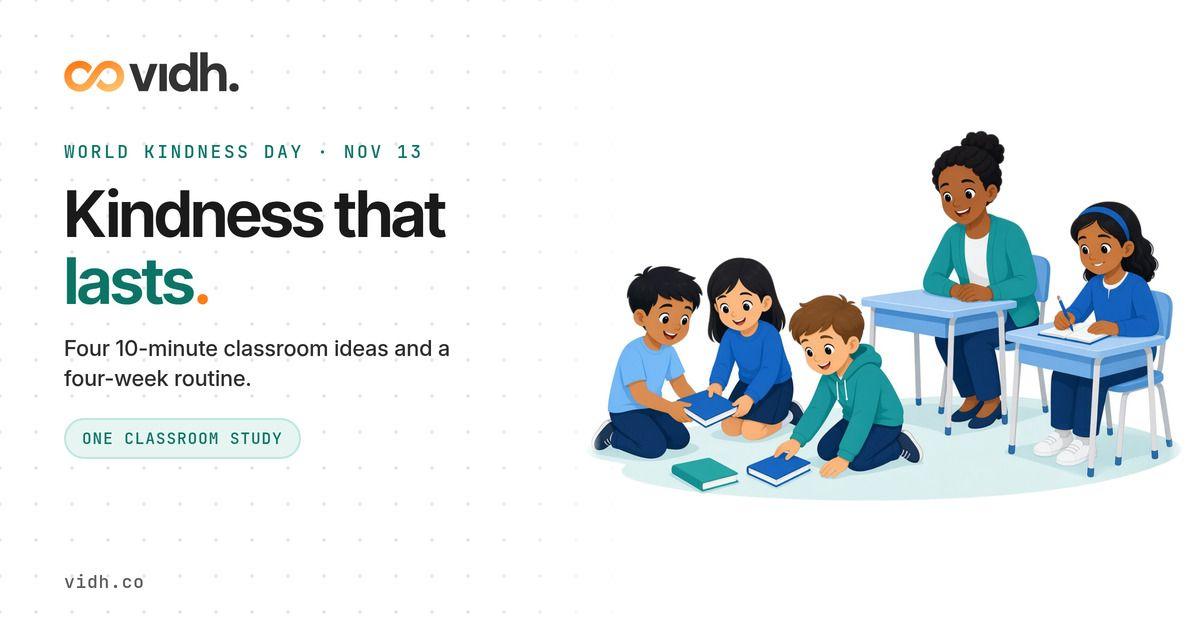
World Kindness Day: 4 Classroom Ideas That Last
5 min read
Four 10-minute World Kindness Day classroom activities, a four-week routine based on one classroom study, and ideas for parents to carry it on at home.
By Bhagya, Vidh · Last updated: November 13, 2026
World Kindness Day is today, and plenty of classrooms in the United States will mark it with a poster or an assembly. That is a good start. This guide gives you four 10-minute activities and a simple four-week routine, so kindness becomes a habit your class keeps, not a one-day event.
Short answer: World Kindness Day is Friday, November 13, 2026. A simple idea with evidence behind it: ask students to do three small kind acts a week and note them briefly. In one classroom study of 9 to 11 year olds, students who did this for four weeks gained more peer acceptance than classmates given another task. Keep it regular and private.
When is World Kindness Day 2026, and who started it?
The Random Acts of Kindness Foundation lists "World Kindness Day®: Nov. 13, 2026". The World Kindness Movement says it "is the creator of World Kindness Day".
If you want ready-made material, the Random Acts of Kindness Foundation offers free school resources on its website, including K-8 lesson plans and a kindness calendar. It is a charity resource, not government guidance, so pick what fits your class.
Does kindness in class actually change anything?
One classroom study suggests it can. In 2012, researchers published a study in PLoS ONE called "Kindness Counts". They describe it this way: "In a longitudinal experiment conducted in 19 classrooms in Vancouver, 9- to 11-year olds were instructed to perform three acts of kindness (versus visit three places) per week over the course of 4 weeks."
Here is what they found. "Students in both conditions improved in well-being, but students who performed kind acts experienced significantly bigger increases in peer acceptance (or sociometric popularity) than students who visited places." Each week, students in both groups wrote down what they had done on short in-class surveys.
The authors suggest a next step for schools: "Teachers and interventionists can build on this study by introducing intentional prosocial activities into classrooms and recommending that such activities be performed regularly and purposefully."
Keep the claim in proportion. This is one study, with 415 students in Canadian classrooms. It does not prove that any single activity works everywhere, but it gives a sensible, low-cost routine to try.
Which 4 kindness activities work in 10 minutes?
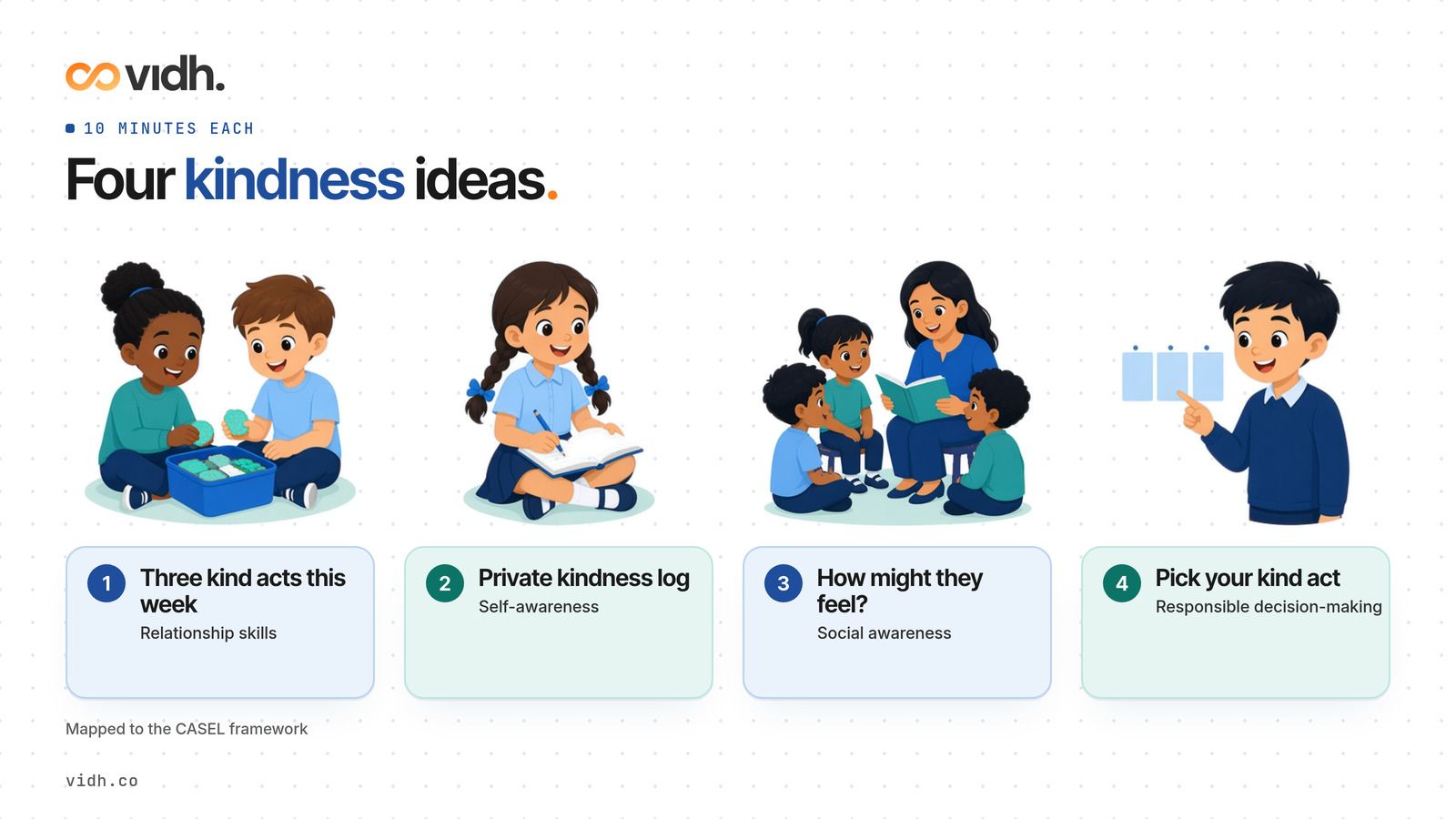
Each idea below links to one of the five areas in the CASEL framework, a nonprofit framework for social and emotional learning. CASEL describes these as "self-awareness, self-management, social awareness, relationship skills, and responsible decision-making." How schools use CASEL varies by state and district.
- Three kind acts this week (relationship skills). Ask each student to plan three small kind acts before next Friday: for anyone, at school or at home. This mirrors the routine in the study. CASEL describes relationship skills as "The abilities to establish and maintain healthy and supportive relationships and to effectively navigate settings with diverse individuals and groups."
- The private kindness log (self-awareness). On Friday, give students two minutes to jot down what they did and how it felt. Keep logs private, as students in the study reported their acts on in-class surveys rather than in front of the class.
- "How might they feel?" (social awareness). Read a short scene from a class book and ask: who here might need some kindness, and what would help? CASEL describes social awareness as "The abilities to understand the perspectives of and empathize with others".
- Pick your kind act (responsible decision-making). Give students a few ideas, such as helping a classmate find something, including someone in a game, or thanking a school worker, and ask them to choose one that fits their day.
A 10-minute Friday script
- Minute 1 to 2: remind the class of the goal, three small kind acts this week, for anyone they choose.
- Minute 3 to 4: share two or three examples, such as holding a door, sharing a snack, helping at home or checking on a friend who seems quiet.
- Minute 5 to 7: students write their plan for next week, or jot down last week's acts in their private log.
- Minute 8 to 9: ask one reflection question, such as "Which kind act was easiest?" or "How did someone react?"
- Minute 10: invite, but never require, one or two students to share.
The examples in the study were everyday ones. The researchers list kind acts such as "gave someone some of my lunch" and "vacuumed the floor", so small acts at home count too.
How do you keep it going for 4 weeks, not 1 day?
The study ran for four weeks, with three kind acts each week. A simple plan:
- Week 1: introduce the idea on World Kindness Day and start the private log.
- Week 2: add the "How might they feel?" discussion once.
- Week 3: invite students to choose a kind act for someone outside their usual group.
- Week 4: ask students to look back at their logs and write one thing they noticed.
A few habits help the routine last:
- Keep it short: five to ten minutes, the same day each week.
- Keep it private: no public charts, points or prizes for kindness.
- Keep it specific: "I helped Sam carry the books" is better than "I was nice".
- Keep it optional to share: some students will want to talk about it, others will not.
How can parents carry it on at home?
Parents can ask a simple question at dinner: "Who was kind to you today, and who were you kind to?" Our list of better questions than "How was school?" has more ideas like this.
Kindness counts in adult spaces too. Parent group chats are a good place to model it, and our school WhatsApp group rules can help. If you want to ask about friendships at your next meeting with the teacher, see our three questions for a short parent-teacher meeting.
For schools thinking about student wellbeing more broadly, see how educational intelligence can reduce student anxiety.
Vidh connects management, teachers, parents and students around each child.
Questions teachers ask
How do I adapt this for different grade levels?
For younger students, model one kind act together and use pictures in the log. For older students, let them plan their own acts and reflect in writing. The study itself worked with 9 to 11 year olds, so younger and older classes are an adaptation, not a tested version.
Is this the same as an anti-bullying program?
No. This routine builds everyday kindness. If a student is being bullied, follow your school's own policy and procedures.
How can I track kindness without a rewards chart?
Use the private log. Students in the study reported what they did each week on in-class surveys, with no public scoreboard.
What about shy students?
Make sharing optional, and offer quiet kind acts such as a note or helping tidy up. The private log lets every student take part.
My older students think kindness activities are "cringe". What then?
Give them choice and ownership. Let them design the kind act, keep it private, and focus on what they noticed rather than on praise.
Sources
- Random Acts of Kindness Foundation, World Kindness Day: https://www.randomactsofkindness.org/world-kindness-day
- World Kindness Movement: https://www.theworldkindnessmovement.org/
- Layous K, Nelson SK, Oberle E, Schonert-Reichl KA, Lyubomirsky S (2012), Kindness Counts: Prompting Prosocial Behavior in Preadolescents Boosts Peer Acceptance and Well-Being, PLoS ONE 7(12): https://journals.plos.org/plosone/article?id=10.1371/journal.pone.0051380
- CASEL, What Is the CASEL Framework?: https://casel.org/fundamentals-of-sel/what-is-the-casel-framework/
All sources were opened on November 10, 2026.
About Vidh
Vidh (vidh.co) is an AI-powered platform for schools, built by Vidh Labs, that connects management, teachers, parents and students around each child.
Questions: hi@vidh.co