Back
Type 1 Diabetes at School: A Care Plan Guide
5 min read
What a child with type 1 diabetes needs at school: the care plan, who does what, the ISPAD low blood glucose steps, exams, trips, privacy and the 4Ts.
By Bhagya, Vidh · Last updated: 12 November 2026
When a child is diagnosed with type 1 diabetes, the school day gains new steps: glucose checks, insulin, snacks on time, and a plan for when things go wrong. Parents worry about the hours they cannot see, and teachers worry about getting it wrong. World Diabetes Day is on 14 November, and its theme for 2026-27 is "Early action on diabetes". This guide sets out what the international guidance for schools from ISPAD (the International Society for Pediatric and Adolescent Diabetes) says, so families and schools can agree one plan.
Short answer: A child with type 1 diabetes needs a written care plan agreed by parents, the diabetes team and the school before term starts, and reviewed at least once a year. It covers glucose checks, insulin, food, sport, exams, trips and emergency steps. Teachers should know the warning signs and the plan, and give daily care discreetly to help avoid stigma.
Please note: This is general information, not medical advice. Always follow your child's diabetes team and their written care plan.
What does a child with type 1 diabetes need at school?
The World Health Organization describes type 1 diabetes as a condition that "is characterized by deficient insulin production and requires daily administration of insulin." Children spend a large part of their waking day at school, so some of that daily care happens there.
ISPAD's school guideline is clear on the starting point: "All students with diabetes must have an individualized plan that details the requirements for diabetes management. The plan must be developed and agreed on with parents in advance of school attendance." It adds that the plan "should be reviewed and amended as and when necessary, according to the needs of the student, and/or at least annually."
These are international guidelines, not the law in any Gulf country. Who may give or supervise insulin, whether there is a school nurse, and the school's snack rules are set by each school, so ask your school how this works.
What goes in a school diabetes care plan?
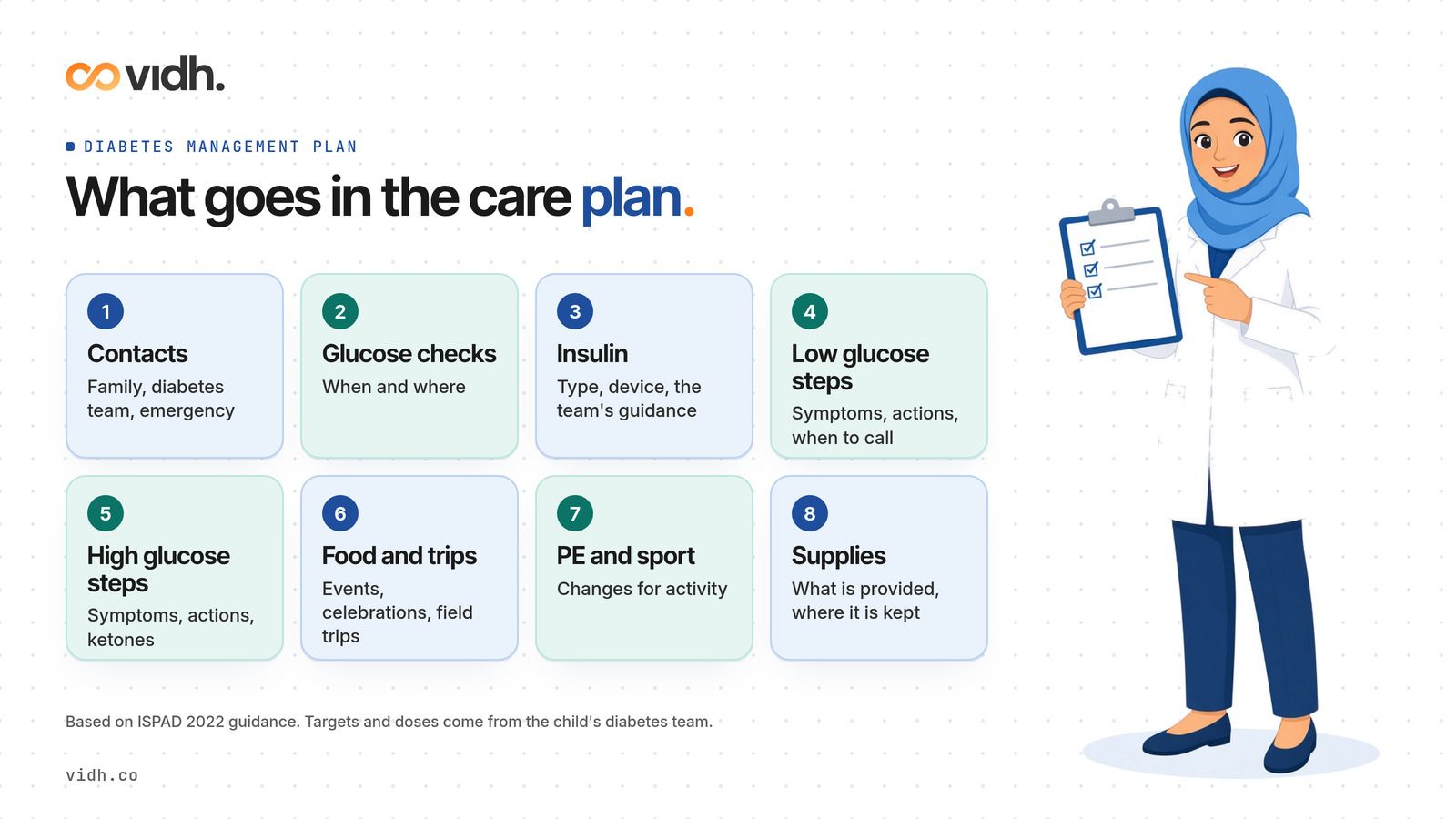
ISPAD calls it a diabetes management plan (DMP). Its recommended contents are:
- Identification: the child's name, date of birth, parents' names, age at diagnosis and type of diabetes.
- Contact information: phone numbers for parents, the child, the diabetes doctor or healthcare professional, and emergency contacts.
- Monitoring: when and where to check glucose, and the target ranges set by the diabetes team.
- Insulin: the type of insulin and device (pen, syringe or pump), with the diabetes team's guidance.
- Low blood glucose: the child's own symptoms, when to act and what to do, when to call for emergency help, and instructions for any glucagon.
- High blood glucose: the child's own symptoms, when to act, and ketone checks.
- Food: meals during school events, celebrations and field trips.
- Exercise: changes needed for PE and school events.
- Self-care: how much the child does on their own.
- Supplies: what is provided and where it is kept.
- Support: the main contact for emergencies or questions about the plan.
ISPAD says the plan should be clearly documented, easy to follow, and not changed without parental agreement. The numbers in it, such as targets and doses, come from your child's diabetes team, not from the school or from this guide.
Who does what: parent, class teacher, school nurse and head?
ISPAD describes a shared job. The medical team and parents give clear instructions for managing low blood glucose, and the family provides the glucose meter or sensor and related supplies. The school identifies trained staff to support diabetes care during school hours, and makes reasonable arrangements so the plan can be delivered.
One ISPAD line matters for every head teacher: "Parents cannot be expected to compensate for a lack of school resources and attend to their child's medical management during the school day."
Good communication holds it together. ISPAD says: "Successful diabetes management at school heavily depends on effective communication and problem-solving with the family." It adds: "Schools should clarify expectations and coordinate communication." Agree one channel for plan updates, and keep questions about a named child out of class group chats. Our guide to choosing a parent-teacher communication app has a checklist for that.
What should teachers do if a child seems low or unwell?
Follow the emergency steps in the child's care plan. ISPAD's Table 2 sets out these principles for low blood glucose (hypoglycaemia) in the school setting. BG means blood glucose and DMP means the diabetes management plan. The glucose level that means "act now" is in the child's plan, so it is not repeated here.
Be prepared:
- "All school staff should be aware of the symptoms and signs of hypoglycemia and how to respond"
- "Emergency Care Plan available (outlines symptoms and management of hypoglycemia)"
- "Diabetes Emergency Kit should be readily available in the classroom/student's bag, containing a BG meter and fast-acting sugar (i.e., glucose tablets, sugar-containing drink) and a small carbohydrate snack"
If the child has symptoms of mild hypoglycaemia:
- "Check BG immediately. If not possible to check BG and student has symptoms, assume hypoglycemia is present."
- "Treat with fast-acting carbohydrate (i.e., fruit juice, glucose tablets, hard candy). The amount depends on the BG level, size of the student and the insulin regimen; this should be indicated in the DMP."
- "Recheck BG in 15 min and repeat treatment if hypoglycemia persists"
- "Do not leave the student unattended until hypoglycemia has resolved."
If the child has severe hypoglycaemia (loss of consciousness and/or seizures):
- "Place student in a 'recovery' position"
- "Immediately place emergency call for assistance"
- "Do not administer anything by mouth"
- "Glucagon is recommended treatment (injectable or intranasal)"
For high blood glucose, Table 2 says that if the student is unwell, "emergency services and parents should be immediately contacted". Every other step is in the care plan.
How do exams, trips and sports days work with diabetes?
The plan travels with the child. ISPAD says the plan applies to school activities outside normal hours too, including before and after school programmes, camps, field trips and school sports events.
For exams, ISPAD says: "Specific written arrangements should be in place (including access to BG monitoring equipment; fast-acting carbohydrates; and hypoglycemia emergency kit) for exams." It also says students "need access to snacks wherever they are, including in the classroom and during tests or examinations." If your child is preparing for board exams, our exam stress tips for parents cover the conversations at home.
For PE and sport, follow the exercise section of the plan. ISPAD asks PE teachers and coaches to make sure monitoring equipment and an emergency kit are available at every activity site. On busy mornings, a night-before school bag routine helps make sure the supplies listed in the plan are packed.
How can schools protect privacy and stop teasing?
ISPAD notes that "Young people with diabetes have a significantly increased risk of experiencing discrimination, stigma and bullying". Its answer is to make care ordinary: "Diabetes care tasks should be integrated into the student's regular daily routine as unobtrusively as possible to preserve their privacy, dignity" and to support their social and educational development.
In practice, ISPAD's advice to PE staff is to treat the student with diabetes the same as other students, except in meeting their medical needs, and to respect their right to privacy and confidentiality. School staff should also be aware of peer influences and help with referrals to counsellors where needed.
What are the warning signs every teacher and parent should know?
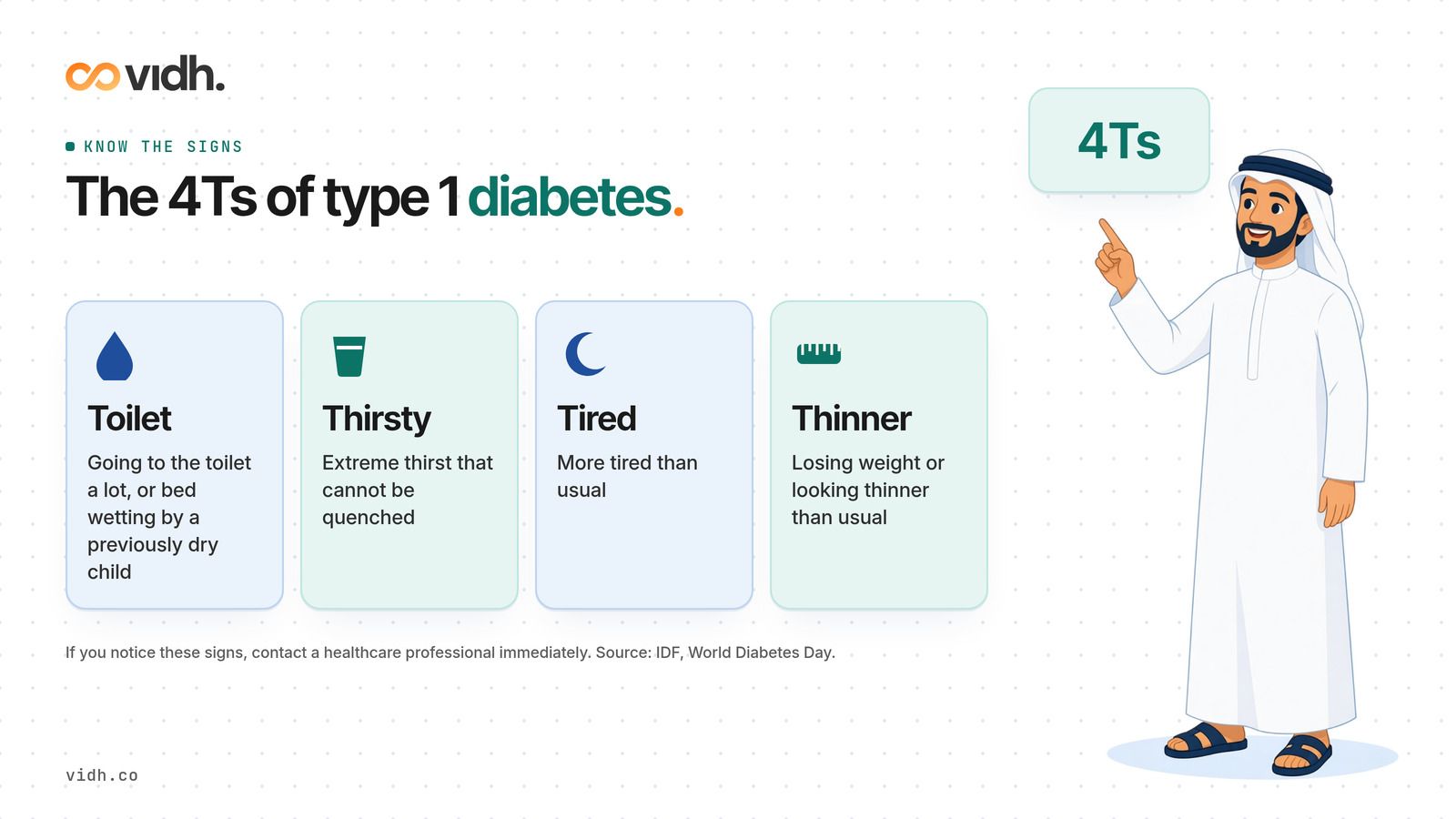
The International Diabetes Federation's World Diabetes Day site says: "Delayed diagnosis of type 1 diabetes can be life-threatening." It lists four signs, often called the 4Ts:
- Toilet: going to the toilet a lot, bed wetting by a previously dry child, or heavier nappies in babies.
- Thirsty: having extreme thirst and not being able to quench the thirst.
- Tired: feeling more tired than usual.
- Thinner: losing weight or looking thinner than usual.
The same page says: "Contact a healthcare professional immediately if you experience these symptoms or notice them in someone else." It also notes that "Type 1 diabetes cannot be prevented and there is no cure for the condition."
For context, IDF's regional page says "85m adults are living with diabetes in MENA". That figure counts adults with all types of diabetes. It is not a figure for children or for type 1 diabetes.
For schools: a short checklist
- Ask for the child's written plan before the first day, and agree a date to review it at least once a year.
- Name the trained staff who support the child, and who covers when they are absent.
- Keep a copy of the emergency steps where the child learns, eats and plays, and on trips.
- Put written exam arrangements in place before assessments.
- Agree one private channel for plan updates with the family.
Vidh connects management, teachers, parents and students around each child. For a wider review of how your school talks to families, see The Parent Communication Audit Every School Should Run.
Questions parents ask
Does my child need a care plan for school?
Yes. ISPAD says all students with diabetes must have an individualised plan, agreed with parents before they start school, and reviewed at least once a year.
Can the school ask me to come in and give insulin?
ISPAD says parents cannot be expected to make up for a lack of school resources by attending to their child's medical care during the school day. How insulin is given or supervised is set by each school, so agree it in the plan.
Can my child take snacks into exams?
ISPAD says students with diabetes need access to snacks wherever they are, including during tests and examinations, and that written exam arrangements should be in place. Ask the school to confirm these before each exam.
What are the 4Ts of type 1 diabetes?
Toilet, Thirsty, Tired and Thinner. If you notice them, the IDF says to contact a healthcare professional immediately.
Is this medical advice?
No. This is general information. Always follow your child's diabetes team and their written care plan.
Sources
- ISPAD Clinical Practice Consensus Guidelines 2022, Chapter 22: Management and support of children and adolescents with diabetes in school (Pediatric Diabetes 2022;23:1478-1495): https://www.ispad.org/static/a1d1b231-8494-41ef-8d6ab5081220ffbb/Chapter22PediatricDiabet.pdf
- World Diabetes Day (International Diabetes Federation), home page: https://worlddiabetesday.org/
- World Diabetes Day (International Diabetes Federation), Know the signs of type 1 diabetes: https://worlddiabetesday.org/know-the-signs-type-1-diabetes/
- International Diabetes Federation, Middle-East and North Africa region: https://idf.org/our-network/regions-and-members/middle-east-and-north-africa/
- World Health Organization, Diabetes fact sheet (3 November 2026): https://www.who.int/news-room/fact-sheets/detail/diabetes
All sources were opened on 10 November 2026 and the quoted lines were checked on the page or PDF. Quotes from ISPAD keep its original spelling.
About Vidh
Vidh (vidh.co) is an AI-powered platform for schools, built by Vidh Labs, that connects management, teachers, parents and students around each child.
Questions: hi@vidh.co