Back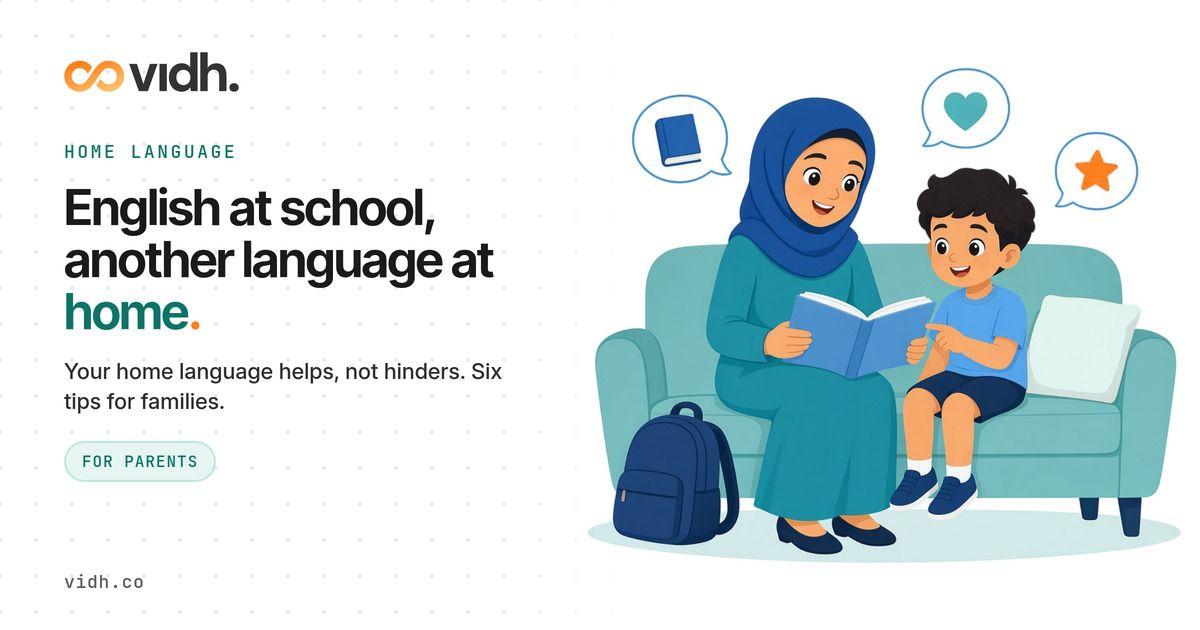
English at School, Another Language at Home: 6 Tips
5 min read
Will speaking your home language slow your child's English? What ASHA, UNESCO and education guidance say, plus six tips and questions for the teacher.
By Bhagya, Vidh · Last updated: 13 November 2026
Many families in the Gulf speak Arabic, Hindi, Urdu, Malayalam, Tagalog or another language at home, while their children learn in English at school. It is common to worry that the home language might slow down English. The guidance from speech and language experts, a government education department and UNESCO points the other way. Here is what they say, and six practical tips for home.
Short answer: No, using your home language does not hold back your child's English. Speak, read and play in the language you know best, even if your child replies in English. Mixing words from two languages is a normal stage. Skills such as reading for meaning can carry across languages, so a strong home language supports learning at an English-medium school.
Will speaking my home language slow down my child's English?
No. The American Speech-Language-Hearing Association (ASHA) advises parents: "Talk to your child in the language(s) you are most comfortable using." It adds: "Using multiple languages does not confuse children or cause speech or language delays. In fact, having a strong foundation in one language supports additional language learning!"
The Victoria State Government in Australia gives the same message to families whose children learn in English: "You are encouraged to speak, read and write with your child in your home language: the language you know best." It also says: "Your child will not be disadvantaged if they don't speak English at home." This is guidance from another country, not Gulf school policy, but it describes the same situation many Gulf families are in.
UNESCO calls this idea "transfer", which it defines as "The process of using the knowledge and skills acquired in one language to achieve the same knowledge and skills in another language." Its 2025 guidance adds: "Once reading skills are established in the L1, they can transfer to reading in other languages, provided the learner has developed speaking and comprehension skills in those languages." L1 means a child's first language.
Is it normal for my child to mix languages?
Yes. ASHA says: "Sometimes children might blend words or grammar rules from different languages. It's an expected part of learning and using more than one language at a time."
So if your child says a sentence that starts in one language and ends in another, that is part of learning, not a problem to fix. You can simply reply in your home language, using the word they reached for.
What should we read and watch at home, and in which language?
Read and watch in both. ASHA suggests reading "multilingual or picture books together in your languages" and talking about the pictures, characters and stories in more than one language.
For screens, ASHA says: "Turn on subtitles for school-aged children to help them connect spoken and written words, which will help them learn to read." Subtitles in English or in your home language can both help.
Victoria's guidance suggests singing, talking, playing number games and reading to your child in your home language, and speaking it during family trips and celebrations.
What if my child answers me in English?
Keep going in your home language. Victoria's guidance says: "Speak to your child in your home language even if your child replies in English. This is so they can hear the differences between the two languages."
Try not to turn it into a battle. Some families keep one time of day, such as dinner or bedtime stories, mainly in the home language, so it feels like a normal part of family life rather than a rule.
What should I ask my child's teacher?
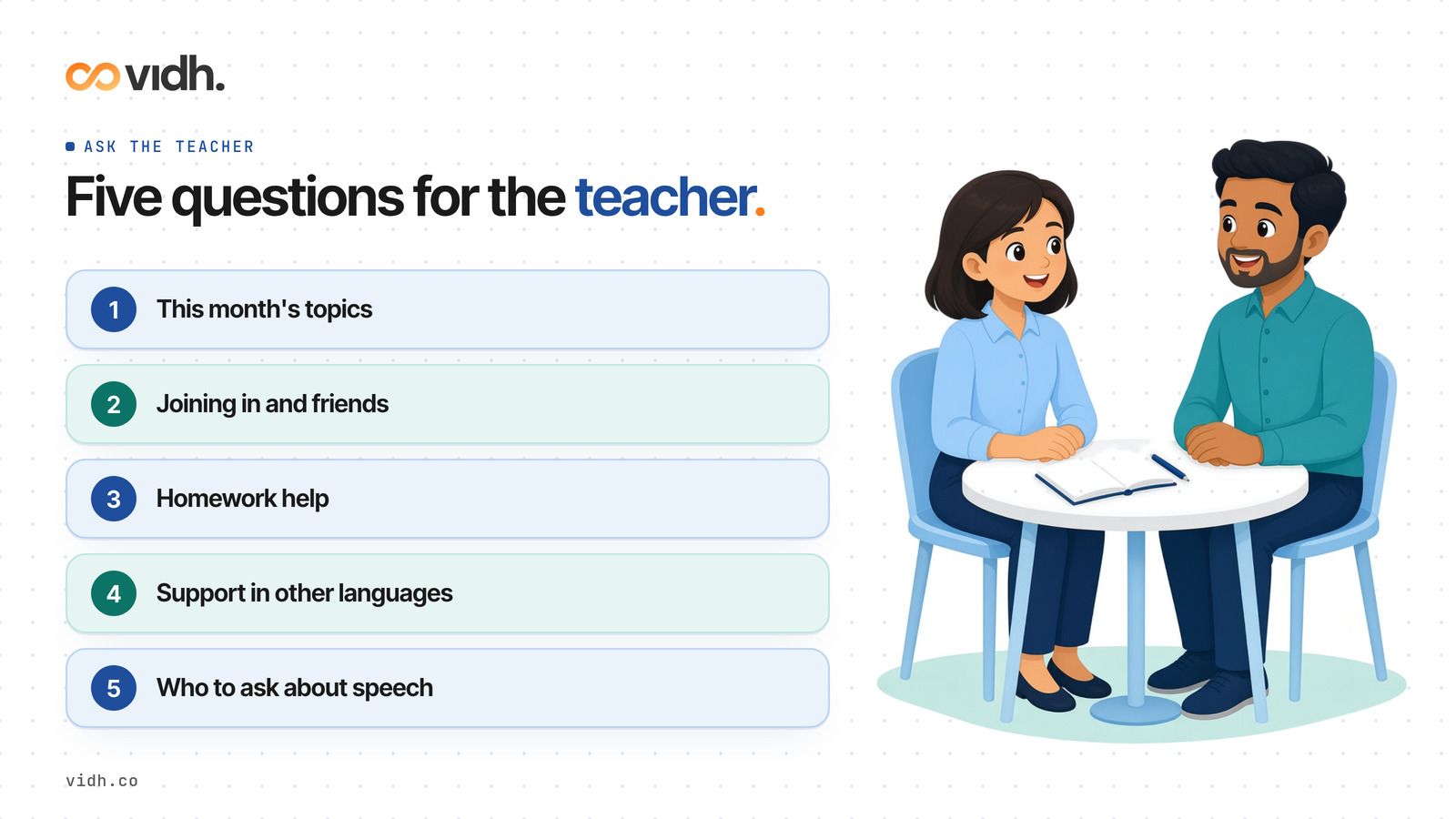
A short conversation with the teacher helps both sides. Useful questions include:
- Which words or topics is the class learning this month, so we can talk about them at home in our language too?
- Is my child joining in and making friends in English?
- How can I help with homework if my English is not strong?
- Does the school offer any support or activities in other languages?
- Who should I speak to if I have a concern about my child's speech or language?
Victoria's guidance says helping with homework in your home language "will help them build skills at school." For example, if a child learns a maths idea in your language, they can then use it in English. Our guide on helping with homework by giving the next step, not the answer works in any language. For more on meetings with teachers, see three questions for a short parent-teacher meeting.
Six tips for a bilingual week at home
- Use the language you know best for everyday talk, stories and feelings.
- Keep a regular home-language time, such as dinner, bedtime stories or calls with grandparents.
- Read picture books together and talk about them in both languages.
- Turn on subtitles when your school-aged child watches shows.
- Talk about the school day in your home language. Our better questions than "How was school?" work in any language.
- Celebrate both languages: songs, festivals and family stories all count.
Vidh connects management, teachers, parents and students around each child.
For schools thinking about language support more widely, see our article on language-inclusive edtech and mother tongue support.
Questions parents ask
My child learns Arabic as a school subject, and we speak a different language at home. Is that too much?
Many children learn more than one language. ASHA says using multiple languages does not confuse children or cause delays. Keep your home language strong, and ask the Arabic teacher how you can support the subject at home.
We use three languages. Is that OK?
ASHA's advice is about learning more than one language, and it suggests talking to your child in the language or languages you are most comfortable using. Keep each language part of real daily life rather than drills.
How do I help with homework if my English is weaker than my child's?
Talk through the idea in your home language, and let your child explain it to you in English. Victoria's guidance says helping with homework in your home language helps children build skills at school.
When should I ask for a speech and language check?
ASHA says: "If your child has a communication issue, it will show up in all the languages they use." If you are concerned, ASHA suggests talking to a speech-language pathologist, also called a speech and language therapist. Your child's teacher or doctor can help you find one.
How common is it for children not to learn in their home language?
UNESCO says that "Globally 40 per cent of the population does not have access to an education in a language they speak or understand." That is a global figure, not a figure for the Gulf.
Sources
- American Speech-Language-Hearing Association (ASHA), Learning More Than One Language: https://www.asha.org/public/speech/development/learning-more-than-one-language/
- Victoria State Government (Australia), Speak to your child in the language you know best (updated 21 October 2026): https://www.vic.gov.au/speak-your-child-language-you-know-best
- UNESCO (2025), Languages matter: global guidance on multilingual education: https://www.unesco.org/en/articles/languages-matter-global-guidance-multilingual-education (PDF: https://www.eenet.org.uk/resources/docs/392477eng.pdf)
- UNESCO, International Mother Language Day: https://www.unesco.org/en/days/mother-language
All sources were opened on 10 November 2026.
About Vidh
Vidh (vidh.co) is an AI-powered platform for schools, built by Vidh Labs, that connects management, teachers, parents and students around each child.
Questions: hi@vidh.co