Back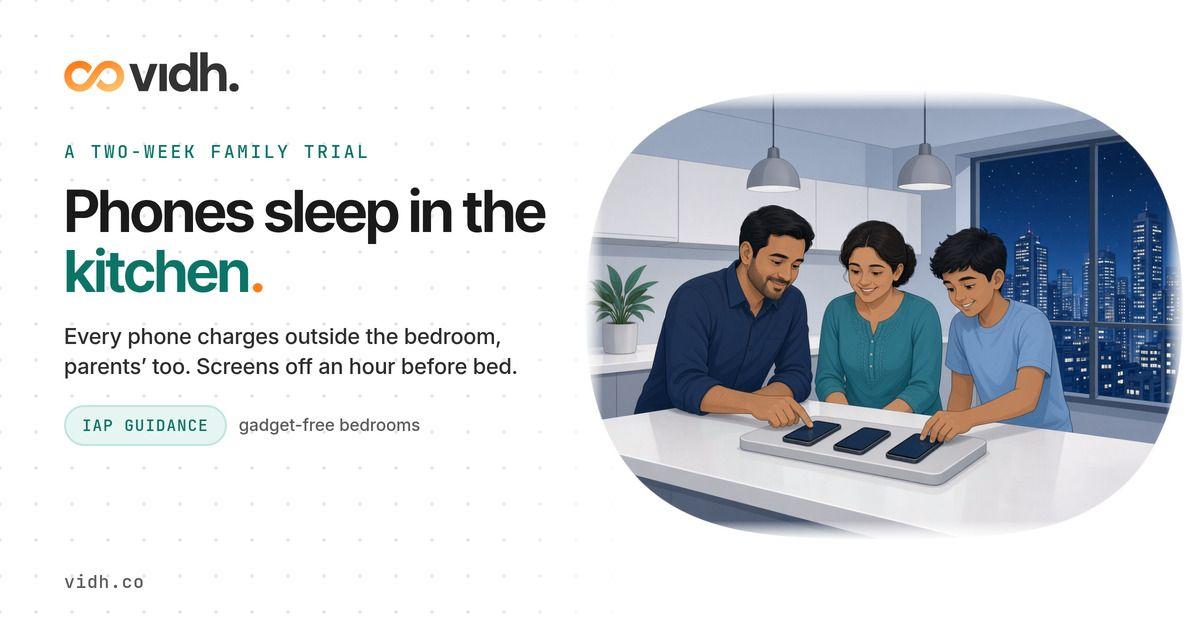
India Families: Phones Charge Outside the Bedroom
5 min read
A 2-week family trial for India: every phone charges outside the bedroom and screens go off an hour before bed, based on IAP and IPS guidance.
By Bhagya, Vidh · Last updated: 22 November 2026
In many Indian homes, the last thing a child sees at night is a phone screen, and often the same is true for their parents. If late-night scrolling is eating into your child's sleep, a simple experiment can help: for two weeks, every phone in the house charges outside the bedroom. This guide is for families in India with children in Class 3 to Class 10, and it is built on guidance from Indian paediatric and psychiatric bodies. It is general information, not medical advice.
Short answer: Vidh's family trial is simple: for two weeks, every phone charges outside the bedroom, including parents' phones, and screens go off an hour before sleep. The Indian Academy of Pediatrics suggests keeping bedrooms gadget-free and switching screens off an hour before bedtime. Use a kitchen charging shelf and a tick chart, then review together after fourteen days.
Why move phones out of the bedroom?
The Indian Academy of Pediatrics (IAP) published guidelines on screen time and digital wellness in Indian Pediatrics in December 2021. Its rules for families include: "Mark digital free zones like bedroom, dining table, kitchen, bathroom, and motorized vehicles where no family member uses a gadget." It also says "Screens should be switched off 1 hour before bedtime as blue light emitted from devices suppresses melatonin secretion necessary for healthy sleep."
The Indian Psychiatric Society's 2020 recommendations for children aged 5 to 18 say: "Ensure that children do not sleep with devices (like tablet or smartphone). Avoid exposure to screen for one hour before bedtime." The American Academy of Pediatrics gives similar advice, recommending that screens stay "out of children's bedrooms, especially at night."
These are professional guidelines, not law. Your child's school may also have its own phone rules.
How much sleep does my child need?
The IAP guidelines say children aged 5 to 10 should have 9 to 12 hours of sleep, and adolescents aged 10 to 18 need 8 to 9 hours of nighttime sleep. If your child has to wake at 6 for the school bus, that means lights out well before 10, even for a teenager.
How does a two-week family trial work?
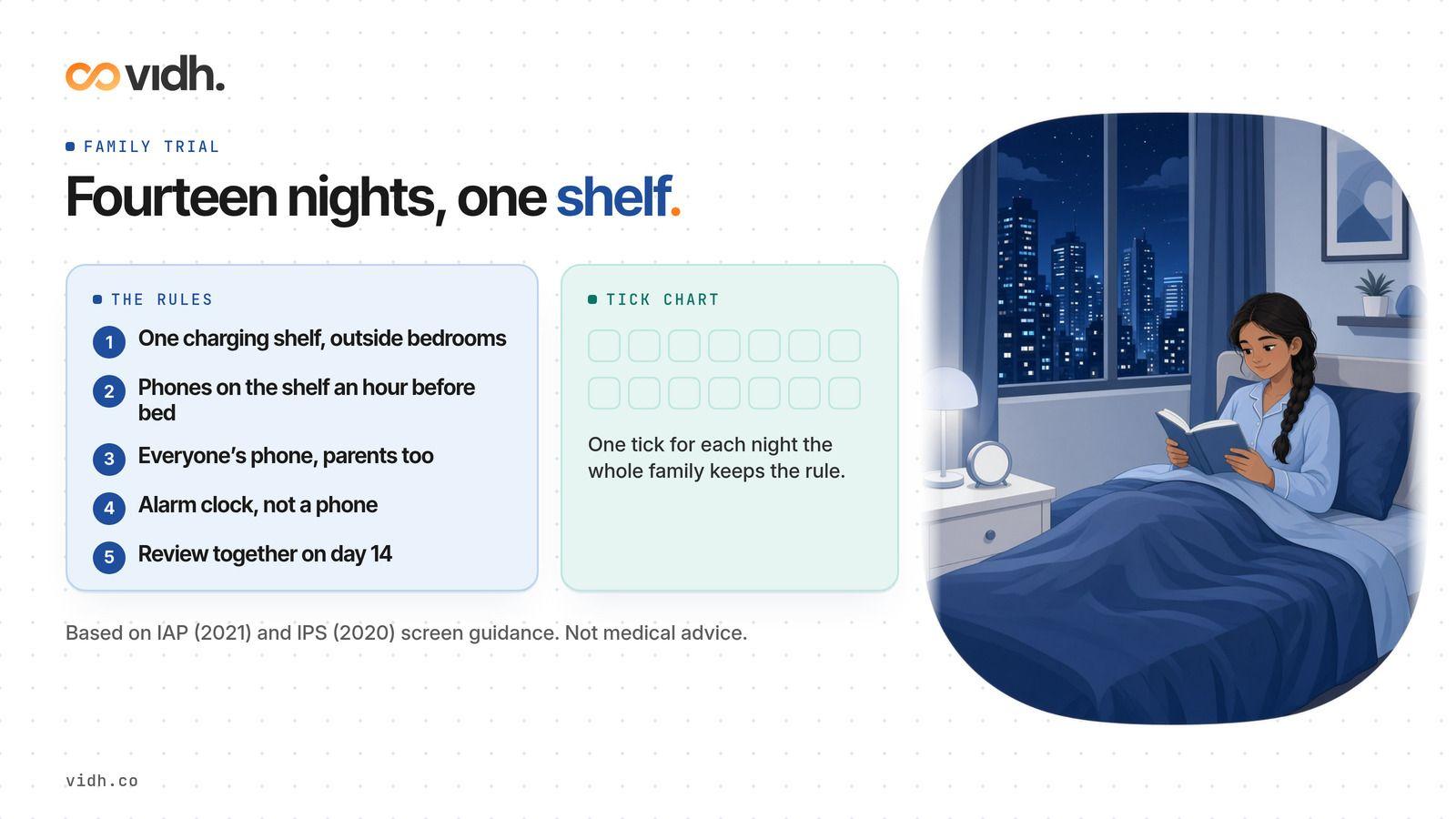
- Pick one charging shelf. Choose a spot outside the bedrooms, such as a kitchen shelf or the living room. Phones rest and charge there; nobody sits and scrolls there.
- Set a phones-down time. One hour before your child's bedtime, every phone goes on the shelf.
- Include everyone. Parents' phones go on the shelf too. The IAP says parents should act as a role model to promote digital wellness in the whole family.
- Buy a simple alarm clock. It removes the most common reason for keeping a phone by the bed.
- Use a tick chart. Put a 14-box chart on the fridge and tick each night the whole family keeps the rule.
- Plan the hour. Reading, a shower, packing the school bag or talking about the day all work well.
What if my child needs the phone for homework or alarms?
Finish online homework earlier in the evening, before phones-down time. The IAP also suggests that "While doing offline homework, all screen devices should be switched off." For alarms, an inexpensive alarm clock does the job without the temptation of notifications.
What do we do on exam nights?
Keep the same rule, especially before board exams. Late-night revision on a phone often turns into scrolling, and sleep matters for memory and focus. Our board exam stress tips for parents have more ideas for exam season.
How do we review it after 14 days?
On day 14, sit down together and ask:
- Did everyone fall asleep earlier?
- Were mornings easier?
- What was hardest, and what would make it easier?
- Do we keep the rule as it is, change the time, or try a different shelf?
Let your child have a real say. The IPS suggests ground rules should preferably be "mutually discussed and agreed upon." Rules that children help write are easier to keep. If school holidays are coming, our Diwali break routine shows how a simple daily rhythm helps in any break, and our look at screen time limits around the world has more context. The AAP's free Family Media Plan tool can help you write your family's rules down.
Questions parents ask
Do parents' phones really have to go on the shelf too?
Yes, for the trial to work. Children copy what they see, and the IAP asks parents to be role models for healthy screen use.
What about class WhatsApp group messages at night?
They can wait until the morning. Most school messages are not urgent, and many schools ask parents not to post late at night. Our school WhatsApp group rules explain why quiet hours help everyone.
Can we relax the rule at weekends?
Keep the shelf rule every night during the two-week trial, so it becomes a habit. After the review, you can agree a slightly later phones-down time on weekends if everyone wants it.
My teenager says everyone else has their phone at night. What do I say?
Listen first, then explain that this is a family trial for two weeks and their opinion counts at the review. Older teens can help choose the phones-down time.
What if my child still cannot sleep?
If sleep problems continue after the trial, or your child often feels tired, worried or low, see your child's doctor.
Sources
- Indian Academy of Pediatrics, Guidelines on Screen Time and Digital Wellness, Indian Pediatrics (e-pub 29 December 2021): https://www.indianpediatrics.net/epub122021/RECOMM-00384.pdf
- Indian Psychiatric Society, Recommendations for Screen Use (e-booklet, 2020): https://indianpsychiatricsociety.org/wp-content/uploads/2020/06/E-Booklet-RECOMMENDATIONS-FOR-SCREEN-USE.pdf
- American Academy of Pediatrics, HealthyChildren.org, Healthy Sleep Habits: How Many Hours Does Your Child Need?: https://www.healthychildren.org/English/healthy-living/sleep/Pages/healthy-sleep-habits-how-many-hours-does-your-child-need.aspx
- American Academy of Pediatrics, Family Media Plan: https://www.healthychildren.org/English/fmp/Pages/MediaPlan.aspx
All sources were opened on 16 November 2026.
About Vidh
Vidh (vidh.co) is an AI-powered platform for schools, built by Vidh Labs, that connects management, teachers, parents and students around each child.
To see how Vidh works for your school, book a 30-min demo.
Questions: hi@vidh.co