Back
US Parents: Sunday-Night School Worries, What to Say
5 min read
What US parents can say on Sunday night when school worries start: AAP and AACAP advice, why staying home backfires, and when to call the doctor.
By Bhagya, Vidh · Last updated: November 22, 2026
It is Sunday night, the bag is by the door, and your child suddenly has a stomachache, or tears, or a long list of reasons they cannot go tomorrow. Many US parents know this moment well, and it often gets harder after a break like Thanksgiving. This guide is for parents of elementary and middle school children. It covers what to say tonight, when staying home helps and when it does not, and when to talk to a doctor. It is general information, not medical advice.
Short answer: Vidh's first step: listen, name the worry, and make one small plan for Monday morning together. Sunday-night dread is common, and AAP notes school worries often show up on school days but fade at weekends. Keep your child going to school unless a doctor advises otherwise. If worries persist or grow, talk to the teacher and your child's doctor.
Why do Sunday-night worries happen?
The American Academy of Pediatrics (AAP) explains that many children who try to avoid school have "anxiety-related symptoms over which they have no conscious control." Headaches and stomachaches are common, and these symptoms "happen most often on school days, and are usually absent on weekends."
The American Academy of Child and Adolescent Psychiatry (AACAP) adds that "Refusal often begins after a period at home, like summer break, a holiday, or a brief illness." That is why the night before school after a long weekend can feel so hard. The CDC notes that "Some anxious children keep their worries to themselves", so a stomachache may be the only sign you see.
What should I say tonight?
- Listen first. Sit down, put your phone away and ask what part of tomorrow feels hardest. Let them finish before you answer.
- Name it. Try: it sounds like you are worried about tomorrow, and that is a real feeling. Naming a worry makes it smaller.
- Stay calm and confident. You might say: I know Monday feels big tonight. You can do hard things, and I will help you get ready.
- Make one small plan. Agree on one thing that will make the morning easier, such as walking in with a friend or knowing who they will sit with at lunch.
Try not to argue about whether the worry is real, and try not to promise they can stay home if it is still there in the morning.
Should I let them stay home?
Usually not, if your child is not physically sick. The AAP's advice is to acknowledge your child's concerns but insist on their return to school, because "The longer they stay home, the more difficult their eventual return will be." AACAP notes that a complaint like a stomachache "often goes away once the child is allowed to stay home", then comes back the next school morning.
If you are not sure whether your child is ill, check with their doctor. The AAP suggests an examination by your child's doctor can rule out physical illness first.
What if something is happening at school?
Sometimes the worry has a clear cause. The Child Mind Institute, a US nonprofit, notes that school refusal "is not the same as playing hooky" and may point to issues like bullying or problems with a teacher. AACAP says that when school refusal shows up for the first time in an older child or teen, it is more often tied to problems with friends, bullying or other concerns.
Ask gentle, open questions about friends, lunch, recess and the bus. Our dinner questions that work better than how was school can help, and our guide to what to say first when a child is being bullied has steps that work in any country.
If you think something is wrong at school, send the teacher a short, private message rather than posting in a class group. Our school WhatsApp group rules explain why. If your school uses Vidh, one-to-one parent replies let you raise it directly with the teacher. Our guide to parent-teacher communication apps explains more.
When should I call the doctor?
The CDC says "Although fears and worries are typical in children, persistent or extreme forms of fear and sadness could be due to anxiety or depression." Talk to your child's doctor if:
- The worries last for weeks, not just a night or two.
- Your child misses school often, or the worry gets worse.
- Sleep, eating, friendships or everyday activities are affected.
- Your child talks about feeling hopeless or hurting themselves.
If your child is in crisis, the CDC points families to the 988 Suicide and Crisis Lifeline: call or text 988, or chat at 988lifeline.org. In an emergency, call 911.
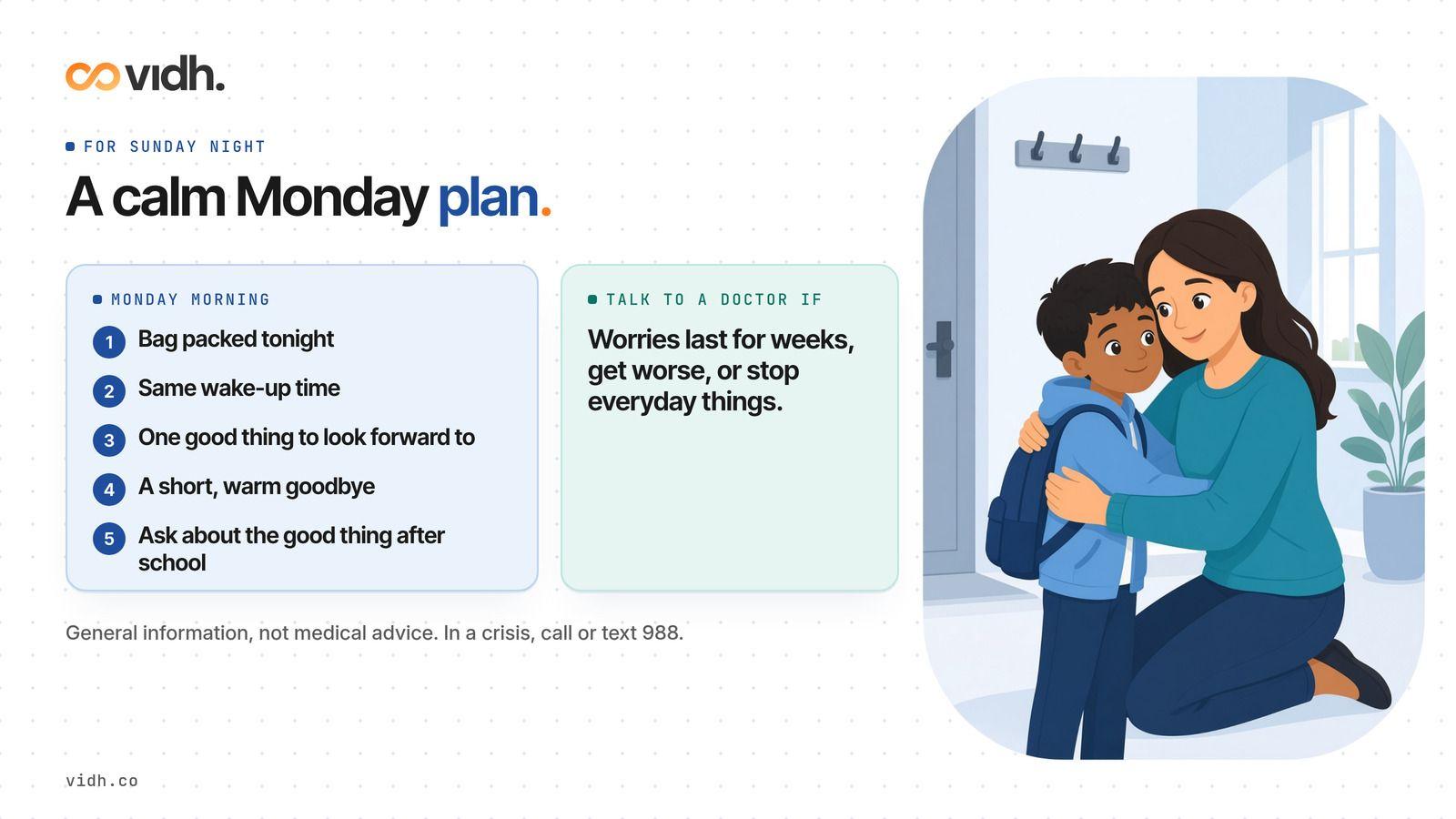
What does a calm Monday morning look like?
- Pack the bag tonight. Our night-before school bag checklist takes about ten minutes.
- Keep the same wake-up time. Rushing makes worries louder.
- Plan one good thing. A favorite snack, a friend to meet, or a fun after-school plan.
- Keep the goodbye short and warm. Long goodbyes can make leaving harder.
- Ask about the good thing after school. Notice what went well.
Questions parents ask
Will it be harder after Thanksgiving break?
It can be. AACAP notes that refusal often begins after a period at home, like a holiday. Keep bedtimes close to normal over the break and talk about the first school day a day or two ahead.
What if my child says they feel sick every Monday?
Take it seriously and check for illness. If the doctor finds nothing physical and the symptoms ease on weekends, worry may be the cause.
Should I tell the teacher?
Yes. A short private message helps the teacher look out for your child and spot anything happening at school.
What if a brother or sister wants to stay home too?
Keep the same plan for everyone who is well enough for school. Give each child a little one-to-one time on Sunday evening so the worried child does not feel singled out.
My teen will not talk to me. What can I do?
Try side-by-side moments, like a car ride or walking the dog, and keep questions open. If you are worried, ask the school counselor or your doctor for advice.
When is it more than worry?
If fear or sadness lasts, gets worse, or stops everyday life, talk to your child's doctor. In a crisis, call or text 988.
Sources
- American Academy of Pediatrics, HealthyChildren.org, School Avoidance: Tips for Concerned Parents: https://www.healthychildren.org/English/health-issues/conditions/emotional-problems/Pages/School-Avoidance.aspx
- American Academy of Child and Adolescent Psychiatry, School Refusal (Facts for Families No. 7): https://www.aacap.org/AACAP/Families_and_Youth/Facts_for_Families/FFF-Guide/School-Refusal-007.aspx
- Centers for Disease Control and Prevention, Anxiety and Depression in Children (May 15, 2026): https://www.cdc.gov/children-mental-health/about/about-anxiety-and-depression-in-children.html
- Child Mind Institute (US nonprofit), When Kids Refuse to Go to School: https://childmind.org/article/when-kids-refuse-to-go-to-school/
All sources were opened on November 16, 2026.
About Vidh
Vidh (vidh.co) is an AI-powered platform for schools, built by Vidh Labs, that connects management, teachers, parents and students around each child.
To see how Vidh works for your school, book a 30-min demo.
Questions: hi@vidh.co