Back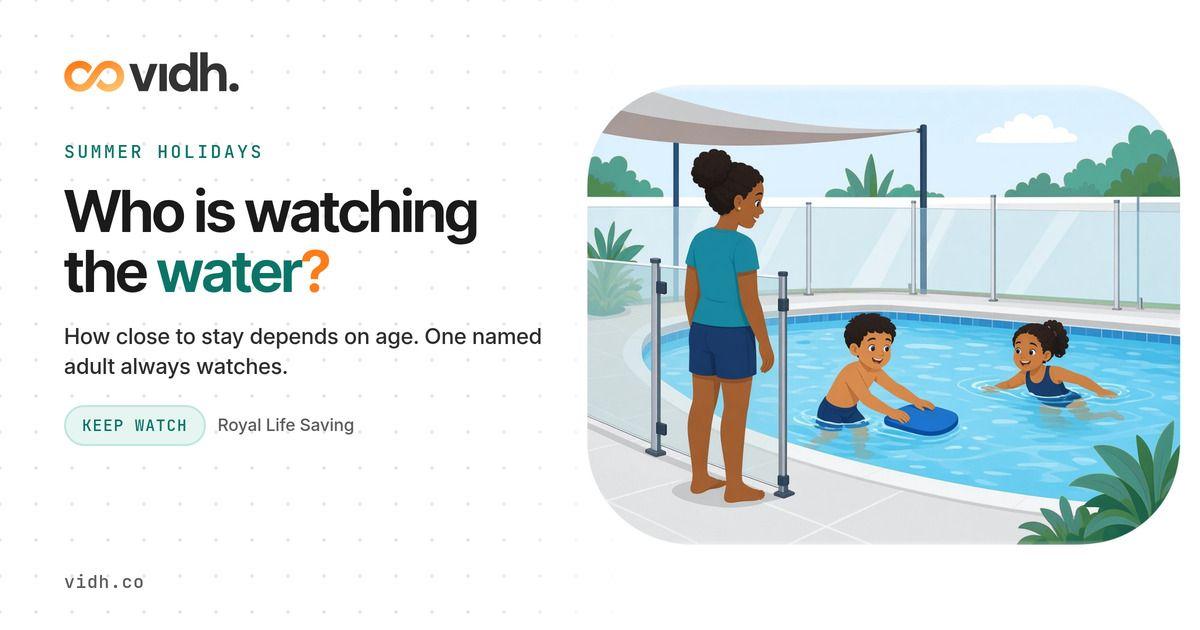
Australia Summer Holidays: Water Safety by Age
5 min read
Water safety by age for the Australian summer holidays: arm's reach for under-fives, swim between the flags, a party water watcher and pool gate checks.
By Bhagya, Vidh · Last updated: 22 November 2026
The Australian summer holidays are close, and for many families that means pools, beaches, rivers and backyard parties. Children of every age need an adult watching near water, but how close you stay depends on how old they are. This guide is for parents of primary and early secondary children in Australia, and for OSHC and vacation care leaders planning summer programs.
Short answer: Vidh's summer rule: an adult always watches, and how close depends on age. For under-fives, stay within arm's reach; for 6 to 10, keep them in sight and be ready to get in; for 11 to 16, keep them in sight and check they swim. At the beach, swim between the red and yellow flags. Check pool gates before summer.
How closely should I watch my child at each age?
Royal Life Saving Society Australia, which runs the Keep Watch program, says "Active adult supervision remains the single most important way to prevent drowning among young children." It also says supervision needs to be constant, without distractions from phones or conversations.
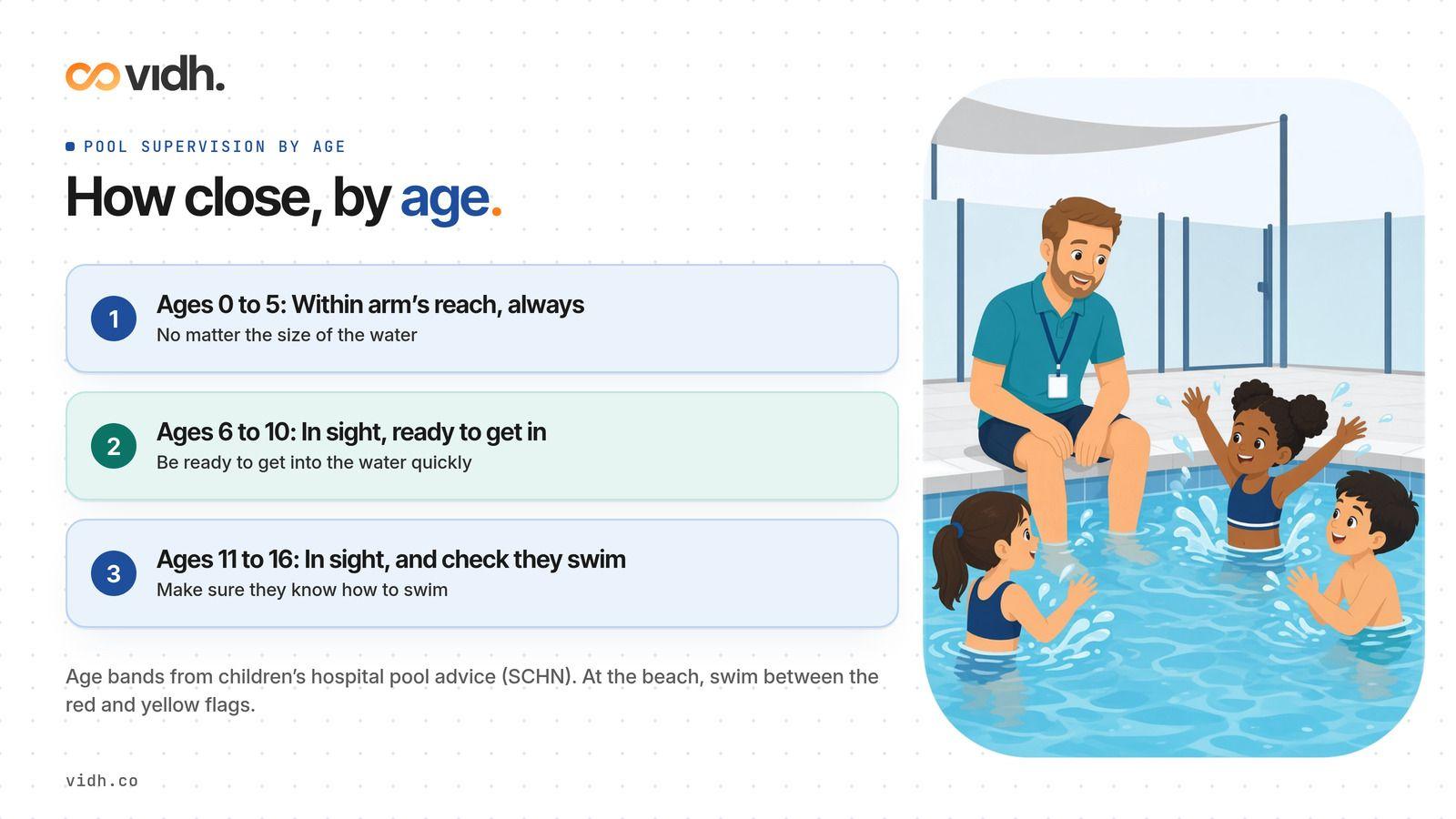
The Sydney Children's Hospitals Network (SCHN) gives simple age bands for pools:
- Children aged 0 to 5: "Stay within arm's reach of your child at all times, no matter the size of the water".
- Children aged 6 to 10: "Keep them in sight and be ready to get into the water quickly if needed".
- Children aged 11 to 16: "Keep them in sight and make sure they know how to swim."
Is a good swimmer still at risk?
Yes. SCHN says "Even if your child is a strong swimmer, they still need you to watch them closely." Swimming lessons build skills and confidence, but they do not replace an adult who is watching. healthdirect, a free health advice service, puts it plainly: "Never leave a child alone around water and always closely watch children in and around water."
What are the beach basics?
- Swim between the flags. healthdirect says "Always swim between the red and yellow flags on patrolled beaches." If there are no red and yellow flags, there is no lifeguard supervision.
- Choose a meeting point. When you arrive, pick an easy-to-find spot, such as the lifeguard tower, and tell your child to go there if you get separated.
- Dress to be seen. Bright swimsuits and rash shirts are easier to spot in the water.
- Teach them to signal. healthdirect suggests teaching school-aged children to stay calm, float and raise an arm to signal to a lifeguard if they need help.
Who watches at a summer party?
At barbecues and Christmas gatherings, everyone assumes someone else is watching. healthdirect warns: "You should never assume someone else will watch children when they are in and around water at parties and other gatherings."
SCHN suggests picking one adult to be the water watcher, wearing a hat or armband so everyone knows who is responsible. Swap the role regularly so the watcher can stay focused, and make sure the watcher is sober and off their phone.
What should I check before summer?
Royal Life Saving "is also urging families to check their pool fences and gates ahead of summer", especially before hosting gatherings. Quick checks:
- The pool gate closes and latches by itself every time.
- Nothing near the fence, such as chairs or pot plants, can be used to climb over.
- Small pools, buckets and paddling pools are emptied after use.
- Your CPR knowledge is fresh. SCHN has free online CPR modules for parents, which do not replace a full training course.
Pool fencing rules are set by each state and territory, so check your own state's rules.
Sun protection matters at the pool too: see our sun safety guide for Australian schools.
What should the holiday care program tell me?
If your child goes to OSHC or vacation care, water outings follow that service's own policy. It is fair to ask:
- How many staff watch the water, and is one person always on watch?
- Do children need to pass a swim check first?
- Will they swim only at patrolled beaches or supervised pools?
- What happens if a child cannot swim?
For more help planning the year ahead, see our starting school checklist for Australian families. For the holiday screen question, our guides to Australia's social media minimum age and screen time limits around the world can help.
Questions parents ask
Are rivers and dams safer than the beach?
No. Rivers, lakes and dams can hide cold water, currents and sudden drops, and they rarely have lifeguards. healthdirect advises always staying with your child while they play in or near the water at the beach, lake or river.
Do inflatable pools need a fence?
SCHN says any pool that can be filled with 30 cm of water or more must have fencing that complies with your state or territory law, and that this includes inflatable and portable pools. Empty small pools after use.
Can an older brother or sister be the water watcher?
It is safer for an adult to watch. Older children can help, but they get distracted and may not be strong enough to help in an emergency.
Do school swimming lessons mean my child is water safe?
Lessons build important skills, but even strong swimmers still need an adult watching them closely, as SCHN says.
Should I do a CPR course?
Yes, if you can. healthdirect says parents and carers should do a first aid course to learn infant and child CPR. A refresher before summer is a good idea.
Are rock pools safe for kids?
Rock platforms can be slippery, and waves can wash people in, so stay close and keep children well back from the edge. healthdirect advises against jumping off rocks.
Sources
- Royal Life Saving Society Australia, Keep Watch: https://www.royallifesaving.com.au/about/campaigns-and-programs/keep-watch
- Sydney Children's Hospitals Network, Pool safety: https://www.schn.health.nsw.gov.au/kids-health-hub/safety-and-injury-prevention/water/pools
- healthdirect, Beach safety: https://www.healthdirect.gov.au/healthy-living/weather-and-environment/beach-safety
- healthdirect, Water safety for babies and children: https://www.healthdirect.gov.au/healthy-living/weather-and-environment/water-safety-for-babies
All sources were opened on 16 November 2026.
About Vidh
Vidh (vidh.co) is an AI-powered platform for schools, built by Vidh Labs, that connects management, teachers, parents and students around each child.
To see how Vidh works for your school, book a 30-min demo.
Questions: hi@vidh.co