Back
Starting School in 2027: A Calm Readiness Checklist
5 min read
Is your child ready for school in 2027? What readiness really means, state age rules, what to practise over summer and what to ask at orientation.
By Bhagya, Vidh · Last updated: 14 November 2026
Orientation season is here. If your child starts Kindergarten, Prep, Foundation, Reception or Pre-primary in Australia in 2027, you may be wondering whether they are "ready". The good news is that readiness is not a test, and most of what helps can be practised calmly at home over summer.
Short answer: School readiness is not about reading or writing. It is about the whole child: being able to manage a lunchbox and toilet, ask for help, and cope with a new routine. Visit the school before day one, talk about the new morning routine, and practise small self-help tasks over summer. Age rules differ by state, so check yours.
Is my child ready for school if they can't read yet?
Yes, reading is not the measure. StartingBlocks, the national family website from the Australian Children's Education and Care Quality Authority (ACECQA), says: "Being school ready is not dependent on whether your child can read and write. Being school ready is about the whole child."
It lists the factors worth thinking about instead: your child's age, emotional maturity, language skills, social skills, physical wellbeing and "their ability to undertake simple self-help tasks independently."
If your child goes to an early childhood service, ask the educators how they see your child's development and how they support the move to school. They see your child in a group every week, which is a useful view to add to your own.
How old does my child need to be to start in 2027?
Age rules, and even the name of the first year, differ by state and territory. Two examples:
- New South Wales: "Children can start Kindergarten at the beginning of the school year if they turn 5, on or before 31 July that year. By law, all children must be in compulsory schooling by their 6th birthday."
- Victoria: "To start Foundation (Prep) in 2027, your child will need to turn 5 years old by 30 April 2027. School is compulsory for children who have turned 6 years old."
If you live in another state or territory, check your own education department's website for the 2027 rules. In NSW, the department adds: "When your child starts school is an individual decision." You can talk it through with your child's preschool teacher, carer, doctor or local school.
What can we practise over summer?
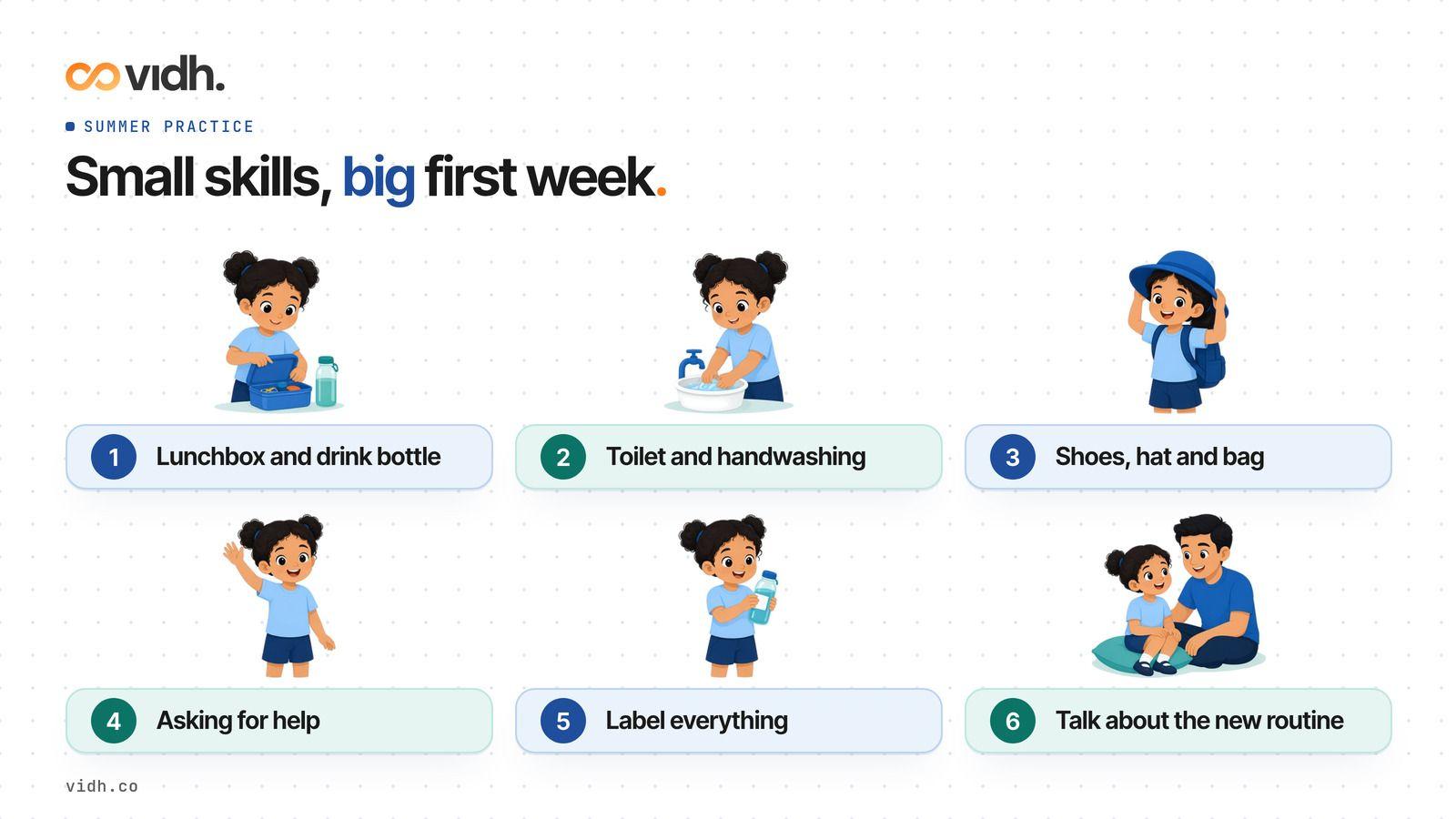
Small, everyday self-help skills make the first weeks easier. StartingBlocks suggests practising with lunch boxes and drink bottles at meal times. Over summer, try these, a little at a time:
- Lunchbox: open and close the lunchbox and drink bottle without help, and practise eating a packed lunch at the table.
- Toilet: go on their own, flush, wash hands, and know it is fine to ask an adult.
- Shoes and bag: put on shoes and a hat, and pack and unpack their own bag.
- Asking for help: practise simple phrases like "Can you help me, please?" and "I don't feel well."
- Name labels: label everything. StartingBlocks says "labelling everything, including clothing, can help reduce anxiety for children, school staff and yourself."
- The new routine: talk about getting up, getting to school and what will be in their lunch box. StartingBlocks suggests speaking with your child "about the change in their daily routine".
Keep it playful. A few minutes of "playing school" with a uniform, bag and lunchbox does more than a long lesson. Ournight-before school bag checklist can turn bag packing into a simple routine from week one.
What happens at orientation, and what should I ask?
StartingBlocks says: "Most schools support your child as they transition to school, through an orientation program, made up of visits to the school and spending time with the kindy teachers and other children."
It also suggests: "Visit the school with your child before they start so they're familiar with the classrooms, playground equipment, bubblers, toilets, sick bay etc."
Useful questions to ask at orientation:
- What does a normal day look like, and when do children eat?
- How will the teacher tell me about my child's day or any worries?
- What should my child bring, and what should stay at home?
- What happens if my child feels unwell at school?
- How does the school handle devices and screens? Our guide toscreen time in schools has an Australian section.
- If the school runs buses, how does transport work? See our guide toschool bus tracking for parents.
The NSW department suggests helping your child through the transition by encouraging them to explore their feelings, helping them connect to their school, supporting friendships, and building their confidence and independence.
How do we handle first-week tears and tiredness?
Tears and tiredness in the first weeks are common, and they usually settle as the new routine becomes familiar. StartingBlocks offers three steady ideas:
- Say goodbye confidently. A quick, confident goodbye "may help them to feel secure and reassured that you trust that they will be okay at school."
- Avoid overloading. It says "when children begin school, they tire easily", so consider fewer after-school activities until they adjust.
- Talk about the day. Tell your child what might happen at school, and in the afternoon, ask about their day.
"How was school?" often gets "fine". Try one specific, warm question instead. Our list ofquestions better than "how was school?" is a good place to start.
Vidh connects management, teachers, parents and students around each child.
Questions parents ask
Should we delay starting school by a year?
It is an individual decision, and the rules on how late a child can start are set by each state or territory. Talk to your child's educators and your local school, and check your state's rules before deciding.
How do we handle the summer holiday routine?
Keep summer relaxed, but in the last week or two, move bedtimes and mornings closer to the school timetable and practise the morning routine a couple of times.
My child is worried about being away from me. What helps?
Visit the school together, talk about what will happen, and keep goodbyes short and confident. Tell the teacher early so they can help your child settle.
My child has additional needs. Who do I talk to?
Talk to the principal before your child starts. The NSW department, for example, says that at the enrolment interview you can discuss "any disability or additional learning and support needs, medical conditions, or other special circumstances before your child starts school."
Should we practise the bus or the walk to school?
Yes. Do the trip together a few times before term starts, at the real time of day, so the route feels familiar.
Sources
- StartingBlocks (ACECQA), Transition to school: https://startingblocks.gov.au/resources/how-to-support-your-child-through-early-childhood-education-and-care/transition-to-school
- NSW Department of Education, Starting school: https://education.nsw.gov.au/schooling/parents-and-carers/going-to-school/primary-schools/starting-school
- NSW Department of Education, Getting ready for primary school: https://education.nsw.gov.au/schooling/parents-and-carers/going-to-school/getting-ready-for-school/starting-primary-school
- Victoria State Government, Enrolling in Foundation (Prep): https://www.vic.gov.au/enrolling-foundation-prep
All sources were opened on 10 November 2026.
About Vidh
Vidh (vidh.co) is an AI-powered platform for schools, built by Vidh Labs, that connects management, teachers, parents and students around each child.
Questions: hi@vidh.co