Back
Children's Day: 5 Rights Your Child Has at School
5 min read
This Children's Day, learn five rights your child has at school under India's RTE Act and the UN Convention, in plain words, and who to talk to.
By Bhagya, Vidh · Last updated: 14 November 2026
Children's Day in India, on 14 November, is a good day to tell children something simple and important: they have rights at school too. This guide explains five of them in plain words, using the Right of Children to Free and Compulsory Education Act, 2009 (the RTE Act) and the UN Convention on the Rights of the Child. It is general information, not legal advice.
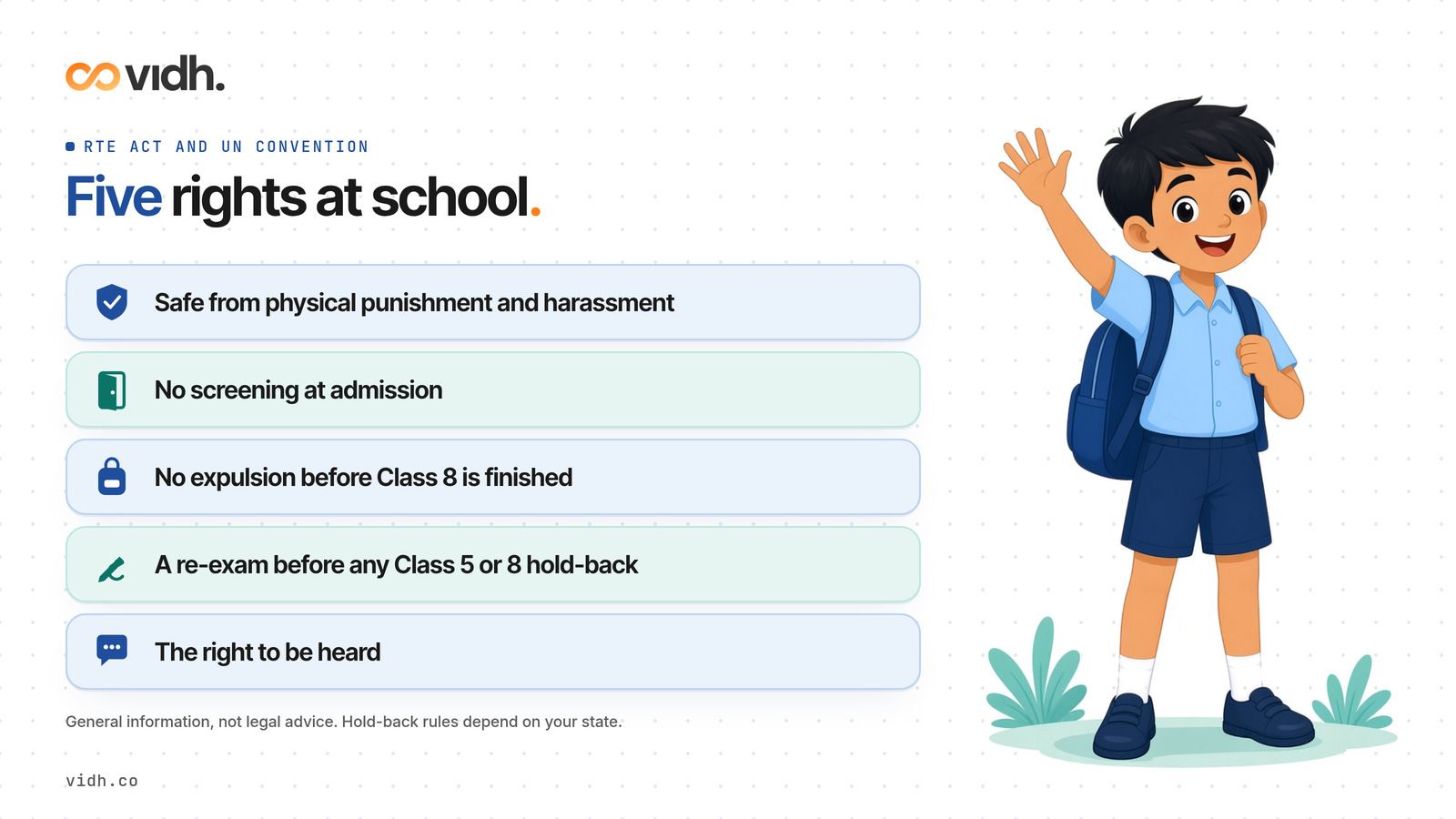
Short answer: Under India's Right to Education Act, no child may face physical punishment or mental harassment at school, and schools may not screen young children for admission. Children cannot be expelled before finishing Class 8, and any Class 5 or 8 hold-back needs a re-exam first. This Children's Day, explain these rights simply and listen to your child's view.
Why talk about rights on Children's Day?
Children's Day in India falls on 14 November, Jawaharlal Nehru's birth anniversary. Many families mark it with treats or a special plan at home, and our guide on letting your child plan Children's Day has ideas for that.
It is also a calm moment to talk about school. Children who know a few basic rights find it easier to tell an adult when something feels wrong. Keep it short and positive: school is a place where you should be safe, treated with respect and heard.
One thing to know first: the RTE Act covers elementary education, which means Class 1 to 8, for children aged six to fourteen.
Can a school punish my child physically or humiliate them?
No. The RTE Act says that no child may be subjected to physical punishment or mental harassment at school. It also says that anyone who breaks this rule can face disciplinary action under the service rules that apply to them.
The UN Convention on the Rights of the Child says schools should ensure "school discipline is administered in a manner consistent with the child's human dignity".
What this means in practice: a school can have rules and consequences, but hitting, slapping, or humiliating a child is not allowed. How to say it to a child: "No one at school is allowed to hurt you or make you feel small. If it happens, tell me."
Can a school test my young child before admission?
The RTE Act does not allow a school to put a child, or the child's parents, through a screening procedure at admission. In plain words, a school should not pick one child over another through a test or an interview, other than by a random method such as a lottery.
So, for admission into elementary classes, a school should not pick children through an entrance test or a parent interview. If a school asks for one, ask politely which rule it is following, and check with your local education office.
Can my child be held back or expelled?
Expulsion: Under the RTE Act, a school cannot expel a child until the child has completed elementary education, that is, Class 8.
Holding back: Since 2019, the Act has provided for a regular exam in Class 5 and Class 8 at the end of every academic year. A child who does not pass gets extra teaching and a chance to take the exam again within two months of the result.
After that, the Act lets each state government decide whether schools may hold back a child in Class 5, Class 8 or both. A state may also decide not to hold back any child until Class 8 is finished. So whether a hold-back can happen depends on your state. Ask your school which rule applies.
If a report card is worrying, our guide on what to say after a low report card helps you keep the conversation kind.
Does my child have a right to be heard at school?
Yes, in spirit. This one comes from the UN Convention, not the RTE Act. Article 12 gives a child who can form their own views "the right to express those views freely in all matters affecting the child, the views of the child being given due weight in accordance with the age and maturity of the child."
At home, practise it: ask your child what they like at school, what worries them, and what they would change. At school, it can mean a child being allowed to explain their side before a decision is made. Listening on Children's Day is a good habit to start.
Who do I talk to if I think a right is being ignored?
Start calmly and close to the child:
- The class teacher. Ask for a short meeting, share what your child said, and listen to the teacher's view. Our guide to choosing a parent-teacher communication app covers raising concerns privately.
- The principal. If it is not resolved, write to the principal with dates and facts, and keep a copy.
- Your local education office or a child rights commission. The National Commission for Protection of Child Rights (NCPCR) says it "is mandated for monitoring of implementation of laws relating to children such as Juvenile Justice (Care and Protection) Act, 2015; Protection of Children from Sexual Offences (POCSO) Act, 2012; and Right of Children to Free and Compulsory Education (RTE) Act, 2009." The Act also refers to State Commissions for Protection of Child Rights.
If your child is in danger or hurt, act first and contact the right authority straight away.
For principals: a clear, kind system for hearing parent concerns prevents most escalations. Our parent communication audit has a section for school leaders.
Questions parents ask
Does the RTE Act cover Class 9 to 12?
No. The Act covers elementary education, Class 1 to 8, for children aged six to fourteen. Rules for higher classes come from your board and state.
Does it apply to private schools?
The Act covers government and aided schools as well as recognised unaided (private) schools. Some categories of school are treated differently, so if you are unsure, ask your state education department.
Does my state hold children back in Class 5 or 8?
It depends on your state. The Act lets each state decide, after a re-exam. Ask your school or check your state education department's notice.
What is the difference between a strict teacher and harassment?
Clear rules, firm reminders and fair consequences are normal. Hitting, humiliating, name-calling or frightening a child are not. If you are unsure, talk to the teacher first and describe exactly what happened.
How do I write a calm first message to the school?
Keep it short: what happened, when, how your child feels, and what you would like. For example: "My child told me about something that happened in class on Tuesday. Could we meet for ten minutes this week to understand it together?"
Sources
- Right of Children to Free and Compulsory Education Act, 2009, definitions (unofficial copy of the India Code text on legislations.in): https://legislations.in/central/2009/the-right-of-children-to-free-and-compulsory-education-act-2009/section-2
- Right of Children to Free and Compulsory Education Act, 2009, admission and screening (unofficial copy of the India Code text on legislations.in): https://legislations.in/central/2009/the-right-of-children-to-free-and-compulsory-education-act-2009/section-13
- Right of Children to Free and Compulsory Education Act, 2009, examination, hold-back and expulsion (unofficial copy of the India Code text on legislations.in): https://legislations.in/central/2009/the-right-of-children-to-free-and-compulsory-education-act-2009/section-16
- Right of Children to Free and Compulsory Education Act, 2009, physical punishment and mental harassment (unofficial copy of the India Code text on legislations.in): https://legislations.in/central/2009/the-right-of-children-to-free-and-compulsory-education-act-2009/section-17
- UN Convention on the Rights of the Child, Articles 12 and 28 (UNICEF text): https://www.unicef.org/child-rights-convention/convention-text
- National Commission for Protection of Child Rights: https://ncpcr.gov.in/
- Children's Day and Jawaharlal Nehru's birth anniversary, 14 November (Nehru Archive): https://nehruarchive.in/events/bal-diwas
All sources were opened on 10 and 11 November 2026. The RTE Act text is checked against an unofficial copy of the India Code text; read the official Act for exact wording.
About Vidh
Vidh (vidh.co) is an AI-powered platform for schools, built by Vidh Labs, that connects management, teachers, parents and students around each child.
Questions: hi@vidh.co