Back
UK Schools: A First-Day Absence Contact Plan
5 min read
A first-day absence contact plan for UK schools: a morning text, a day 3 call and a warm welcome back, in line with the DfE's 2026 attendance guidance.
By Bhagya, Vidh · Last updated: 23 November 2026
A child is missing from the register, and nobody has called. In the UK, schools in England follow the Department for Education's (DfE) attendance guidance, updated in July 2026, on what to do next. This guide is for attendance leads, office staff and heads in England who want a calm, consistent first-day routine. Scotland, Wales and Northern Ireland have their own guidance.
Short answer: Vidh's first-day plan for UK schools: if a child is absent with no message, contact the family that day, try a second emergency contact if needed, and keep going if the absence continues. DfE's 2026 guidance expects first-day contact where no reason has been given, and repeated or long absence can be a safeguarding warning sign.
What does the 2026 guidance expect on day one?
DfE's statutory guidance "Working together to improve school attendance" (July 2026, paragraph 42) was last updated on 9 July 2026. It asks schools to "Expect parents to contact the school when their child is absent to explain the reason and put in place processes to contact parents on the first day of absence where a reason has not been provided." It adds: "If absence continues without explanation, further contact should be made to ensure safeguarding."
The same paragraph says the register should stay open for a set time that is "not longer than 30 minutes". Where an absence is recorded as unexplained, the correct code should go in as soon as the reason is known, and "no later than 5 working days after the session."
What is the 3-message ladder?
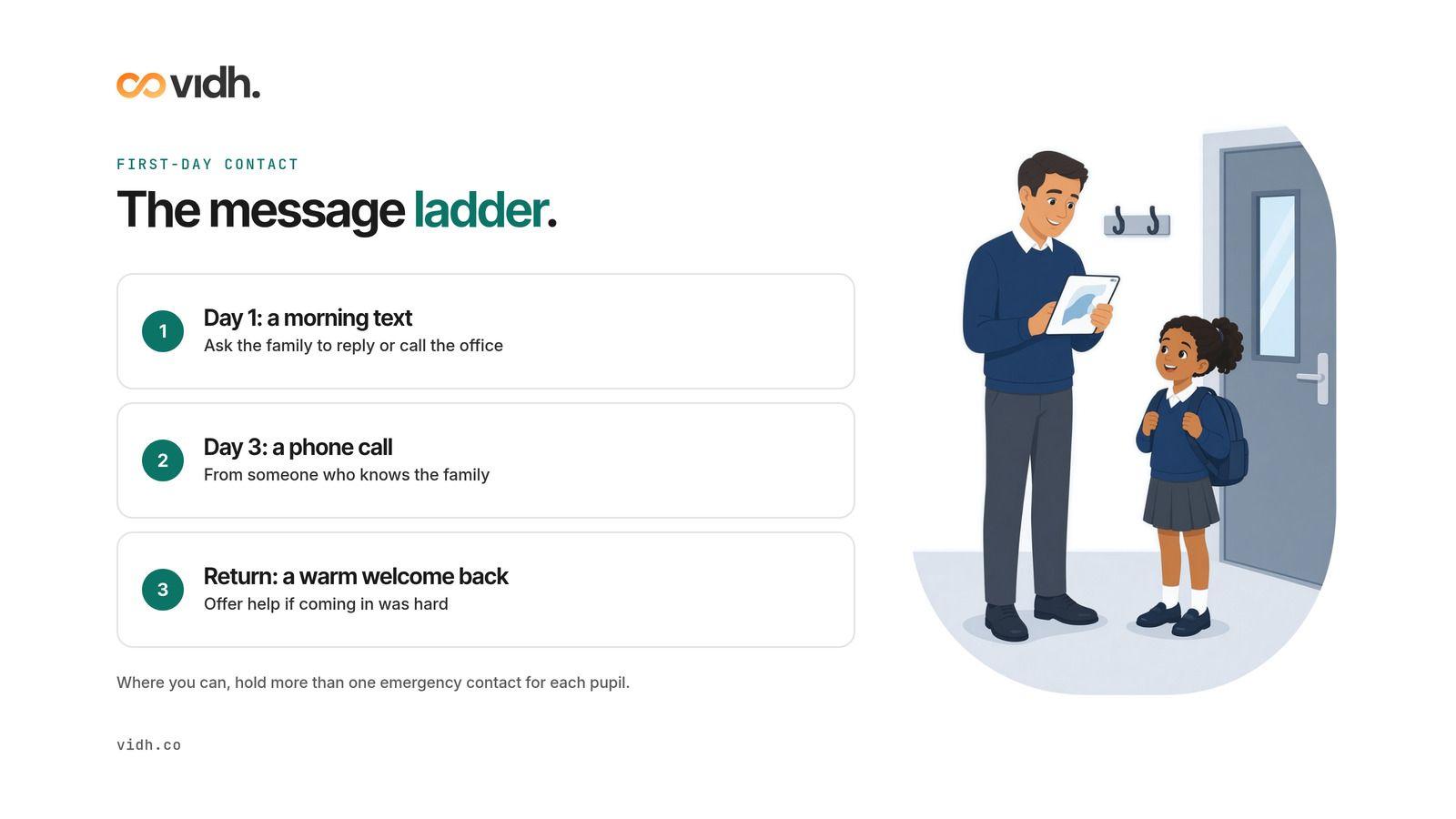
Three short messages cover most days. These are our suggested wordings, so adapt them to your school:
- Day 1, morning text: Hello, your child is not in school today and we have not heard why. Please reply or call the school office so we know they are safe.
- Day 3, phone call: We are calling because your child has been away for three days. Is everything all right, and is there anything we can do to help them come back?
- Welcome back: It is good to have your child back. If anything made it hard to come in, we would like to help.
Keep the tone warm. The aim is to know the child is safe, not to tell anyone off.
Why hold a second emergency contact?
The guidance says: "Where reasonably possible hold more than one emergency contact number for each pupil." If the first number goes to voicemail, a second contact gives the office another way to reach a responsible adult. A quick check of contact details at the start of each term keeps the list current.
When does absence become a safeguarding step?
Keeping children safe in education 2026 (KCSIE), paragraph 221, says children being absent from education "for prolonged periods and/or on repeat occasions can act as a vital warning sign to a range of safeguarding issues". Follow your school's safeguarding policy, and involve the designated safeguarding lead (DSL) when a pattern appears or when nobody can be reached.
DfE also publishes separate statutory guidance on children missing education (CME), for local authorities and schools working together to identify and support children who are not receiving a suitable education.
How should we talk about attendance with families?
The 2026 guidance says "Schools should avoid headline percentages and instead make this understandable for parents". It gives the amount of time missed and the impact on learning as examples. A sentence like 'missed six mornings this half term' means more to a family than a percentage.
For illness questions, our guide is my child too ill for school? helps families decide. If a child is avoiding school because of unkindness, see what to say first at home. For a wider look at messages to families, try the parent communication audit.
Vidh supports one-to-one parent replies, which keep this kind of follow-up private between the school and the family.
Questions schools ask
Does the first-day contact have to be a phone call?
The guidance asks schools to put processes in place to contact parents on the first day, and that line does not name one method. A text followed by a call if nobody replies is one simple routine.
What if a family never replies?
Try the other contacts, record each attempt and follow your safeguarding policy. If absence continues without explanation, the guidance says further contact should be made to ensure safeguarding.
How quickly should we fix an unexplained code?
As soon as the reason is known, and no later than 5 working days after the session, according to the 2026 guidance.
Should we tell families their child's attendance percentage?
The guidance says to avoid headline percentages and make attendance understandable instead, for example the time missed and the impact on learning.
Does this apply in Scotland, Wales or Northern Ireland?
No. This DfE guidance applies to England. The other UK nations have their own attendance guidance.
Who should make the day-3 call?
Someone who knows the family, such as the form tutor or the attendance lead, is often best placed to have a calm conversation.
Sources
- Department for Education, Working together to improve school attendance (statutory guidance, July 2026): https://assets.publishing.service.gov.uk/media/6a4f9ec6a6586e258d371bd0/Working_together_to_improve_school_attendance_2026.pdf
- Department for Education, Working together to improve school attendance, publication page (last updated 9 July 2026): https://www.gov.uk/government/publications/working-together-to-improve-school-attendance
- Department for Education, Keeping children safe in education 2026: https://assets.publishing.service.gov.uk/media/6ac3c09c11ed58342ad8e4ac/Keeping_children_safe_in_education_2026.pdf
- Department for Education, Children missing education (last updated 8 September 2025): https://www.gov.uk/government/publications/children-missing-education
All sources were opened on 17 November 2026.
About Vidh
Vidh (vidh.co) is an AI-powered platform for schools, built by Vidh Labs, that connects management, teachers, parents and students around each child.
To see how Vidh works for your school, book a 30-min demo.
Questions: hi@vidh.co