Back
Is My Child Too Ill for School? A UK Parent's Quick Guide
5 min read
NHS advice for UK parents on keeping a child off school: high temperature, sickness bugs, coughs and colds, what needs no day off, and what to tell school.
By Bhagya, Vidh · Last updated: 11 November 2026
It is 7am, your child says they feel poorly, and you have about ten minutes to decide. This guide puts the NHS advice for the most common school-morning questions in one place, so you can make the call and tell the school quickly.
Short answer: Keep your child home with a high temperature until it has gone, and after vomiting or diarrhoea until 48 hours have passed with no symptoms. A slight cough, cold or sore throat without a temperature is fine for school if they are otherwise well. Head lice and cold sores need no day off. Phone the school on the first day.
Is my child too ill for school today?
The NHS has a parent-facing page called "Is my child too ill for school?". It also points to the government's health protection guidance for schools and nurseries on GOV.UK, which says when children should and should not be kept off. Here is a quick view of the NHS advice.
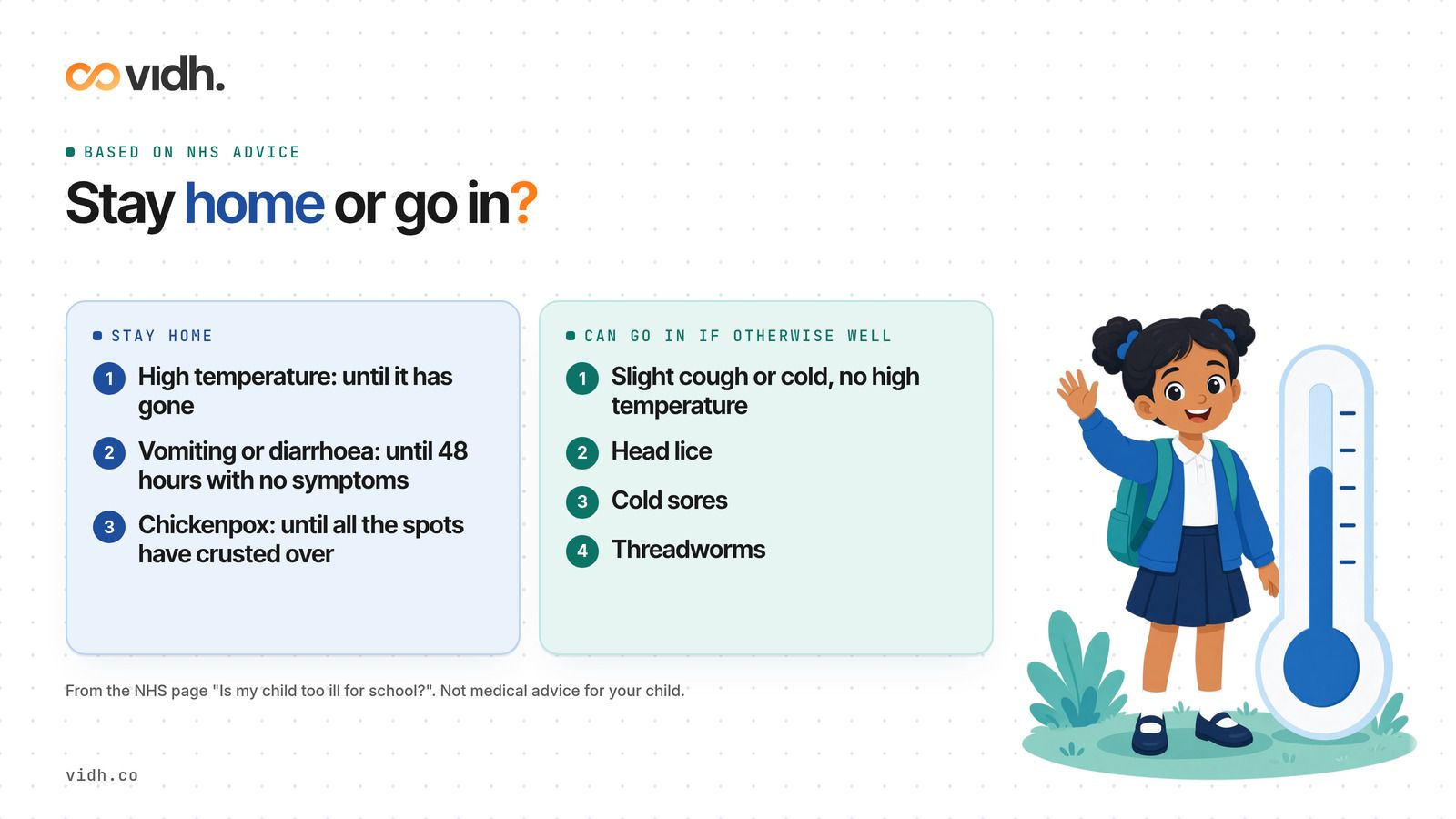
- High temperature: keep them off school until it goes away.
- Vomiting or diarrhoea: stay off until they have not been sick or had diarrhoea for at least 2 days (48 hours).
- Slight cough, cold, runny nose, sore throat or headache: fine for school if they are otherwise well and do not have a high temperature.
- Chickenpox: keep them off until all the spots have crusted over, usually about 5 days after the spots first appeared.
- Head lice, cold sores and threadworms: no need to keep them off school.
In England, GOV.UK says you can only allow your child to miss school if either they are too ill to go in, or you have advance permission from the school. The guidance is different in Scotland, Wales and Northern Ireland, so check your nation's own pages for the wider rules.
Should I keep my child off with a high temperature?
Yes. The NHS says: "If your child has a high temperature, keep them off school until it goes away." The same applies when a high temperature comes with other symptoms. With a sore throat, for example, the NHS says they should stay at home until the temperature goes away, and notes that a sore throat with a high temperature can be a symptom of tonsillitis.
For an ear infection, the NHS says to keep them off if they have a high temperature or severe earache, until they are feeling better or the temperature has gone.
How long should they stay off after vomiting or diarrhoea?
The NHS line is: "Children with diarrhoea or vomiting should stay away from school until they have not been sick or had diarrhoea for at least 2 days (48 hours)."
That 48-hour window starts from the last time they were sick or had diarrhoea, not from when they first felt ill. If your child was last sick on Monday evening, Thursday morning is the earliest the 48 hours will have passed for a normal school start.
Can they go in with a cough, cold or sore throat?
Usually, yes. The NHS says: "It's fine to send your child to school with slight cough or common cold symptoms, such as a runny nose, sore throat or headache, as long as they're otherwise well and do not have a high temperature."
Two small habits help the whole class. The NHS suggests encouraging your child to throw away used tissues and to wash their hands regularly. For COVID-19, the NHS says a child with mild symptoms, such as a runny nose, sore throat or slight cough, who feels well enough can go to school.
Which common conditions do not need a day off?
According to the NHS, these do not need a day off school on their own:
- Head lice and nits: "There's no need to keep your child off school if they have head lice." You can treat them without seeing a GP.
- Cold sores: no need to stay off. Encourage your child not to touch the blister, kiss anyone, or share cups and towels.
- Threadworms: no need to stay off. Your pharmacist can recommend a treatment.
- Hand, foot and mouth disease: no need to stay off if your child seems well enough to go to school.
- Conjunctivitis: no need to stay off unless they are feeling very unwell. Get advice from your pharmacist.
- Slapped cheek syndrome: no need to stay off, because once the rash appears they are no longer infectious. Do let the school know.
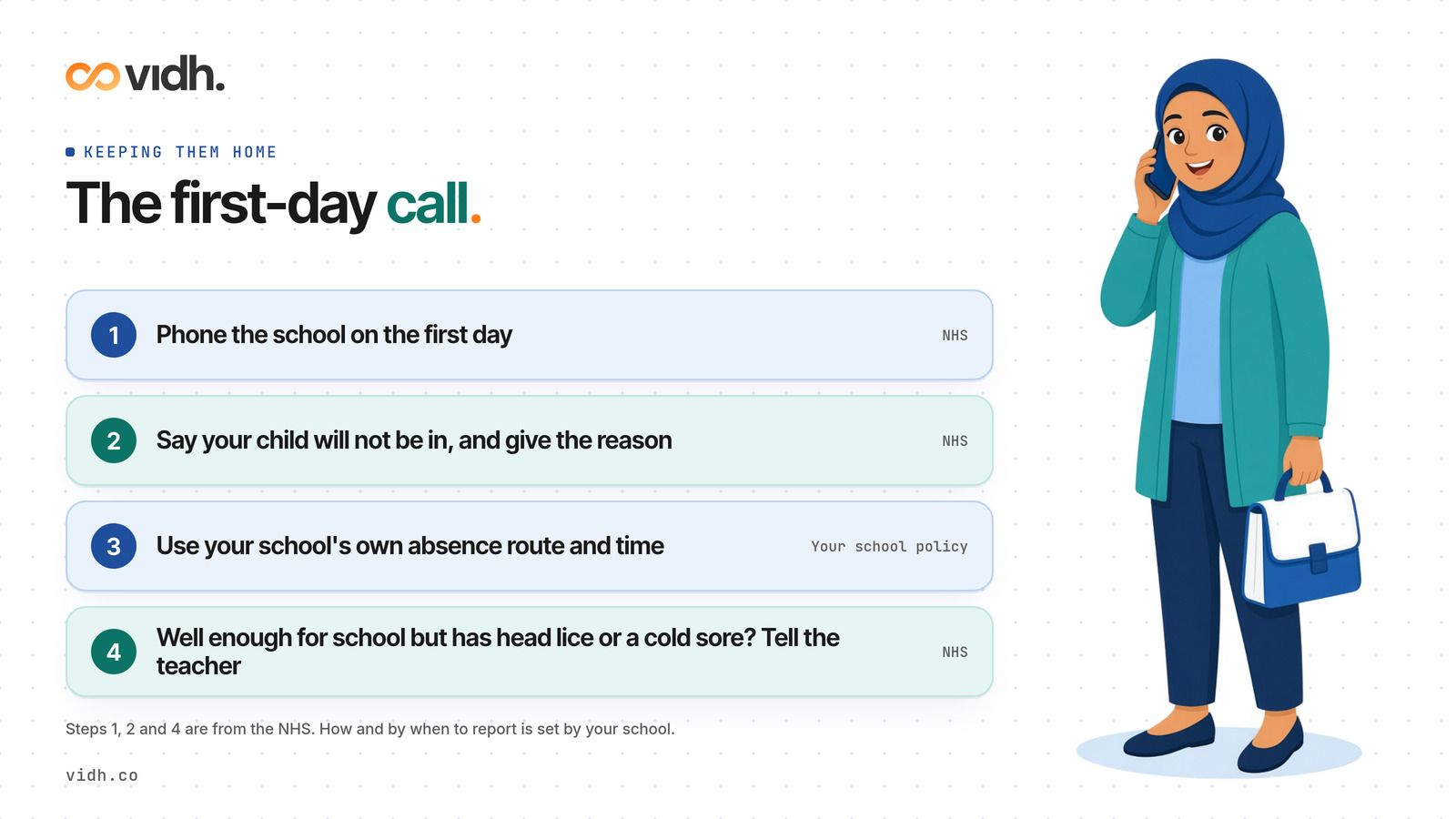
If your child is well enough for school but has an infection that could be passed on, such as a cold sore or head lice, the NHS says to let their teacher know.
Some conditions do need time off or treatment first. The NHS page covers chickenpox, impetigo, measles, scarlet fever and ringworm, each with its own advice. Read the NHS entry for that condition rather than guessing.
What do I tell the school, and when?
The NHS says: "If you do keep your child at home, it's important to phone the school or nursery on the first day." Let them know that your child will not be in and give the reason.
How you report it, and by what time, is set by each school. Check your school's absence policy before you need it. GOV.UK also notes that the school will contact you if your child is enrolled and does not turn up, even if they are only absent for a day.
If your child cannot go to school for a long period because of a health problem, GOV.UK says there is extra support available. Ask the school about it early.
What if it is a tummy ache before school every Monday?
The NHS says it is normal for children to feel a little anxious sometimes, and that they may get a tummy ache or headache, or have problems eating or sleeping. It also says: "Avoiding school can make a child's anxiety about going to school worse."
The NHS suggests talking about any worries, such as bullying, friendship problems, school work or sensory problems, and working with the school to find ways to help. If your child is still struggling and it is affecting their everyday life, the NHS says it might be good to talk to your GP or school nurse. For gentle ways to open that conversation at home, see Better Than "How Was School?": Dinner Questions That Actually Work.
A calm evening routine can also make sick-day mornings easier to judge. Our night-before school bag checklist keeps the basics ready by the door.
For schools: how to make illness reporting easy for parents
In England, the Department for Education's statutory guidance "Working together to improve school attendance" applies to local-authority-maintained schools, academies, independent schools and local authorities. It was last updated on 9 July 2026, with technical clarifications. Your own absence policy should sit alongside it.
A few practical steps help parents report illness quickly:
- Publish one clear way to report an absence, and say it in the same words on the website, in the handbook and in the welcome pack.
- Set your own morning cut-off time in your policy, and state it plainly.
- Reply to each absence message one-to-one. An illness report about a named child does not belong in a class group thread.
- Link parents to the NHS page so the "should they stay off?" question has one trusted answer.
Whatever channel your school uses for absence messages, keep the first-day call or message short and factual. For a wider review of your parent channels, see The Parent Communication Audit Every School Should Run and Parent-Teacher Communication App: 12 Things to Check.
Questions parents ask
Can my child go to school with a runny nose?
Yes, if they are otherwise well and do not have a high temperature. The NHS says slight cough or common cold symptoms are fine for school.
How long after a sickness bug can my child go back to school?
The NHS says 48 hours after they were last sick or last had diarrhoea.
Do I need to phone the school every day my child is off?
The NHS says to phone on the first day. Whether you need to update the school each day is set by your school's absence policy, so check it.
Is head lice a reason to keep my child off?
No. The NHS says there is no need to keep your child off school with head lice. Let their teacher know.
My child says they feel sick every school morning. Should I keep them home?
The NHS says avoiding school can make anxiety about school worse. Talk about their worries, work with the school, and if it is affecting everyday life, speak to your GP or school nurse.
Sources
- NHS, "Is my child too ill for school?" (page last reviewed 5 April 2024, next review due 5 April 2027): https://www.nhs.uk/live-well/is-my-child-too-ill-for-school/
- GOV.UK, "School attendance and absence": https://www.gov.uk/school-attendance-absence
- Department for Education, "Working together to improve school attendance" (last updated 9 July 2026, applies to England): https://www.gov.uk/government/publications/working-together-to-improve-school-attendance
- UK Health Security Agency, "Infection prevention tools and resources for children and young people's settings" (updated 7 September 2026): https://www.gov.uk/government/publications/health-protection-in-schools-and-other-childcare-facilities/children-and-young-people-settings-tools-and-resources
All sources were opened on 10 November 2026 and the quoted lines were checked on the page. This guide shares NHS and government guidance; it is not medical advice for your child.
About Vidh
Vidh (vidh.co) is an AI-powered platform for schools, built by Vidh Labs, that connects management, teachers, parents and students around each child.
Questions: hi@vidh.co