Back
India Schools: A 5-Day Results Plan Before the PTM
5 min read
A 5-day plan for schools in India after half-yearly results: sort by subject gap, group students, message parents and plan the PTM slots.
By Bhagya, Vidh · Last updated: 23 November 2026
Half-yearly results are in at many schools across India, and the parent-teacher meeting (PTM) is close. This guide is for principals, academic coordinators and class teachers, especially in CBSE schools, who want every family to leave the PTM with a plan, not just a rank. Half-yearly exams, PTM dates and result formats are each school's own practice. The board facts below apply across CBSE.
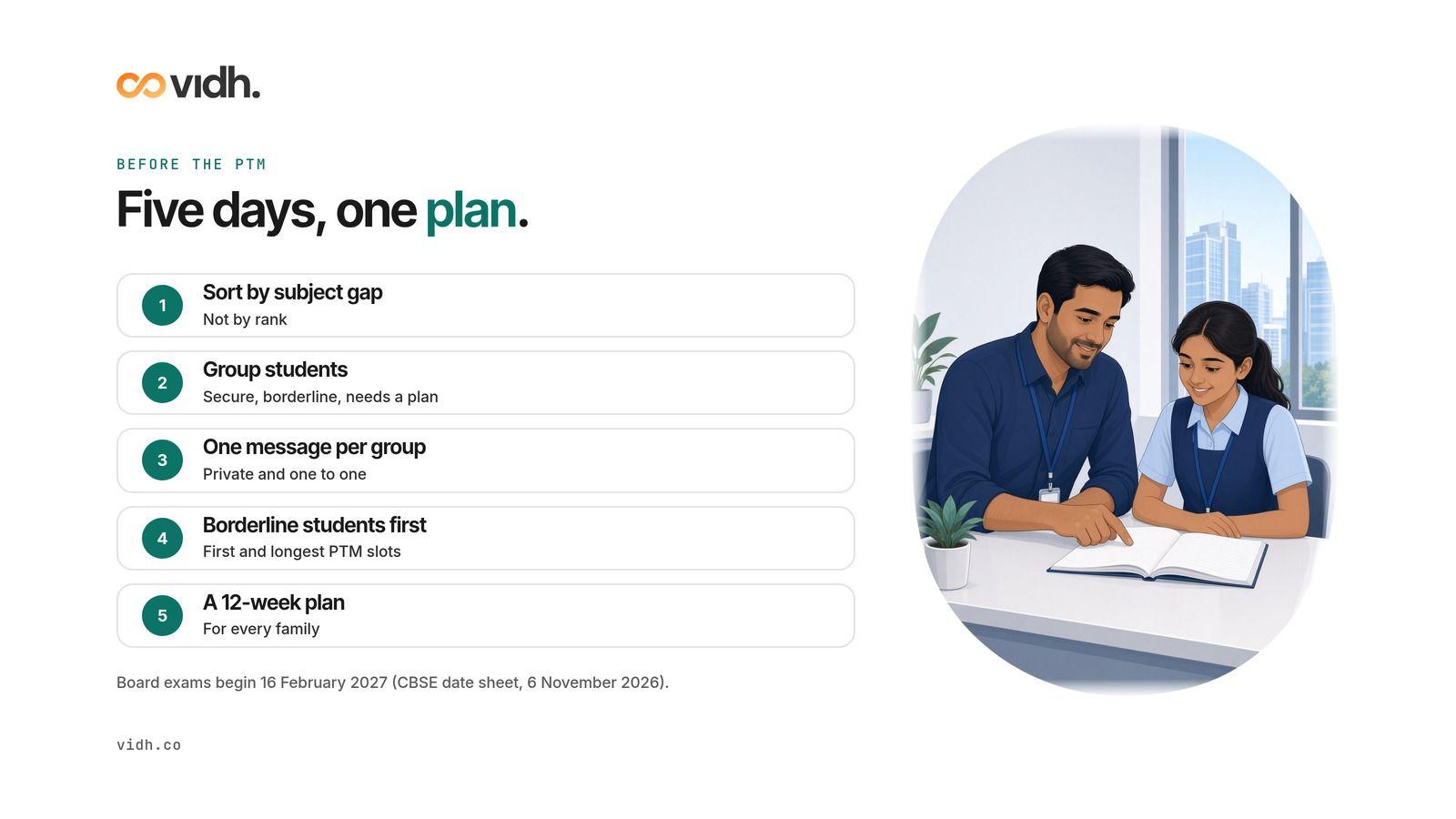
Short answer: Vidh's 5-day results plan for schools in India: sort marks by subject gap, not rank; group students as secure, borderline or needs a plan; send one parent message per group; give borderline students the first PTM slots; and leave every family with a 12-week plan. CBSE board exams begin on 16 February 2027.
How long is it from the PTM to the board exams?
CBSE's date sheet circular of 6 November 2026 says the Class X and Class XII board examinations are "scheduled to commence from 16 February 2027 (Tuesday)". It also says "All examinations will commence at 10:30 a.m. (IST)." From a PTM in the last week of November, that is about 12 weeks. Twelve weeks is enough to close a gap in one or two subjects, if the plan starts now.
For most Class X subjects, CBSE's marks bifurcation for 2026-27 shows 80 marks for the theory exam and 20 for internal assessment. Science, Social Science, Mathematics (Standard) and Hindi Course-A all follow this split. Some skill subjects split marks differently, so check the row for each subject.
Day 1: How should we sort the marks?
Sort by subject gap, not by rank. A student with a high overall score and one weak subject needs a different conversation from a student whose marks are all close together. For each student, note:
- the lowest subject and its mark
- the gap between the strongest and the weakest subject
- any subject where the mark dropped since the last test
- missed lessons or assessments that explain a low mark
Day 2: How do we group students?
Three groups keep the PTM manageable:
- Secure: steady across subjects. The message is to keep going and protect sleep and routine.
- Borderline: one or two subjects need work. These students gain most from a clear 12-week plan.
- Needs a plan: several subjects are weak, or marks fell sharply. Talk to the family before the PTM if you can.
The groups are for teachers' planning. They are not labels to share with students in class.
Day 3: What should each parent message say?
Send one short message per group before the PTM. These are our suggested wordings, so adapt them to your school:
- Secure: Your child's half-yearly results are steady across subjects. At the PTM we will share one stretch goal for each subject before the board exams.
- Borderline: Your child is doing well in most subjects, and one subject needs focused work. At the PTM we will name it and share a 12-week plan, so please come at your booked time.
- Needs a plan: We would like to talk about your child's half-yearly results before the PTM. Could you share a time this week for a short call? We will bring a plan, not just marks.
Keep each message private and one to one. Never compare a child with classmates in a parent message.
Day 4: Who gets the first PTM slots?
Give borderline students the first and longest slots. Their families can act on a plan straight away, and the next 12 weeks matter most for them. Families in the needs-a-plan group should already have had a call, so use the PTM to agree the plan in writing. Secure students can have shorter slots, but every family should leave with one next step.
Day 5: What does a 12-week countdown look like?
Give every family the same simple shape, with different content for each group:
- Weeks 1 to 4: fix the weakest topics in the gap subject, one topic a week.
- Weeks 5 to 8: timed practice with sample papers, marked and discussed.
- Weeks 9 to 12: revision, full papers and steady sleep before 16 February.
Add a short check-in note to families at week 4 and week 8. Our guide to CBSE's two board exams in 2027 explains the exam pattern families will ask about.
How can the HPC help the PTM conversation?
NCERT's PARAKH team has developed a 360-degree Holistic Progress Card (HPC) to support competency-based assessment. In NCERT's guide for the Secondary Stage, progress is "mapped and assessed across three abilities, Awareness, Sensitivity, Creativity, and three performance levels, Beginner, Proficient, and Advanced." If your school uses the HPC, these words give families a way to talk about progress beyond marks. Beginner is a starting point, not a verdict.
For more on data-led meetings, see our guide to student analytics for parent-teacher meetings. Vidh Intelligence can surface which students need attention as results come in.
Questions schools ask
Should we share class ranks at the PTM?
That is each school's choice. Subject-level feedback gives a family something to act on, and a rank alone does not.
What if a family cannot come to the PTM?
Offer a short phone call or a written summary with the same plan. Borderline and needs-a-plan families should not miss the plan because they missed the slot.
Does the 12-week plan work for Class XII too?
Yes, the same shape works. CBSE's date sheet covers Class X and Class XII, and both begin on 16 February 2027. Check the date sheet for each subject's exam date.
How do we talk to a student who did badly?
Start with what went right, name one subject to work on, and agree one small step for this week. Our guide on what to say after a low report card has phrases families can use at home too.
How can families help at home during the 12 weeks?
Keep routines steady, protect sleep and keep comments calm. Share our guide on board exam stress and what to say at home.
Do half-yearly marks count towards the board result?
CBSE's marks bifurcation for 2026-27 lists theory and internal assessment marks for each subject. How your school's own half-yearly exam feeds into internal assessment is a question for your school.
Sources
- CBSE, Date Sheet for Class X and Class XII Board Examinations, 2027 (6 November 2026): https://www.cbse.gov.in/cbsenew/documents/Datesheet_ClassX%20_XII_2027_Main_06112026.pdf
- CBSE, Marks bifurcation for Class X and Class XII, 2026-27: https://www.cbse.gov.in/cbsenew/documents/Circular_Marks_Bifurcation_06112026%20-.pdf
- NCERT PARAKH, Holistic Progress Card: https://parakh.ncert.gov.in/hpc/
- NCERT, How to fill the HPC (Secondary Stage): https://parakh.ncert.gov.in/media/hpc-files/how-to-fill-pdf/How-to-fill-the-HPC-(Secondary-Stage).pdf
All sources were opened on 17 November 2026.
About Vidh
Vidh (vidh.co) is an AI-powered platform for schools, built by Vidh Labs, that connects management, teachers, parents and students around each child.
To see how Vidh works for your school, book a 30-min demo.
Questions: hi@vidh.co