Back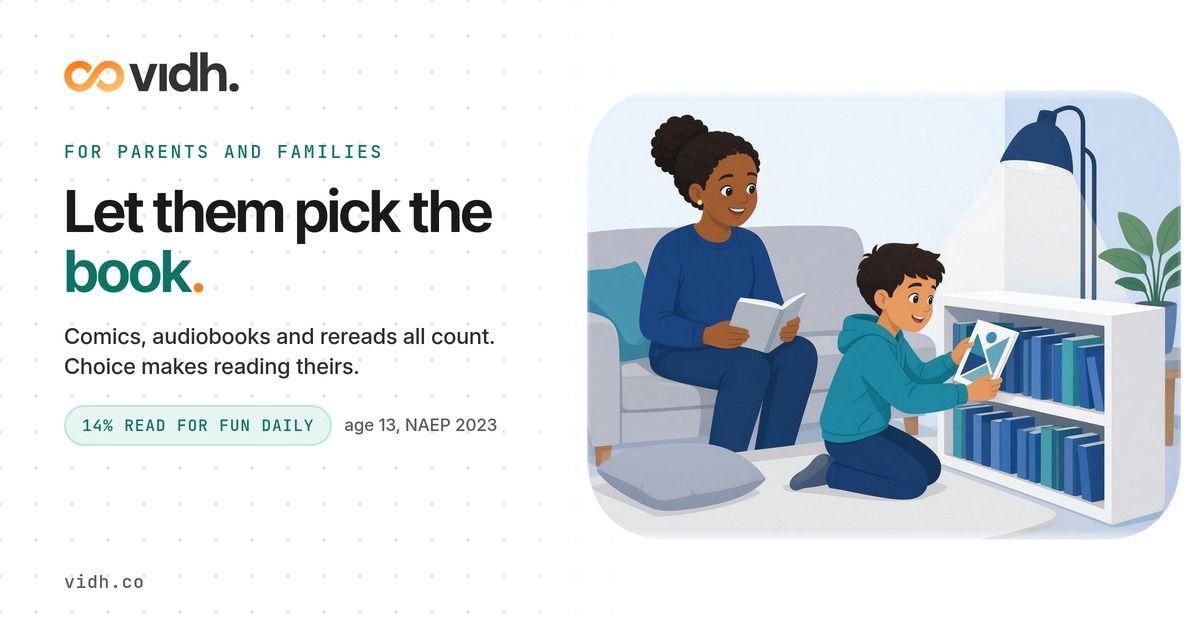
US Parents: Let Kids Choose the Book Tonight
5 min read
Only 14% of US 13-year-olds read for fun almost every day (NAEP 2023). Let kids choose the book: a my-pick shelf, rereads and a long weekend plan.
By Bhagya, Vidh · Last updated: 20 November 2026
If your child groans at the word reading, you are not alone. Across the US, the share of 13-year-olds who read for fun almost every day has fallen sharply over the past decade. Today is also UNICEF's World Children's Day, with the theme "My day, my rights, my future." So here is a small way to hand part of the day back to your child: let them pick the book. This guide is for US parents of children in kindergarten to grade 8, and for the school librarians who work with them.
Short answer: Vidh's tip for tonight: let your child pick the book, even a comic or one they have read five times. In 2023 only fourteen percent of US 13-year-olds said they read for fun almost every day. Choice makes reading feel like theirs. Keep one free-choice shelf, read nearby, skip the quiz, and talk about the story instead.
Why are fewer US kids reading for fun?
The National Assessment of Educational Progress (NAEP) asks 13-year-olds how often they read for fun on their own time. Its 2023 long-term trend results are stark: "In 2023, fourteen percent of students reported reading for fun almost every day." That was "3 percentage points lower than 2020, and 13 percentage points lower than 2012."
The same NAEP results show that 13-year-olds who read for fun almost every day had a higher average reading score than students who read for fun less often. That does not prove one causes the other, but it is a good reason to protect reading time that feels like fun, not homework.
NAEP measures 13-year-olds, but reading habits start much earlier, so the ideas below work from kindergarten up.
Does it matter what they choose?
Less than you might think. Comics, graphic novels, joke books, magazines, audiobooks and books they have read five times all count as reading for fun. Tonight the goal is enjoyment, not stretching their reading level. Harder books can come through school; home is where a child learns that reading is something they like doing.
The UN Convention on the Rights of the Child recognizes "the right of the child to rest and leisure, to engage in play and recreational activities appropriate to the age of the child". A book chosen for pleasure fits that idea well.
How do you set up a my-pick shelf at home?
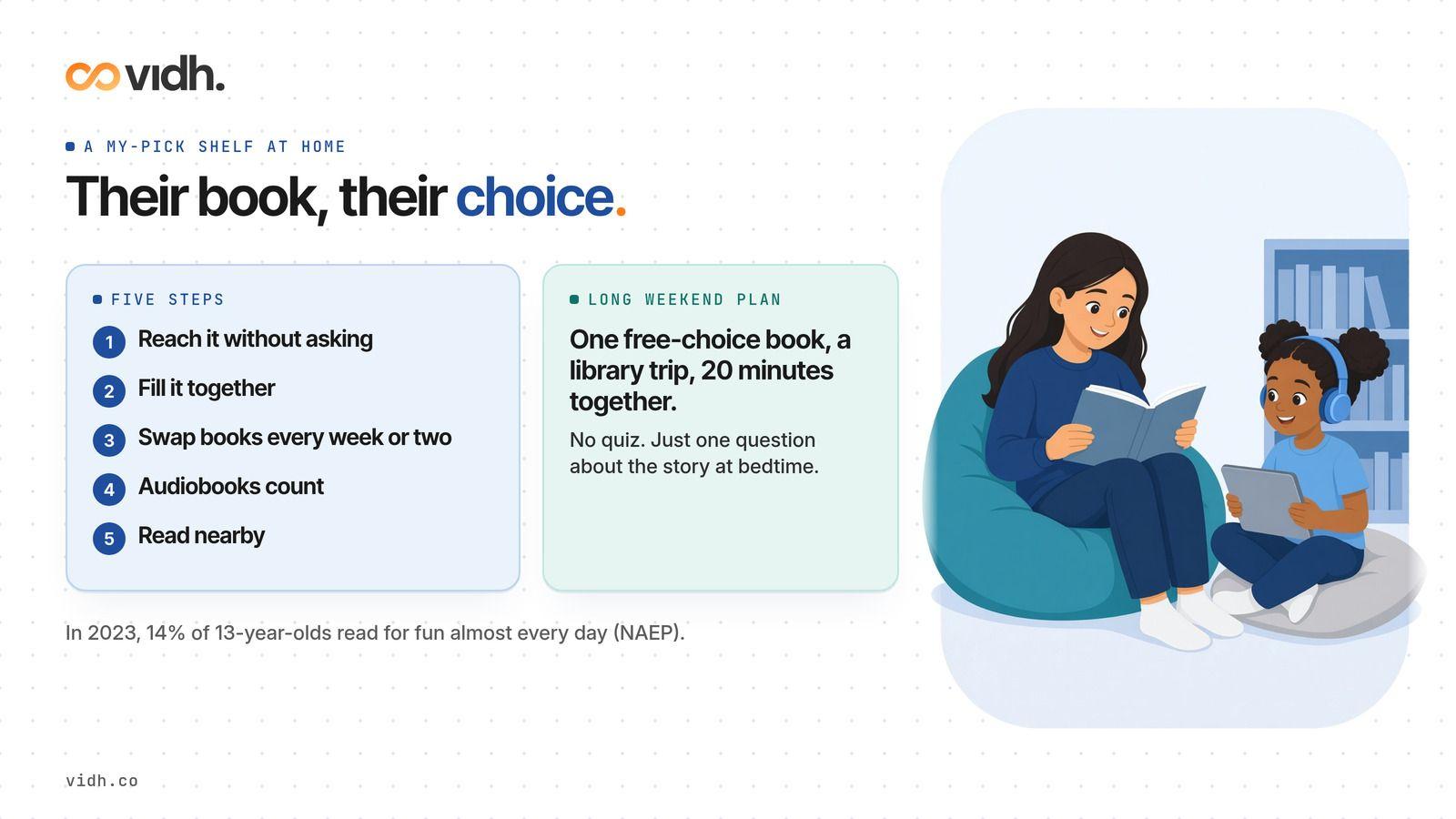
- Choose one low shelf or basket. Somewhere your child can reach without asking.
- Fill it together. Library books, hand-me-downs, comics and a few new finds. Let your child veto anything.
- Refresh it often. Swap a few books every week or two so there is always something new.
- Add audiobooks. Listening to a story is still enjoying a story, especially on car trips.
- Read nearby. Sit with your own book or magazine. Children copy what they see.
What if they choose the same book again?
Let them. Rereading a favorite is normal and useful: children notice new details, build confidence and enjoy knowing what comes next. To widen their choices, put two or three new books next to the favorite and let them decide, rather than taking the old one away.
How do you talk to the teacher about reading logs?
Reading logs, minutes and reading levels are set by each school or district, not by any national rule. If logging minutes is turning reading into a chore at your house, it is fair to ask the teacher about it. You could ask whether some of the reading can be comics or audiobooks, or whether you can talk about the story instead of filling in the log on some nights.
Our guide to three questions for a short parent-teacher meeting can help you raise it, and homework help that gives the next step, not the answer has more on avoiding battles at the kitchen table. If your school uses Vidh, one-to-one parent replies make it easy to send that question privately to the teacher.
What can a long weekend reading plan look like?
Next week's long weekend is a good time to try it:
- One free-choice book or comic, picked by your child.
- A library trip, if you can, with no rules about what comes home.
- Twenty minutes of reading together after dinner, with no quiz afterwards.
- One question at bedtime about the story, such as who was the funniest character.
For more ways to talk about the story, try our dinner questions that work better than how was school. If screens are competing with books, our look at screen time limits around the world may help.
Questions parents ask
My child says reading is boring. Where do I start?
Start with their interests, not a book list. A child who loves football, animals or video games will often read a comic, fact book or guide about it. Small wins come first.
Do screens count as reading?
Reading an e-book or a digital comic still counts. Scrolling short videos does not. If you use a tablet for reading, turn off notifications and keep it for the book.
What if the book seems too easy?
Easy books build fluency and confidence. At home, enjoyment matters more than difficulty; the teacher will stretch them in class.
Is a library card worth it?
Yes. A library card lets children try lots of books without you buying them, so a book they give up on costs nothing.
What about brothers and sisters?
Give each child their own shelf or basket, even a small one. Choice only works if the pick is really theirs.
When should I ask the school for help?
If your child avoids reading of every kind, struggles with words they should know, or gets upset about reading, talk to the teacher. They can tell you what they see in class and whether extra support makes sense.
Sources
- National Center for Education Statistics, The Nation's Report Card, NAEP Long-Term Trend 2023 highlights (13-year-olds): https://www.nationsreportcard.gov/highlights/ltt/2023/
- UNICEF, World Children's Day, November 20, 2026: https://www.unicef.org/take-action/campaigns/world-childrens-day
- UNICEF, Convention on the Rights of the Child (text), Article 31: https://www.unicef.org/child-rights-convention/convention-text
All sources were opened on November 16, 2026.
About Vidh
Vidh (vidh.co) is an AI-powered platform for schools, built by Vidh Labs, that connects management, teachers, parents and students around each child.
To see how Vidh works for your school, book a 30-min demo.
Questions: hi@vidh.co